www.optimistdaily.com
The three muscle groups behind knee stability, and how to train them
BY THE OPTIMIST DAILY EDITORIAL TEAM
Running, climbing stairs, squatting to pick something up from the floor: every one of these movements passes through the knees. It is easy to take that for granted until they start to complain.
“Everybody could probably benefit from some sort of strengthening to improve stability of the knee,” says Carrie Whitelam, a physical therapist at Hospital for Special Surgery in New York City.
Knee stability, as Whitelam defines it, is “the ability to maintain alignment and positioning of your knee during movement and activity.” The practical version is simpler: it is what keeps your knee from wobbling, caving inward, or grinding in ways that create pain over time.
Three muscles doing most of the work
Two kinds of structures hold the knee in place. Passive ones, including ligaments like the ACL and MCL, provide structural support. Active ones, including the muscles you train, provide dynamic control.
The quads, hamstrings, and glutes are the three muscle groups most responsible for that dynamic control. Physical therapist Braidy Solie explains that each plays a distinct role: the quads straighten the knee, the hamstrings bend it, and the hips act as a “steering wheel” that controls the knee’s position and alignment throughout movement.
When all three are strong and coordinated, your bones, cartilage, and ligaments don’t have to absorb the stress they were never designed to handle alone. When they are not, that stress lands somewhere it shouldn’t.
Three exercises that build it
Solie recommends three moves as effective starting points: the step-up, the forward lunge, and the lateral lunge. These exercises require the quads and hamstrings to work together at the knee while the hips maintain alignment, which mirrors what the knees are asked to do during most everyday activities.
For a beginner approach, run them as a short circuit: each exercise for 30 seconds, rest 30 seconds, repeat for three to four rounds. Once the movements feel controlled and easy, add weight in the form of dumbbells or kettlebells and shift to three sets of 15 to 20 repetitions, gradually increasing the load over time.
The step-up
This is a good place to start. Standing in front of a sturdy box or step, you step up with one foot, bring the other to join it, then step back down and alternate which foot leads. The key is keeping your knee tracking directly over your foot the whole time, without letting it collapse inward. Solie values this move because when you place your foot on the step, “you’re pre-positioning your limb in the position that you want to maintain” through the whole rep, which makes it easier to learn what good knee alignment actually feels like.
The forward lunge
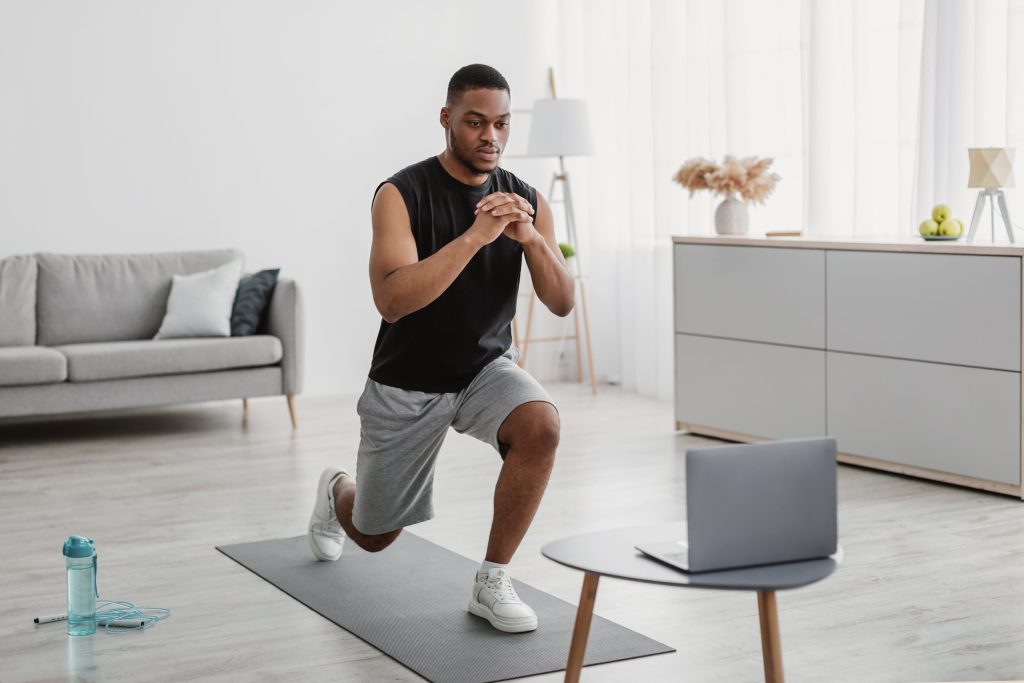
Forward lunging adds complexity. You step forward with one foot, lower both knees toward 90-degree angles, then push back to standing before alternating sides. The chest stays upright, the core engages, and the front knee stays above the foot rather than drifting past it. The lunge is trickier than the step-up because it involves decelerating as you step forward, which demands more from the stabilizing muscles. If the knee wobbles a lot at first, a squat is a useful starting point. Once the movement feels controlled, try two versions: one with a vertical torso, which loads the quads more, and one with a slight forward hip hinge, which shifts the work toward the glutes.
The lateral lunge
This exercise is certainly the most demanding of the three. You step out to one side, hinge at the hips, push them back, and lower into a bend before pushing off to return to center, then alternate sides. Because your center of mass is moving sideways while the knee flexes forward, it requires “a lot more coordination,” Solie says. Good cues: keep your chest up, don’t let the knee cave inward, and avoid letting the hip pop out at the bottom. If the full version is too much at first, try the static variation, where the foot stays on the ground, and you lunge in and out without the stepping motion.
Why this matters beyond the gym
The case for this kind of work is not purely about avoiding injury, though that is a compelling reason on its own. It is also about longevity: the ability to climb stairs, carry groceries, play with children, and keep doing the physical things that make life feel full, well into old age.
“These types of movements have a great crossover for helping build knee stability during functional things throughout the day,” Solie says. Most people’s training is built around strength and cardio. Adding a few targeted moves for stability is a modest change with a long payoff.
Did this solution stand out? Share it with a friend or support our mission by becoming an Emissary.The post The three muscle groups behind knee stability, and how to train them first appeared on The Optimist Daily: Making Solutions the News.








 New Posts (Home)
 ChatBox
 Popular Posts
  Game Zone
 Top PodCasts