www.optimistdaily.com
Earth Prize 2026 part II: seaweed fabric, hornbill nests, and a healing bandage
BY THE OPTIMIST DAILY EDITORIAL TEAM
This is part two of our Earth Prize 2026 coverage. Part one covered four regional winners from Ireland, Kenya, Gaza, and India, including Tala and Farah Mousa, whose Build Hope Palestine project we first wrote about earlier this month. Here are the remaining three.
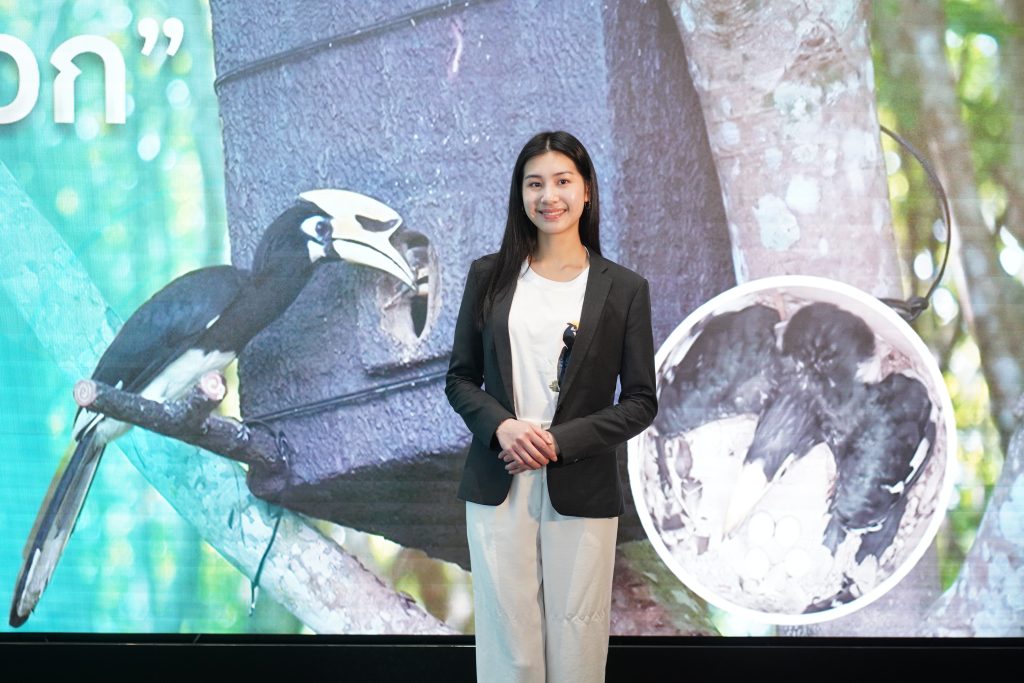
Thailand: nests for hornbills, and a reason for communities to protect them
Proud inspecting the artificial nests made from upcycled plastic bottles.
Yanin Tangkaravakoon is 17 and goes by Proud. She first saw hornbills on a school field trip to Khao Yai National Park and was captivated by them. Years later, she learned that 51 of the world’s 62 hornbill species were in decline due to deforestation, habitat loss, and poaching, and was inspired to spend years working with the Thailand Hornbill Research Foundation to figure out what she could do.
Hornbills are critical seed dispersers, which means their movement through forests determines where trees grow and regenerate. Lose them and the forest changes with them, quietly and permanently.
Proud’s project, Homes for Hornbills, runs on three tracks: artificial nests built from upcycled plastic bottles and shaped to hornbill nesting requirements; a school-based conservation programme; and income alternatives for local communities to reduce the financial pull toward poaching. Twenty nests have been installed in southern Thailand. Fourteen hornbill chicks fledged in 2025; 14 nests are now occupied. Proud also produced a documentary about the project, which is streaming on Thai PBS.
“Seeing how important hornbills are to forests made me realise how urgent it is to protect them,” she said. “Winning the Earth Prize gives me the chance to expand nest deployment and partner with local communities to create long-term solutions for both wildlife and the forests they sustain.”
Puerto Rico: flip-flops from a beach problem
Helena do Rego in the lab, photo by Gabriela Bolinaga.
Helena do Rego, 17, has watched sargassum seaweed pile up on Puerto Rico’s beaches for years. The smell is strong, the shorelines become unusable, and the seaweed just keeps coming. In 2025 alone, more than 40 million metric tons washed ashore across the region.
Puerto Rico’s landfills are already at 85 percent capacity, taking in around 250 million pounds of textile waste a year with only nine to 12 percent recycled. Helena’s solution, SargaTex PR, turns excess sargassum into a biofabric for short-use items: flip-flops, beach footwear, spa products. Early prototypes, made with cranberry juice and coffee grounds among other local materials, biodegrade within weeks. The sargassum that overwhelms the beach becomes the material that replaces something worse.
With her prize funding, Helena plans to develop the fabric through university labs, scale collection with local organisation Scuba Dogs, and pursue partnerships with beach shops and tourism businesses.
“Seeing how sargassum was taking over our beaches made me realise how urgent the problem had become,” she said. “This gives me the chance to scale a solution that turns waste into materials that are better for both people and the planet.”
Brazil: a bandage from aloe and chamomile that breaks down in 48 hours
HADA – demonstration of the testing phase and prototype creation.
Bernardo Renner and Ísís Valentin both play volleyball. Anyone who plays this sport will know that cuts and scrapes happen regularly; the treatment was always a basic bandage that covered the wound and didn’t do much else. They started wondering why no one has improved on this yet.
Their solution, HADA, is a biodegradable dressing made from aloe vera and chamomile, both of which have well-documented antibacterial, anti-inflammatory, and tissue-regenerating properties. It promotes healing and breaks down in soil within 48 hours.
An estimated 2.2 billion plastic bandages were discarded in 2023 alone. They covered wounds without helping them heal, and left microplastic waste behind. Bernardo and Ísís have produced four research papers, developed working prototypes, and partnered with Instituto Caldeira, one of southern Brazil’s largest innovation hubs. Their prize funding is going toward regulatory approvals and deployment in schools, sports centres, and healthcare settings.
“Something as small as a bandage is used by millions of people every day, yet it creates waste and doesn’t always support healing,” they said. “Winning The Earth Prize gives us the chance to bring HADA into real-world use.”
Cast your vote
There will be seven regional winners and one global winner decided by public vote, closing May 29. You can vote now on the Earth Prize website. The competition is now in its fifth year, founded during the 2019 School Strike for Climate by The Earth Foundation. Since then, it has reached more than 21,000 students across 169 countries and distributed more than $500,000 in prize funding.
Did this solution stand out? Share it with a friend or support our mission by becoming an Emissary.The post Earth Prize 2026 part II: seaweed fabric, hornbill nests, and a healing bandage first appeared on The Optimist Daily: Making Solutions the News.








 New Posts (Home)
 ChatBox
 Popular Posts
  Game Zone
 Top PodCasts