reactormag.com
The Cabinet of Dr. Caligari: An Allegory of Anxiety and Terror in the Aftermath of War
Column
Science Fiction Film Club
The Cabinet of Dr. Caligari: An Allegory of Anxiety and Terror in the Aftermath of War
Unpacking the murky origins and warring interpretations of a legendary silent film.
By Kali Wallace
|
Published on May 20, 2026
Comment
0
Share New
Share
The Cabinet of Dr. Caligari (German: Das Cabinet des Dr. Caligari) (1920) Directed by Robert Wiene. Written by Hans Janowitz and Carl Mayer. Starring Conrad Veidt, Werner Krauss, and Friedrich Feher.
In the summer of 1918, a few months before the November 11 armistice that ended the First World War, two young German writers were introduced by mutual friends. Hans Janowitz and Carl Mayer had served in the German military during the war, and the experience had turned both of them into staunch pacifists and left them deeply disillusioned with their nation. They were also penniless and in need of work, so when somebody suggested they try their hand writing a screenplay, they decided to give it a shot.
This was just over twenty years after brothers Auguste and Louis Lumière had held the first public screening of a motion picture in Paris in March of 1895. Since that fateful presentation, which consisted of ten brief films showcasing ordinary events like workers leaving a factory and swimmers jumping into the sea, filmmaking had become tremendously popular entertainment, increasingly serious art, and a wildly lucrative industry. It was also, from the start, a multinational phenomenon, with films being exported and imported across borders frequently.
That changed with the start of World War I. The nations now actively fighting each other were no longer importing each other’s films; in particular, Germany was no longer trading films with the Allied countries. But the German people still loved movies, and there were already theaters all across the country, so the government had partially nationalized the film industry to keep it alive—and, of course, to contribute to wartime propaganda.
It worked, and the German film industry survived WWI. Times were hard, but people kept making and watching movies, and the film industry grew and evolved. German film studios, like their counterparts in Europe and the United States, were making as many films as they could, as quickly as they could, to appeal to as broad an audience as possible.
According to Hans Janowitz, it was silent film actor Gilda Langer who suggested that he and Mayer write a screenplay. They were young, angry, and desperately in need of money, so they thought: Why not? They looked around for inspiration. There was the recently ended war, of course, and their bitter experiences in it, but there were also inspirations of a smaller scale: a circus sideshow, a woman’s murder. That is how The Cabinet of Dr. Caligari was born. Their screenplay, although fairly mundane in conception, would evolve into a highly stylized, artistically unique film allegory about the absolute power of a hateful authority inflicting fear and violence on young people who are helpless to resist.
Or so the story goes. We have to be a bit careful here.
Janowitz wrote about the inception of Caligari in 1941, more than twenty years after the film came out. In that narrative, he said a few things that have turned out to be not quite accurate, possibly because he misremembered, or because he was embellishing, or because his own views on his younger self and the film had changed over time. This makes identifying absolute facts regarding the production of Caligari somewhat difficult. The film is over a hundred years old. Janowitz and Mayer have been dead for more than 70 years, director Robert Wiene for even longer, so some details are simply unverifiable.
That’s common for old movies, but in the case of Caligari the inevitable questions have invited rather more than the usual amount of academic interest. There is the popular story of how the film was made, then there is a small but lively academic subculture dedicated to dissecting and verifying that story. In the words of film scholar Mike Budd, who edited The Cabinet of Dr. Caligari: Texts, Contexts, Histories (Rutgers University Press, 1990), “The myth is entertaining and memorable, and some of it is probably true, but it resembles too much all those other stories coming out of Hollywood, [German production studio] UFA, and other commercial film industries.”
In other words, it’s not easy to tease out what actually happened from what has been repeated and embellished over more than a century, because people have liked stories about the making of movies for as long as movies have been around.
Janowitz and Mayer wrote the screenplay for Caligari over a few months in 1918 and 1919. Contrary to popular belief, they did not actually set out to make a pointed political allegory. They wrote a story about hypnosis and murder, and only later did they recognize how heavily their experiences in the war and the German political climate had weighed on them. This comes straight from Janowitz’s own writing. In his 1941 monograph “Caligari —The Story of a Famous Story,” which is reprinted in excepts in Budd’s book, he wrote, “It was years after the completion of our screenplay that we realized our subconscious intention… the corresponding connection between our Doctor Caligari, and the great authoritative power of a government that we hated, which had subdued us into an oath, forcing conscription on those in opposition of its official war aims, compelling us to murder and be murdered….”
I’ve come across a few critics and film scholars who think that sounds too convenient, suggesting that maybe Janowitz was seizing on a weightier interpretation decades later simply because it was popular. And, sure, that’s possible; that’s something we’ll never know. But I don’t think Janowitz’s experience is unbelievable. In fact, I think it’s a pretty normal experience for writers to look back on something we wrote when we were young, with the help of time and life experience and outside perspectives, and think, “Oh dear. I really was working through some shit when I wrote this, wasn’t I?”
Screenplay in hand, Janowitz and Mayer went looking for somebody to make the movie. The German film industry at the time was partially nationalized, but in many ways it still functioned similar to the Hollywood studio system. Erich Pommer, co-founder and production head of the studio Decla-Film, purchased the script. Pommer and producer Rudolf Meinert were interested in the film for the most mundane of reasons: they thought it would be fast and cheap to make, and audiences would like a melodramatic thriller. Their first choice for director was our old buddy Fritz Lang, but he was busy with the two-part adventure film The Spiders (1919 and 1920), so they had to find somebody else. They brought on Robert Wiene, a prolific director and screenwriter at the time, although only a fraction of his movies survive today.
This is where the story of the film’s production starts to get into a bit of a muddle. The conflicting stories arise from two key areas: the script and the visual design.
We’ll start with the latter. Just about everybody involved with the film—particularly Janowitz, Pommer, and Wiene—would later claim the film’s striking visual style was mostly their idea. We have no real way of knowing how much of any of those claims are true. What we do know is that the look of the film was the work of three artists: Hermann Warm, Walter Reimann, and Walter Röhrig. All three were part of Germany’s avant-garde art scene and had worked in set design for Expressionist plays and films, so it seems likely that in hiring them the filmmakers knew what to expect.
From what I’ve read, there was no point at which any of the artists considered giving the film a naturalistic look. Even from the very earliest planning stages, they decided the film was going to be weird, stylized, and nightmarish, and it did not take much to convince Wiene and the producers to go along with the idea. Expressionism was fairly common in German at the time, but not in cinema, and everybody agreed the Expressionist style would make the film stand out.
I’m writing this with the assumption that if you’re reading this, you’ve seen The Cabinet of Dr. Caligari. But if you haven’t, and you have somehow also missed ever seeing stills from the movie over the past century, I need you to pause now and go have a look at some images from the film. There really is nothing quite like it.
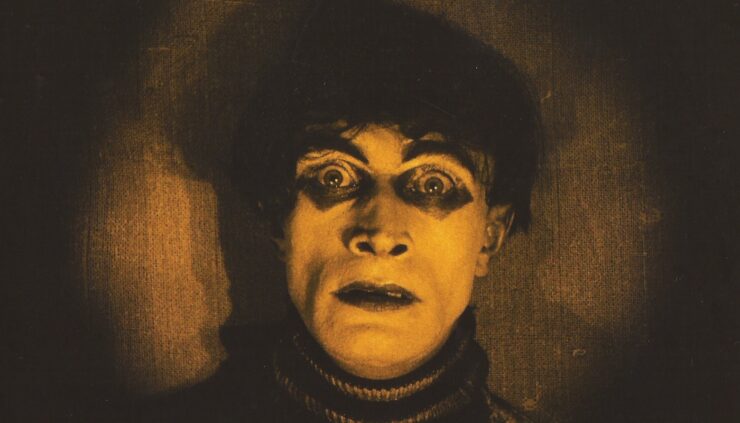
Caligari is a stunning movie. It’s weird, disorienting, and captivating. There are almost no right angles. Rooms are not shaped like rooms; doorways and windows are slanted into outrageous trapezoids. We see close interior settings and broad exterior settings, but all they have in common is that the sense of perspective is all wrong. Shadows are in the wrong place—because they were painted onto the sets—and some sets are entirely the wrong size for the actors. The scale is completely mismatched to how the characters move through the environment. The characters (with two exceptions) move through the film in a fairly ordinary way, dressed and made-up in fairly ordinary style, acting as they would in any other setting. The normalcy of their actions only emphasizes how very abnormal their world is. It looks like drawings come to life, like a dreamscape stuck somewhere between two and three dimensions, like what might happen if somebody dropped a normal film on the ground and had trouble putting the pieces together. It’s incredible to look at. I absolutely love it.
In a 2005 conversation for the CUNY film series City Cinematheque, professors Jerry Carlson and Gilberto Perez briefly discuss how none of this is a mistake. Stage set designers, even those working with limited budgets and time frames, or those more used to German Expressionist stage production, knew how to create naturalistic environments with two-dimensional backdrops. Nobody made Caligari look the way it does because they didn’t know better.
And then there is the color. If you haven’t seen this movie in a few decades, you might have only seen a black-and-white version, although it greatly depends on which restoration you saw and when. For much of the film’s history, people watched the grayscale version and didn’t know anything was wrong, because that is what we expect movies from 1920 to look like.
But in fact, shades of gray weren’t what theatergoers in 1920 would have seen. The original exhibition nitrate reels of film were hand-tinted in a variety of colors: entire scenes washed with murky yellow, sickly green, burnished orange, giving every segment another layer of unreality. Unfortunately, most of the subsequent copies of the film were preserved without the tinting. The original colors were restored in stages over the years, with the most recent restoration being completed in 2014. Film restorationist Barbara Flueckiger goes into detail on both the film’s long restoration history and the work to restore its original colors in a 2015 article in The Moving Image. They used six differently tinted copies of the film from around the world, all dating from the 1920s, to piece together what the original color might have looked like and create a restored digital version.
Everything about Caligari’s visual style was unusual in 1920, and it’s still unusual today. The mode of most cinema, then and now, is to aim for either natural realism or convincing illusion. The filmmakers of Caligari believed that releasing a movie that looked so different would garner a lot of attention, whether positive or negative, and they were right. Everybody noticed, and almost immediately other filmmakers began borrowing.
The impact of the film’s visual style is obvious throughout film history: in contemporaries such as Yakov Protazanov’s Aelita (1924) and Fritz Lang’s Metropolis (1927); in the Hollywood monster flicks of the ’30s and the noir films of the ’40s and ’50s that so loved shadowy, off-kilter visuals; and in films made by later generations riffing on those genres and styles, such as the highly stylized films of Tim Burton and Guillermo del Toro. Caligari is one of those rare films that is so well-known and looks so unique that nobody can manage to rip if off exactly, but just about every film era since the ’20s has paid homage to it in various ways.
That brings us to the other component of the Caligari muddle, which is the story. Or, more specifically, the script.
The film’s plot is not particularly complex: A mad doctor, Caligari (Werner Krauss), is hypnotizing a sleepwalker, Cesare (Conrad Veidt), to kill people, and a trio of young friends (Friedrich Feher as Francis, Lil Dagover as Jane, and Hans Heinrich von Twardowski as Alan) find themselves on the receiving end of this senseless violence. Alan is killed, Jane is abducted, and Francis is determined to reveal Caligari’s evil nature.
The main action of the movie is enclosed in a narrative frame. It begins with Francis telling the story to an attentive listener, and it ends with the twist that Francis himself is a patient in a mental institution, Jane and Cesare are his fellow patients, and Caligari is the doctor treating them.
The Cabinet of Dr. Caligari is often referred to as the first true horror movie, and it’s easy to see why. So much of its story feels familiar to anybody who has seen a horror movie at any point in the intervening century. The killer stalking the night, the violent deaths we can all see coming, the beautiful young woman in peril. There’s even a bit of a love triangle. The film’s characters aren’t well-developed; they are primarily archetypes portrayed in broad strokes. It’s not a problem for the film, because every part of it feels so unhinged from reality that we accept the characters having a detached, dreamlike feel as well. The most striking of them is the somnambulist Cesare, who is both frightening and pitiable. Veidt is truly fantastic in the role, making the most of the exaggerated shadows of his eyes in those close-up keyhole views and the uncanny way he moves through the streets.
(You’ve seen Veidt before in a very different movie: he plays the Nazi officer Major Strasser in Casablanca. Veidt was Jewish and fled Germany in 1933, but he spent a lot of his American career getting cast as Nazis. He was, understandably, not terribly happy about that.)
The it’s-all-in-his-head twist ending is another element that feels familiar today, and I doubt it was that shocking to audiences even when the film was new, not in the era of Gothic melodrama and detective fiction. Even so, Caligari’s twist ending has been the subject of very niche but very serious academic debate for decades.
I’ve done a lot of research while writing this column over the past two years. Most of it has been very focused on the films we watch, but some of it has been into more general film history, and just about every book and documentary that mentions The Cabinet of Dr. Caligari has told the same story. I’m going to quote Mark Cousins’ The Story of Film (Pavilion, 2004) as just one example: “The film’s writers, Carl Mayer and Hans Janowitz, had considered their story in political terms. Caligari represented the malign and controlling German state, Cesare represented ordinary people manipulated by it. The thirty-eight-year-old Wiene and his producer, Erich Pommer, removed the film’s political edge by adding not only an opening sequence, but a coda….”
This is the story about Caligari: angry and disillusioned Janowitz and Mayer, fresh out of fighting in WWI, wrote an allegory of German politics and the callousness of systems of power that send young people to kill and die. But Wiene and Pommer, without the knowledge or blessing of the screenwriters, added the coda, which reverses the film’s entire theme and political message.
This interpretation of the film was popularized by Siegfried Kracauer in his book From Caligari to Hitler: A Psychological History of the German Film (Princeton University Press, 1947). Kracauer drew his information from Janowitz’s account written circa 1941, the same one I quoted from above, which is partially reprinted in Budd’s The Cabinet of Dr. Caligari: Texts, Contexts, Histories. (In those excepts, Janowitz places the blame for the mental hospital frame firmly on Wiene, calling him a “cowardly” director, and not on Pommer.)
Kracauer’s argument is that the framing scenes were added to the movie specifically to defang its political message, which he links to broader trends in German cinema leading to the beginning of the Nazi Germany. The central story is a critique of absolute authority, but the frame story inverts that critique by making Caligari, the authority, benign and helpful rather than malevolent. In Kracauer’s argument, that change is emblematic of Germany’s cultural evolution toward totalitarianism. “While the original story exposed the madness inherent in authority,” he wrote, “Wiene’s Caligari glorified authority and convicted its antagonist of madness. A revolutionary film was thus turned into a conformist one…”
That’s the story that Budd refers to as an “entertaining and memorable” myth. Indeed, it has so many things we love in a cinematic story: meddling filmmakers ruining an artistic vision, cultural trends prophesying a horrific future, a One True Interpretation that can be discovered if we just know how to look at it.
There’s just a little bit of a problem: It’s not clear who added the narrative framing device or why, nor that the addition of the frame necessarily has the effect that Kracauer describes. It’s also not clear that Janowitz and Mayer meant to write a revolutionary film, even if they did later acknowledge it as such.
One curious thing to note, one that’s obvious to anybody watching the movie, is that it’s not remotely apparent that the film’s narrative frame is intended to provide a clear dividing line between delusion and reality. The frame scenes look like the rest of the movie, particularly the coda. That scene in the mental hospital courtyard bears all the same visual hallmarks of the uncomfortable perspective, the unnatural shadows, the distorted architecture. Maybe that’s because the production wasn’t going to spend money on another set. Maybe it’s because the filmmakers wanted both the frame and the core story to be nightmarishly unreal. Maybe it was meant to portray madness inside madness. We don’t know and we’ll likely never know, but I do think it’s interesting that the so-called “real” world doesn’t look very real at all.
Another curious footnote is that Fritz Lang claimed that when he was in discussions to direct the film, he suggested adding a more normal, less stylized opening scene to let the audience ease into the film. Now, as we already discussed when we watched Metropolis, Lang is another man whose personal recollections don’t always match historical evidence, so there’s no way of knowing how those conversations actually went. If we take his word for it, it does sound like it was a purely commercial suggestion, not a political or ideological strategy. Everybody involved knew The Cabinet of Dr. Caligari was an oddball film that might not appeal to audiences expecting more commonplace mystery and melodrama, and the filmmakers may have been looking for a way to ground it.
The disputed origins of the narrative frame were, for a long time, impossible to fact-check. Kracauer had access to Janowitz’s personal narrative, but he did not have a copy of the script, because as far as he knew there were no surviving copies. It would turn out there was one—just one!—in the hands of actor Werner Krauss, who played Caligari. Krauss refused to show it to anybody while he lived. (I don’t know if Kracauer asked. Kracauer was Jewish and living in the U.S. during and after WWII, while Krauss was a fervent anti-Semite who collaborated with the Nazis during the war and was undergoing mandatory “denazification” afterward, so it seems unlikely there would have been friendly correspondence between the two.) After Krauss’ death in 1959, however, his estate sold the script the Museum of Film and Television in Berlin, and film scholars were finally able to read it. New interpretations began to appear over the next couple of decades.
Alas, the script didn’t clear anything up, because the copy Krauss held onto for all those years was neither the frame-free version Janowitz described as the original nor the final shooting script that matches the film. It is instead a surprise third thing: a version of the script in which the movie begins with Francis telling the story at a bourgeois garden party, and there is no twist coda at the end to indicate it is a delusion. Which, yes, sounds like it might have come from Lang’s suggestion of a grounding opening scene, but that’s pure speculation. That version of the script doesn’t prove anything one way or another, except that at some point there was a version of the film considered in which Francis’ story is presented as actual, not a delusion. (The film’s Expressionist visual style is not described or dictated in the script. That, presumably, all developed off-page.)
After the script was made public, some film scholars decided its existence disproved Janowitz’s account and Kracauer’s interpretation. Others think it changes nothing. Most fall somewhere in the middle. It remains unclear when or how one existing script evolved into what was filmed, who wrote and added that frame, and what they intended. It’s a question that vexes film historians largely because of the impact of Kracauer’s interpretation, and I understand that all too well. I think it’s natural to want to be able to trace decisions in popular art and entertainment that can predict the rise of Nazism and the outbreak of WWII, to be able to pinpoint moments in which the quashing of critical political themes to soothe popular tastes added another building block on a path toward totalitarianism. We very desperately want the interplay between art and politics to be that direct, because that would mean we can extrapolate the latter from the former.
The fact that we don’t know why the frame story was added is frustrating, because the reason could mean so many things. It could have been an ideological decision. It could have been a commercial decision. It could have been both, as Kracauer posits that the decision was made because “films, at least commercial films, are forced to answer to mass desires;” it is in those mass desires he sees the warning signs of rising conformism and totalitarianism. It could also have been the same decision that countless storytellers have made, the one that has them thinking, “Man, wouldn’t it be fucked up if it was all in his head?” without considering all the thematic implications. (That’s a decision that countless thriller writers have made and continue to make and will probably continue to make, even when I very much wish they would give it a rest and try something new.)
Which brings us to the obvious question: Does it matter?
Does it matter if we’ll likely never know exactly why the film has a frame story that the screenwriters did not want? Does it matter if Wiene intended to change the meaning to make it more palatable and less revolutionary? Does it matter if film school textbooks repeat somewhat mythologized and not entirely accurate versions of events? Does it matter if Janowitz revised his own history when he was writing about the film twenty years after its release?
I think it does, but not because I think we are going to uncover clear answers. I think it matters because people have been talking about this film for over a hundred years, and what they have said offers fascinating insight into both the art and politics. Film is the artistic medium of the 20th century. It was born as the century was dawning and spread worldwide almost immediately, but what films mean and how we view them is constantly evolving. There was never a point at which filmmaking was insulated from tumultuous politics and horrors of the 20th century. It is true that the film Janowitz and Mayer wrote in 1918 is not the same film that Wiene directed. But it’s also true that the people who watched the movie in 1920, when WWI was so newly ended their ears were still ringing from the bombs, were not watching it in the same context as those who watched after WWII, or in the ’70s, or today.
All art is political, whether artists intend it to be or not, and artists have no control over how people will interpret their work after ten or twenty or a hundred years. This is especially true in an artistic medium that, by its history and its nature, records and reflects the world back to the people living in it. For all the debate about the narrative frame in the movie, that’s not what people remember, because that’s not the part that resonates most strongly. What resonates is the nightmarish imagery, the disorienting visuals, the terrifying villain who incites others to violence so easily and the crushing helplessness of the man forced to be his weapon. Nobody thinks of Caligari as a movie about a friendly psychiatrist just trying to help an unwell young man. The frame is almost irrelevant when we watch the film today, because the story that Janowitz and Mayer intended shines through so much stronger.
The Cabinet of Dr. Caligari is a movie with remarkable staying power. It’s an unsettling, weird, and beautiful film. There may not be a singular true interpretation that we can uncover if we dig deep enough, but the themes of authority and control, madness and reality, violence and fear, have remained uncomfortably relevant, while the movie itself, in all its distorted glory, remains entirely unique.
What do you think of The Cabinet of Dr. Caligari? What do you think of that notorious narrative frame? What are your favorite later films obviously impacted by Caligari’s style?
Next week: We’ve gone into dreams, we’ve gone into drugs, we’ve gone into hypnosis, so now it’s time to go into the sinister mind control exerted over an entire popular with Alex Proyas’ Dark City. Find it online.[end-mark]
The post <i>The Cabinet of Dr. Caligari</i>: An Allegory of Anxiety and Terror in the Aftermath of War appeared first on Reactor.








 New Posts (Home)
 ChatBox
 Popular Posts
  Game Zone
 Top PodCasts