www.upworthy.com
Scientists think humans developed right-handedness thanks to these 2 factors
Since the dawn of man, right-handedness has reigned supreme without much intel as to why. While our ape brethren also develop strong preferences toward one hand over another, there is generally an equal number of left- and right-handed individuals. Conversely, 90% of humans are right-handed. And now, scientists think they have discovered when this prevalence developed.
A new study led by researchers at the University of Oxford suggests that it went hand-in-hand (pardon the pun) with two other major evolutionary shifts: walking on two legs and developing much larger brains.
Thousands of primates helped narrow the possibilities
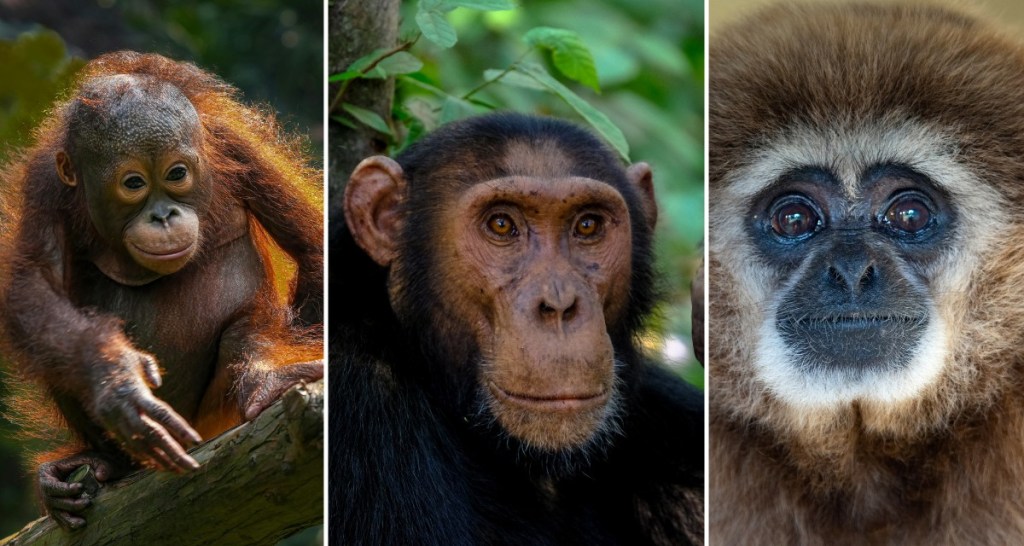
A variety of primates, Canva
The research, published in PLOS Biology, analyzed data from 2,025 monkeys and apes representing 41 different primate species. All the evolutionary factors tested—tool use, diet, habitat, body size, social structure, brain size, movement patterns, etc.—seemed to match human data, leaving no real clues as to why our species decided to become almost exclusively right-handed.
However, that changed once researchers added brain size and the ratio between arm length and leg length to their analysis. Suddenly humans, with their larger brains and legs much longer than their arms (a hallmark trait of bipedal walking), stood out from an evolutionary standpoint.
These factors, along with other fossil records, help us imagine a timeline that looked something like this:
The evolution of bidepal movement, Canva
Human ancestors (Ardipithecus and Australopithecus, respectively) began walking upright, allowing one hand to become specialized over the other. At this point, there would likely be an equal number of left-handers to right-handers.
As our brains grow to incorporate more complex activities like using tools, communicating through a wide array of gestures, and participating in complex tasks like cooking and performing rituals, so too does our right-hand bias. In fact, the same 90% right-hand dominance is already present around 2.6 million years ago…before Homo sapiens and Neanderthals entered the scene.
One side of the brain might hold an important clue
Image of the brain hemispheres, Canva
That third factor (complex tasks) is particularly interesting. Sequentially organized behaviors, also known as hierarchical action, are often believed to be something managed by the brain’s left hemisphere. The left hemisphere also controls all the motor functions and movements on the right side of the body. That said, all three elements, along with the fact that humans learn by imitating their parents, likely played equally important roles in the evolutionary narrative.
Ancient “hobbits” added another intriguing clue
Backing this theory is the “hobbit” species discovered in Indonesia. This ancient humanoid species maintained smaller brains and the ability to climb while also walking. Conversely, it did not have nearly the same amount of right-hand dominance.
There are, of course, more mysteries to unravel. Why some of us are still left-handed, for instance. Or whether the limb preference of other animals suggests a similar evolutionary pattern. But, regardless, the study reminds us that even the most seemingly simple quirks that make us human actually tell an incomprehensibly vast story of how we came to be in the first place.
The post Scientists think humans developed right-handedness thanks to these 2 factors appeared first on Upworthy.








 New Posts (Home)
 ChatBox
 Popular Posts
  Game Zone
 Top PodCasts