www.dailywire.com
The Pope And AI Walk Into A Bar…
In a standoff over ethics and foreign affairs with the leader of the free world, a company can do worse than to post up a co-founder alongside the spiritual father of roughly 1 in 5 living human beings.
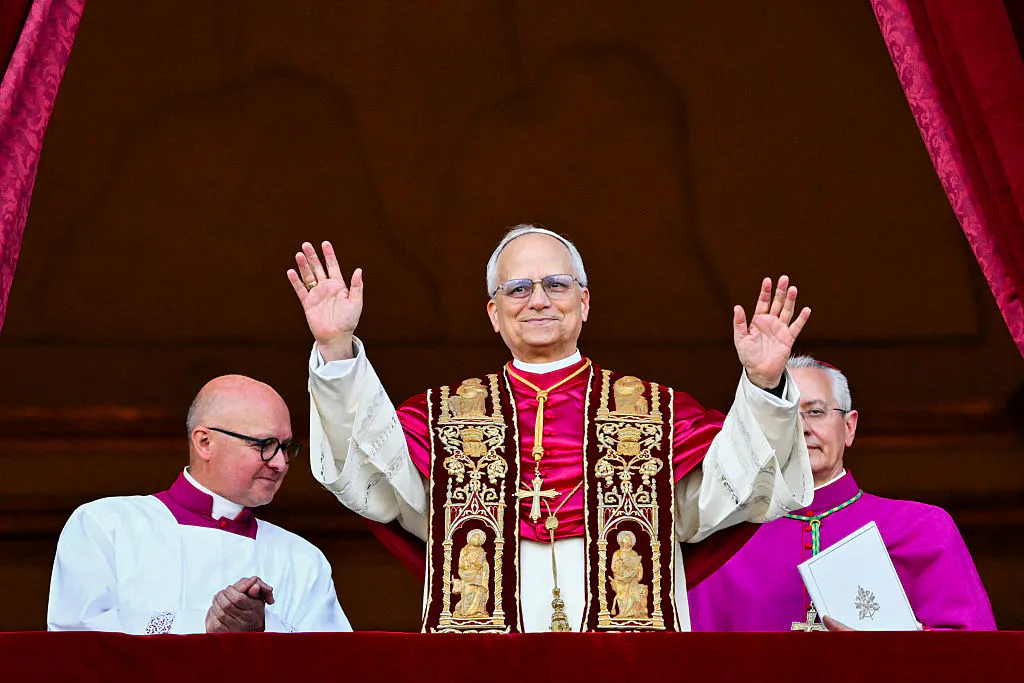
Anthropic will pull that off next week, when Chris Olah, its lead on interpreting AI, joins the Holy Father, Pope Leo XIV, as he presents his first encyclical, “Magnifica Humanitas” (that is, magnificent humanity), which concerns “safeguarding the human person in the time of artificial intelligence.”
The pope will break with tradition by appearing at the publication of his letter. The event will also include other church leaders and two theologians.
It will undoubtedly be a day of envy in the comms office at OpenAI. And the White House will be frustrated seeing a firm it shut out go global, but these are temporal matters.
All signs indicate that next week’s event will instead seek to refocus the attention of the faithful on what recurs through history, on the eternal.
In one of his first speeches to fellow cardinals, Pope Leo echoed the past with the present, calling artificial intelligence “another industrial revolution.”
On new things
We don’t know what his encyclical will say, but its context indicates the pope believes humanity has entered an era of rapid growth powered by data centers, neural networks, and a vast electrical dynamo bent to the will of a manmade demiurge.
Notably, his first encyclical will be dated May 15, the anniversary of the day his namesake, Pope Leo XIII, published the Rerum Novarum (or “On New Things”), the crucial Catholic doctrine written amid humanity’s first age of machines, on workers and capitalists and how they might collaborate for the “beauty of good order.”
But for a hint of what to expect, we can look to prior messages on AI from the church. In January 2025, the Roman Curia released a note, Antiqua Et Nova (ancient and new), calling on believers to “a renewed appreciation of all that is human.”
Which echoes a sentiment from the Rerum Novarum, that “it is the mind, or reason, which is the predominant element in us who are human creatures; it is this which renders a human being human, and distinguishes him essentially from the brute.”
After humans
But now brute machinery may, as Anthropic’s founder Dario Amodei wrote in his own extensive missive in 2024, “Machines of Loving Grace,” create a “country of geniuses in a datacenter.”
How is the Holy Father to console his flock when faced with its potential obsolescence? And why would he stand alongside one of the companies most responsible for ushering in this fresh new flavor of existential dread?
Anthropic did not reply to a request for comment.
But it may simply be that Anthropic has shown its willingness to engage with Christian theologians, among others, on these difficult questions. It is a company that has said humanity is in a kind of adolescence.
And, in adolescence, we turn to fathers.
Olah has reportedly been convening Christian thinkers on such topics since at least March. And, in his essay, Amodei wrote hopefully of AI furthering economic equity and men living meaningfully after we enter the era of truly powerful but benignly aligned artificial intelligence.
If that’s how it turns out.
Final days
In particular, this question of alignment looms over next week. If the pope takes seriously AI’s economic potential, what might he make of basilisk and paperclip monster prophecies?
Anthropic, after all, has been a leading proponent of guarding against a computer-powered apocalypse.
Nathan Schneider, a professor at the University of Colorado who has been writing about the deep questions raised by artificial intelligence, drew attention to just this question when we spoke.
“One other question I would pose, that I’m going to be reading the document for, is whether the Pope buys an apocalyptic narrative around AGI and a Singularity event,” he said.
“I think there’s a good theological case to be made that too much worrying about AGI is a kind of idolatry.”
The Rerum Novarum, he noted, was written in part as a rejection of another apocalyptic vision from man’s first industrial revolution: Karl Marx’s foretelling of the collapse of Capitalism (which, so far, not so good).
AGI doomerism is, to Schneider, another attempt to secularize the end times. Stewarding the Earth is man’s business. Ending it is God’s.
What lasts
But the secular world will watch whether and how President Trump reacts to the joint appearance by two present-day giants who refuse to toe his particular line.
The pope has had, after all, his own disagreements with the president, over immigration and U.S. incursions into Iran, but it’s unlikely that Anthropic is there for politics. This appearance has likely been in the works for some time.
So the loudest thing both parties can say about those disputes with the White House is nothing at all. Moments like these are about what is enduring. Meanwhile, political controversies are the Kleenex of history. They dissolve.
Look, Schneider says, for the pope, like his predecessor, to craft another path through the thicket of secular futures, of doomscapes and utopias, to a vision in which this new era might permit humans to give more attention to what his fellow bishops called “the continual search for the True and the Good.”
Or as the prior Leo put it, to remember that “age gives way to age, but the events of one century are wonderfully like those of another, for they are directed by the providence of God, who overrules the course of history in accordance with His purposes in creating the race of man.”
***
This is republished with permission from the author and Pirate Wires. The original can be found here.
Brady Dale is the writer of the Front Stage Exit newsletter and writes for Pirate Wires. He was the author of the first book about FTX founder, crypto billionaire and convicted felon, Sam Bankman-Fried.








 New Posts (Home)
 ChatBox
 Popular Posts
  Game Zone
 Top PodCasts