www.newsbusters.org
PBS's Encomium to Heroic James Comey: 'Is Trump's DOJ 'Irreparable'?
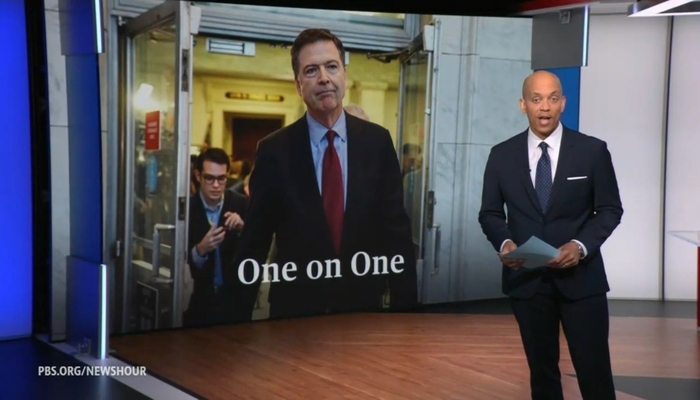
Former FBI Director James Comey was granted a 10-minute-long interview on the PBS News Hour Monday, ostensibly to discuss his new fiction thriller, but mostly to let host Geoff Bennett elicit condemnation of President Trump, in response to Comey’s indictment by the Department of Justice for his infamous, since-deleted 2025 Instagram post composed of seashells on the beach spelling out "86 47", which could be interpreted as an assassination reference.
Bennett: On the DOJ case against you, the acting U.S. attorney general, Todd Blanche, as you well know, he says this case goes far beyond a single Instagram post of a section of seashells on the beach. Here's what he said on "Meet the Press" two weeks ago.
Todd Blanche, Acting U.S. Attorney General: This is not just about a single Instagram post. This is about a body of evidence that the grand jury collected over the series of about 11 months. That evidence was presented to the grand jury. And it's not the government, it's not the Department of Justice, it's not Todd Blanche that returned an indictment against James Comey. It's a grand jury.
….
Bennett: Well, on that point, do you think the administration and President Trump, particularly, are they focused on securing a conviction or is the process itself a form of punishment?
Comey: The last case, it struck me that the process was the punishment….
The PBS anchor cannot consider that this spin can be applied to Trump: that all the lawfare was a punishment for winning the White House -- and then for aiming to win it again.
Bennett wondered why former attorney generals Merrick Garland (under Biden) and Bill Barr (under Trump) weren't standing up for Comey, asking "What do you make of their silence?" Comey replied that it was "dangerous to use the Department of Justice in the way they used it in charging me or in going after John Brennan."
Former CIA Director John Brennan is hardly a Resistance hero; he allegedly lied to Congress regarding the debunked Steele Dossier, used to lay the groundwork for the phony accusation of Trump-Russia collusion. Brennan insisted on including the then-dubious, now wholly discredited document in the intelligence community’s official assessment, despite its scurrilous claims.
Bennett got moralistic.
Bennett: Do you think, is -- silence itself these days is a form of complicity?
Comey: Well, it depends upon the reason the person is silent....
Bennett: How much damage under President Trump do you think has been done to the Justice Department? And is it irreparable?
The host prodded Comey from the left about his decision as FBI director to reopen the Hillary Clinton email investigation right before the 2016 election, which many Democrats claim handed the election to Trump. Bennett wondered if he was ridden with guilt over that decision.
Bennett: ….Do you ever sit with the possibility that everything that you're going through now is an extension of that decision?
After Comey defended his decision, Bennett continued to relitigate a 10-year-old election.
PBS's Geoff Bennett: "At the same time the Clinton investigation was announced, the FBI...was also investigating the Trump campaign for ties to Russia...Voters went in knowing that Hillary Clinton was under scrutiny, not knowing about Trump. How is that not a thumb on the scale?" pic.twitter.com/nOy1y8hJvB
— Clay Waters (@claywaters44) May 22, 2026
Bennett: At the same time the Clinton investigation was announced, the FBI, we later learned, was also investigating the Trump campaign for ties to Russia. You said nothing about that. Voters went in knowing that Hillary Clinton was under scrutiny, not knowing about Donald Trump. How is that not a thumb on the scale?
A transcript is available, click “Expand.”
PBS News Hour
5/18/26
Geoff Bennett: Former FBI Director James Comey faces trial later this summer on charges he threatened President Trump's life. The case stems from this Instagram post a year ago, a photo of shell spelling out 8647.
Prosecutors say the slang term 86 meant intent to do harm to Mr. Trump, the 47th president. It is the second indictment against the former FBI director in one of several investigations and lawsuits involving people President Trump sees as his political enemies.
Comey also has a new crime novel out, "Red Verdict." It's a legal thriller centered on Russian espionage.
I spoke with him earlier today.
Former FBI Director James Comey, welcome to the "News Hour."
James Comey, Former FBI Director: Great to be with you.
Geoff Bennett: Yes. I want to start with your reaction to this DOJ announcement today. The department says it's creating a nearly $1.8 billion fund, taxpayer money, to compensate Trump allies who say they were unfairly targeted by the previous administration. What kind of precedent does this set?
James Comey: I have never heard of it. And I first thought it was an Onion piece when I read about it. I don't know how it will work and how it will be administered. I kiddingly, want to know, do I get to apply? Do all victims of weaponization get to ask for attorney's fees? We will have to see.
Geoff Bennett: Would you submit a claim?
James Comey: I might, maybe just to be humorous about the whole thing. But if it's for people who've been targeted for reasons other than the normal standards of the Department of Justice, I'm ready to get in line.
Geoff Bennett: On the DOJ case against you, the acting U.S. attorney general, Todd Blanche, as you well know, he says this case goes far beyond a single Instagram post of a section of seashells on the beach.
Here's what he said on "Meet the Press" two weeks ago.
Todd Blanche, Acting U.S. Attorney General: This is not just about a single Instagram post. This is about a body of evidence that the grand jury collected over the series of about 11 months. That evidence was presented to the grand jury. And it's not the government, it's not the Department of Justice, it's not Todd Blanche that returned an indictment against James Comey. It's a grand jury.
Geoff Bennett: So, you know how grand juries work. Without discussing your defense, what do you think the government is trying to prove here?
James Comey: Yes, I don't know what he means. It would be great if he would bone up on the rules that govern out-of-court statements. I can't talk about the case. He shouldn't be talking about the case. We'll find out as the case goes forward.
Geoff Bennett: Were you aware that you've been under investigation for nearly a year?
James Comey: I can't answer that one. I'm tempted to, but I really can't.
Geoff Bennett: Your lawyers, as I understand it, they're arguing selective and vindictive prosecution. There's a fairly high bar for that. Are you confident that a judge will dismiss this case or do you think it goes to trial?
James Comey: Well, we'll see how this case plays out. In the last case that was thrown out, we made a vindictive and selective prosecution motion that I think was very strong. It didn't get a chance to be granted because of the other problems with the case. We'll have to see how this one goes.
Geoff Bennett: Right. That case was thrown out on a technicality, not the merits. Are you concerned that the government in this go-round is being more careful and more intentional about how they prosecute this case?
James Comey: Yes, I don't want to comment on how they're doing this case. Whether it's this case or something else, they're going to come after me as long as Donald Trump is obsessing about it and John Brennan and other people, his so-called enemies list. That'll go on until he leaves office.
Geoff Bennett: Well, on that point, do you think the administration and President Trump, particularly, are they focused on securing a conviction or is the process itself a form of punishment?
James Comey: The last case, it struck me that the process was the punishment. It didn't matter to them how it turned out. They sacrificed the careers of lots of good people who resigned, rather than be part of it, or got fired, and they still pressed on.
So I think it feels more to me like it's about punishing.
Geoff Bennett: President Trump has been publicly fixated on you for nearly a decade, since 2017. Do you have a sense of why? Does it extend beyond what has been publicly established about your role in the Russia investigation?
James Comey: Yes, I don't know. But there's no doubt there's an obsession there. I'm kind of a relationship he can't get over it. It doesn't go both ways. I don't wake up at 3:00 a.m. thinking about him and needing to talk about him on social media.
But I don't know what it is. People have said it's you're too tall or it's something else. I really don't know.
Geoff Bennett: You've said that people with credibility and institutional standing should be speaking out.
And yet we've heard nothing from Merrick Garland, from Lisa Monaco, from Chris Wray, from Bill Barr of late. What do you make of their silence?
James Comey: I don't know, because I don't -- I'm not in their shoes. I don't know what the limitations their career or their family circumstances present to them.
Everybody who can -- and I'm not saying they can, but everybody who can ought to be speaking, because it's dangerous to use the Department of Justice in the way they used it in charging me or in going after John Brennan. So everybody who has a voice and the ability to speak ought to.
Geoff Bennett: Do you think, is -- silence itself these days is a form of complicity?
James Comey: Well, it depends upon the reason the person is silent. But if you have the ability to speak and you're not speaking up and you know enough about how the rule of law matters, then it gets you into a zone of complicity.
I've said, look, I need to someday tell my grandchildren when they're teenagers, what did pop do during this time? And I don't want to say he was afraid or he thought they would come after him. That's not something you can look your grandchildren in the eye and tell them.
Geoff Bennett:
How much damage under President Trump do you think has been done to the Justice Department? And is it irreparable?
James Comey: Tremendous damage in the loss of talented people, in the demoralization of lots of people who are hanging on, in the reputation by taking off the blindfold that we like to use to depict Lady Justice and instead going after people for reasons that a Department of Justice never should.
All of those things have damaged the Department of Justice. It's easily fixed. Once these characters are gone, hundreds of people, including some I'm related to, I expect will flow back in and it can be rebuilt, because we've done it before. It was done by Gerald Ford when he appointed Edward Levi, the president of the University of Chicago, to take over and become attorney general after one of the prior attorney generals went to jail.
So we've done it before 50 years ago. We can do it again.
Geoff Bennett: Easily fixed?
James Comey: I think it is easily fixed, because it's all about the character of the people.
Get a great leader in there, pick strong people, and show your work to the American people. That's what they did during Ed Levi's two years after Watergate, and it changed how people thought about the department.
Geoff Bennett: You have become something of a symbol of resistance to some on the anti-Trump left, but there are lots of Democrats who believe that your decision to announce the reopening of the Clinton e-mail investigation 11 days before the 2016 election, that that decision ultimately handed the presidency to Donald Trump.
You have said that you would make that same call again. Do you ever sit with the possibility that everything that you're going through now is an extension of that decision?
James Comey: Yes, I have thought about it. Someone asked me, what -- did I create a Frankenstein that then consumed me or something? I don't think in that lyrical way, but it was -- yes, I mean, it's a decision that I would make today.
Would give anything not to have been involved and make it at all. And I kind of doubt, after seeing 2020 and then 2024, that we had an impact on the election, but we went into it assuming that it could. And it was just less bad than the other option.
Geoff Bennett: At the same time the Clinton investigation was announced, the FBI, we later learned, was also investigating the Trump campaign for ties to Russia. You said nothing about that. Voters went in knowing that Hillary Clinton was under scrutiny, not knowing about Donald Trump.
How is that not a thumb on the scale?
James Comey: That's actually us being consistent in the way we're treating these things. The Clinton investigation was a criminal investigation that was not only public. It was closed by us publicly. And then I and the attorney general defended the work all summer.
The Trump-related investigation was a counterintelligence investigation that had just begun in the summer of 2016, where the candidate was not the subject of the investigation. And so, actually, I don't remember any conversation about whether we ought to be publicizing a classified early investigation. So they're just very different things.
Geoff Bennett: Let's talk about this book.
This new book, "Red Verdict," it centers on Russian counterintelligence, institutional vulnerability. How much of it is fiction and how much is rooted in genuine concern about the country's ability to defend itself right now?
James Comey: Well, the work is a work of fiction. So the stories I tell are made up.
What it is real in capturing is the nature of the people involved, sort of the zeitgeist of the counterintelligence work that they do, and the continuing threat from Russia. And our adversaries in the counterintelligence space overwhelmingly were and are China, Russia and Iran.
And so here I have chosen to write about a fictional, but all too real threat from Russia.
Geoff Bennett: You know, in speaking with you prior to this interview and watching some of your other interviews, there is an optimism that you have. I wonder what accounts for it, despite the firing, the indictments, your own family's sacrifice. What gives you confidence that any of this comes back?
James Comey: Because I believe in the people who make up these institutions. I just came from talking to a room full of college students who are burning to get involved and to make a difference.
And I know a little bit about our history, how screwed up America has been in my lifetime and before, and I believe America's line is a jagged line. We make progress, we retreat, we make progress. Our progress always exceeds the last retreat. And so we're about to see a U-turn in this country that will make Hungary look like a pimple.
We are going to have a tremendous releasing of energy and progress. And then, probably while I'm still alive, we will have another retreat, and then it will go on and on. That's the American story.
Geoff Bennett: Former FBI Director James Comey, his new book, a crime novel, is called "Red Verdict." Thank you so much for speaking with me.
James Comey: Thanks for having me.








 New Posts (Home)
 ChatBox
 Popular Posts
  Game Zone
 Top PodCasts