www.newsbusters.org
CNN’s Kaitlan Collins Welcomes Zohran Mamdani’s Costly Housing Plan
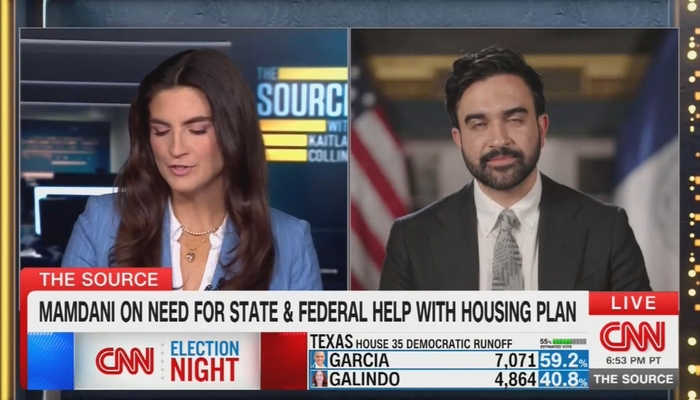
New York City, once regarded as the greatest, is now most famous for being the most expensive city in North America. The citizens who stay, rather than flee to more affordable areas, face crushing taxes and struggle to make ends meet. And what is Democratic Mayor Zohran Mamdani’s solution to this crisis? Throw more money at it and hope it gets better, as evidenced by his Tuesday night interview on CNN’s The Source with Kaitlan Collins, where he received little critical pushback to his costly housing plan.
According to Mayor Mamdani, New York City’s foremost problem is “the lack of affordable housing,” and he foresees prices going up by the end of the year. Collins welcomed Mamdani on air to tout his new Block by Block plan:
This is an announcement that does three key things: it builds 200,000 new affordable homes, preserves 200,000 affordable homes alongside it, and then additionally it invests in tenants across the city, makes it easier to provide code enforcement for housing violations, and does all of this while investing more than $5 billion in public housing, which has long been neglected, not just in our city, but frankly, across our country.
New York’s public housing fund is already at a whopping $1.2 billion, according to CNN, but Mamdani bragged about ballooning that to about $5.6 billion:
This is the first step in our administration's approach to delivering for New Yorkers, who at the beginning of NYCHA’s were shown a vision of city government delivering dignity for the most working class of the city… now public housing has about $80 billion in capital needs, and too often that's been a figure that's been used to justify doing nothing. And what we're saying as an administration is that we're not going to wait any longer for the federal government to be a partner in this work. We're going to start to deliver it ourselves.
Collins then threw Mamdani a soft-ball question referencing his proposed pied-a-terre tax, though she only asked if he had heard back from Citadel CEO Ken Griffin, whose apartment building Mamdani stood in front of while gleefully announcing this new tax.
Instead of defending the tax, Mamdani said that he was “looking to ensure that [he meets] with anyone who is a part of this city’s not only economy, but also [its] future.” The only problem with his statement is that, with Mamdani’s aggressive anti-corporation policies and high prices in general causing businesses of all sizes to flee the city, soon there may not be many business leaders left for him to meet with.
Collins also gave Mamdani an opportunity to snipe at Amazon founder Jeff Bezos’s recent CNBC comment that doubling his taxes is “not going to help that teacher in Queens.” Mamdani repeated the common lie that the wealthiest do not “pay their fair share,” ignoring the inconvenient fact that the top one percent pay a disproportionate share (about 46 percent) of the city’s personal income tax.
If Mamdani were to liquidate all of Bezos’s assets, which Bezos himself does not have immediate access to, the money would not be enough to keep New York City running for even two years. The costs are simply too high, and now Mamdani wants to increase them with his inane Block by Block plan.
But of course, Mamdani faced no challenges from Collins, who often just queued him up to issue his talking points (Click “expand”):
And I know, during the campaign, you wanted to double the city's funding for public housing. Right now, it's about $1.2 billion annually. The executive budget you have calls for $5.6 billion over five years. Do you still plan ultimately to double it?
(…)
Well, I mean, speaking of your government and the state government, the plan is also calling for up to a $100 billion in that public investment over a decade, funded through municipal bonds, higher taxes on corporations and top earners. Do you think you'll get the state approval that that requires?
(…)
You've said before that the city's housing budget, as you put it, cannot be tackled without the assistance of the federal government. Have you gotten any assurances from the Trump administration that that money will be coming?
(…)
Have you spoken to the President lately?
She only ended the segment smiling with the mayor and cheering on the Knicks.
The full transcript is below. Click "expand" to read:
CNN’s The Source
May 26, 2026
9:50:17 p.m. Eastern
(…)
KAITLAN COLLINS: And joining me now is New York City Mayor Zohran Mamdani. And thank you, Mr. Mayor, for being here.
As you're rolling out this new plan, just for everyone to understand the reality of what New Yorkers are facing. There was a study that your Office of Equity and Racial Justice did that found that the median cost for a couple with no kids is over $106,000 to live in New York. That's without kids, just to emphasize that.
When everything from gas, to food, construction, prices are up, what do you expect a number like that to be by the end of this year?
ZOHRAN MAMDANI: You know, I think we're going to keep seeing numbers like that increase across the country, given the economic conditions that Americans are living with. As you said, the war in Iran also is not just a moral affront or a political affront, it's also an economic affront to Americans' ability to make ends meet, and that even trickles down to New Yorkers' ability to live in this city.
However, the announcement we made today of a plan called Block by Block is looking to do everything we can to actually lower costs in this city because, we know that at the heart of a cost of living crisis, the number one driver of that crisis is the housing crisis.
And this is an announcement that does three key things: it builds 200,000 new affordable homes, preserves 200,000 affordable homes alongside it, and then additionally it invests in tenants across the city, makes it easier to provide code enforcement for housing violations, and does all of this while investing more than $5 billion in public housing, which has long been neglected, not just in our city, but frankly, across our country.
COLLINS: And I know, during the campaign, you wanted to double the city's funding for public housing. Right now, it's about $1.2 billion annually. The executive budget you have calls for $5.6 billion over five years. Do you still plan ultimately to double it?
MAMDANI: Yes, absolutely. This is the first step in our administration's approach to delivering for New Yorkers, who at the beginning of NYCHA's inception were shown a vision of city government delivering dignity for the most working class of the city.
And yet over the last few decades, ever since the Reagan cuts, we have seen public housing be overlooked and ignored time and time again, where now public housing has about $80 billion in capital needs, and too often that's been a figure that's been used to justify doing nothing.
And what we're saying as an administration is that we're not going to wait any longer for the federal government to be a partner in this work. We're going to start to deliver it ourselves.
COLLINS: Well, I mean, speaking of your government and the state government, the plan is also calling for up to a $100 billion in that public investment over a decade, funded through municipal bonds, higher taxes on corporations and top earners. Do you think you'll get the state approval that that requires?
MAMDANI: You know, we continue to be confident of the partnership we're building with the state. We've seen our ability to spend more of our capital dollars on housing as something that was unlocked through that partnership. And it's going to continue because, what we're talking about are hundreds of thousands of New Yorkers who live in public housing, who currently today are forced to endure hundreds of days before an elevator is fixed or before a vacant unit is turned over.
And this is just one part of our larger vision of building more housing than the city has seen for quite some time because, as you know, it's an issue across the country. And yet in New York City, the most expensive city in the United States of America, we've allowed the scale of ambition to be something that we only read about in our history books, while we continue to justify what has been a city that doesn't build enough for the people that it has.
COLLINS: You've said before that the city's housing budget, as you put it, cannot be tackled without the assistance of the federal government. Have you gotten any assurances from the Trump administration that that money will be coming?
MAMDANI: You know, I've shared with the President directly my hopes in working together to deliver Sunnyside Yard, which would be the largest housing development since the early '70s. Happens to be the same year since the Knicks last won the championship. We're hoping that continues this year as well.
And we've put that forward because, that would build 12,000 homes and create 30,000 jobs, and it would do so in partnership with the federal administration. So, we've put that forward, the President was interested, and that conversation continues. However, we know that this city will need to lead, and we look forward to having other partners join us at the table.
COLLINS: What does that conversation look like right now? I mean, I know obviously we all saw your meeting with the President last fall. Has he said anything in terms of committing to that funding?
MAMDANI: Yeah, I think it's still an active conversation. However, the President did make clear that he was interested in this.
And we've known that this is an idea that has lived within the public imagination for decades. It's going to take a lot to actually get it to fruition, but we are committed to that because, we think that it has a generational opportunity to unlock stability for New Yorkers who would live in this housing, as well as New Yorkers who would work on this housing, which is a key part of our plan, is that we look at New York City through every single lens of those that are going to actually construct these houses, those that are going to steward these houses, those that are going to live in these houses. Because, for too long we've thought of New Yorkers only in one way, when in fact many construction workers, at the end of the day, they go home and they're a tenant in our city.
COLLINS: Yeah. Well, I mean, since you and the President talked about that plan. He posted later, despite it being a very warm and glowy meeting, from what the press saw, he said, quote, Mayor Mamdani is destroying New York City. It has no chance. And the United States of America should not contribute to its failure.
I mean, some people might see that and say, 'But where does that leave plans, especially things like this housing plan that will rely on federal money?' And are you worried about that being at risk here?
MAMDANI: I think the President and I have said many things about the other. I don't think they preclude the ability for the city to actually work together with the federal administration on something of this scale.
And we're going to keep pushing it forward because, we believe that for far too long, ambition has been something that has been left in the history books of our city. I mean, when we look at the fact that the Empire State Building was built in 13 months. And now, you know, we spend about seven months after constructing a building just to move a tenant in? It's frankly unacceptable.
And we want to show what's possible in this country. In order to do so, we have to be willing to lead with a vision of ambition that actually matches the scale of the crisis. We're going to keep doing that here, and we will always leave an invitation open to the federal administration to join us in any of this work because we know that these are not just New Yorkers. They're Americans, and they too need to see a government that actually cares about their well-being.
COLLINS: Have you spoken to the President lately?
MAMDANI: I know - I keep those conversations between the two of us. I will tell you, however, that whenever we do speak, they are conversations about the welfare of this city, and anything that we can do to make it easier for New Yorkers to live here.
COLLINS: You know, and you talk about housing. You have met with a bunch of CEOs, in the last several weeks, after you announced that - what's been described as a pied-a-terre tax on second homes of the city's wealthiest. You put out that ad, obviously singling out the announcement -- that singled out the Citadel CEO, Ken Griffin. He later called that video, quote, 'Creepy and weird.'
I know that your office, and - that you've reached out to him. Have you heard back from Ken Griffin?
MAMDANI: We've reached out to make it clear that I'm willing to meet with any and all business leaders across the city. And I think that's important because, as the mayor of this city, I'm looking to ensure that I meet with anyone who is a part of this city's not just economy, but also our future. And what we've seen, whether it be Ken Griffin, whether it be Jamie Dimon, whether it be David Solomon, so many other business leaders across this city, is people who are creating jobs in the city.
And even at their level of employment, whose workforce still face the pressures of an affordability crisis because, as you know, in New York City, you can be making six figures, and you're still going to blink when you realize you have to pay $20,000 a year for child care for a single child in this city. And so, we are looking forward to partnering with anyone and anyone to deliver on a vision that will take care of everyone across these five boroughs.
COLLINS: But you - so, have you heard back from him, or you have not?
MAMDANI: Not as yet. But I'm going to continue to have these meetings to make it clear what our vision actually is for the city.
COLLINS: Speaking of executives, Jeff Bezos told CNBC last week on taxes, and obviously, you know, what you've said about affordability is looming in the background of this. He said that you could double his taxes and, as he put it, quote, 'It's not going to help that teacher in Queens, I promise you.'
What was your response to that comment from Jeff Bezos?
MAMDANI: You know, I know a few teachers in Queens who would beg to differ.
And I think that if I was worth as much money as he was, then I would probably say the same thing. The fact of the matter is that we are talking about a city where one in four New Yorkers are living in poverty, and we're hearing from one of the richest men that our world has ever seen, about how he and others who make that kind of money shouldn't have to pay their fair share.
And frankly, what New Yorkers want to see is a tax system that recognizes the scale of this affordability crisis and actually provides a way for city government to be able to invest in those same New Yorkers in the manner that we used to, decades ago.
COLLINS: On another topic. New Yorkers are in a very celebratory mood today because the New York Knicks have not won an NBA championship, I looked at this, since 1973.
MAMDANI: Come on.
COLLINS: They actually have not been to the finals since you were seven years old.
Did you ever think that you would see a Knicks finals run during your first year as mayor?
MAMDANI: You know, I prayed for it, I hoped for it, but you know, I didn't want to jinx it. But it is incredible. As you said, 1999, you know, the last time the Knicks were in the finals, Ricky Martin 'Livin' la Vida Loca' was top of the charts, and we are incredibly excited to be playing that song again here in New York City today because, we're hopeful, we're excited. It's truly an incredible time to be a New Yorker.
COLLINS: Were you trolling Vivek Ramaswamy with your -- with your post overnight?
MAMDANI: You know, I just hoped he had a nice night. And we had a great one in New York.
COLLINS: That sounds like a yes.
MAMDANI: I'll leave that to you.
COLLINS: Mayor Zohran Mamdani, thank you for joining us. And Go Knicks.
MAMDANI: Go Knicks. It's a pleasure.








 New Posts (Home)
 ChatBox
 Popular Posts
  Game Zone
 Top PodCasts