pacificlegal.org
One mother’s fight to restore merit-based admissions in NYC’s Specialized High Schools
Every November, students vying for a spot at one of New York City’s eight Specialized High Schools take the admissions exam that will determine their academic trajectory.
The notoriously rigorous Specialized High Schools Admissions Test (SHSAT) spans three hours and assesses a student’s abilities in English language arts and mathematics. Admission is highly competitive. There are around 4,000 to 5,000 seats available across all eight of the nine schools each year, and anywhere from 25,000 to 30,000 students take the SHSAT.
For years, this intense, merit-driven admissions process has helped build these schools into behemoths of academic excellence. Seats are reserved for the city’s best and brightest, whose test scores show that they can handle the advanced curriculum these schools provide.
Despite the SHSAT’s tried-and-true record for identifying gifted students, recent changes to the Discovery program have weakened the city’s longstanding merit-based admissions system.
A seat at Stuyvesant
A major draw for students interested in attending one of the Specialized High Schools is the focus on Science Technology Engineering and Mathematics (STEM). In total, there are nine Specialized High Schools, and the majority are devoted to STEM. Only one, Fiorello H. LaGuardia High School of Music & Art and Performing Arts, does not require its students to take the SHSAT. The cutoff scores for each of the eight SHSAT schools vary each year based on seat availability, applicant preferences, and SHSAT scores
Upon registering for the exam, students are asked to rank their school preferences. When the time came for Yi Fang Chen’s son, M.P., to rank his school preferences ahead of the 2025 exam, there was no doubt that his first choice would be Stuyvesant High School.
Of all the city’s Specialized High Schools, many consider Stuyvesant to be the crown jewel.
Stuyvesant is the oldest of the nine schools. Since 1904, it has cultivated a tradition of excellence, with multiple alumni going on to win Nobel Prizes in physics, chemistry, economics, and medicine-related fields. For the Chen family, Stuyvesant also had the added benefit of being just a short subway ride from their home, making it the ideal choice all around.
M.P. has already demonstrated a deep commitment to his studies. He attends one of the city’s gifted and talented middle schools and has a strong background in mathematics. After spending years preparing for the test, he and his parents were hopeful that his SHSAT scores would earn him a spot at Stuyvesant.
In March 2026, his results came in. M.P. received an impressive score of 558, placing him in approximately the 95th percentile.
One year prior, his score would have been high enough to secure a spot at Stuyvesant. But for the 2026/27 school year, he was just three points below the cutoff score. Meanwhile, thanks to changes in the Specialized High Schools admissions system that de-emphasized individual merit, students who scored at least 63 points lower than M.P. on the SHSAT were granted admission to Stuyvesant.
How merit built an American Dream
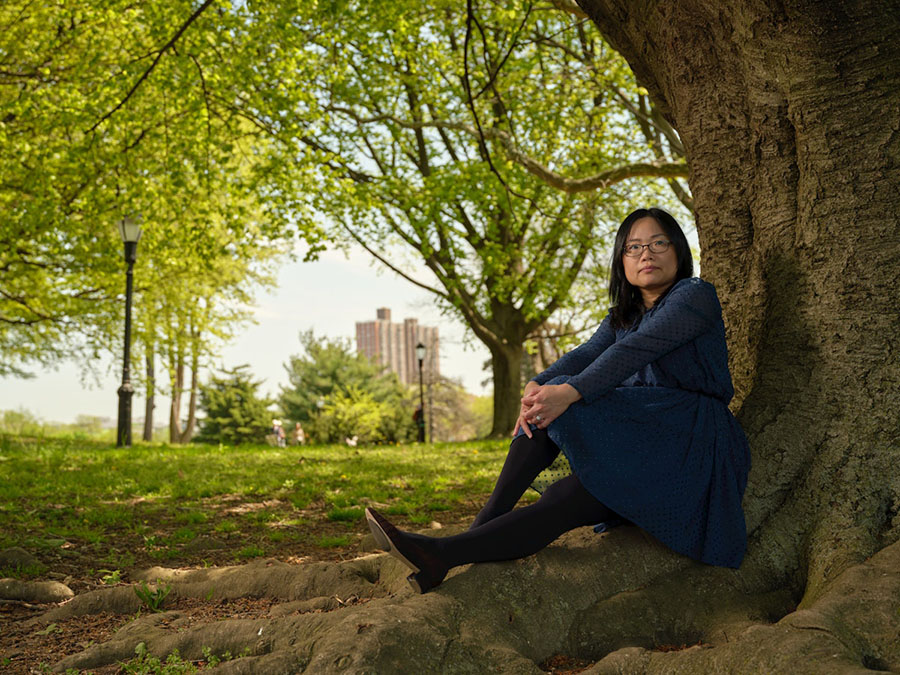
Yi Fang has raised her children to understand that merit—and nothing else—should determine their opportunities in education. She doesn’t just preach this philosophy—she’s lived it.
Both Yi Fang and her husband are immigrants to this country, hailing from China and Hong Kong respectively. As children from working-class families, they both understood that education was the key to building a prosperous life with financial security.
Yi Fang was a teenager when her family moved from China to New York City. Her parents were focused on doing what they could to make ends meet, so her dedication to her education was a self-driven pursuit.
During those first few years, she had to navigate starting high school in a new country where she didn’t speak the language. And while English was foreign to her, she took comfort in the universal language of numbers.
She excelled in mathematics and within a few years had gotten a good grasp on the English language. When she wasn’t studying, she was pouring herself into extracurricular activities and volunteer work. While other teens enjoyed their summer freedom, Yi Fang was volunteering at Bellevue Hospital Center as an interpreter, helping medical staff communicate with Chinese-speaking patients.
Her years of volunteer work combined with her academic record helped her earn a scholarship from the Bill & Melinda Gates Foundation, which funded both her undergraduate and graduate degrees.
Yi Fang attended NYU, starting as a chemical engineering major and then switching to mathematics. She then earned her Ph.D. in statistics from Stanford, where she met her husband. The pair then moved back to New York City, where they are now raising their three children.
Yi Fang is proud of what she has been able to achieve, telling PLF that “through my hard work, taking exams, and then getting involved in extracurricular activities, I was able to go to a good school. I was able to achieve what my parents came to this country for.”
It is important to her that her children understand the importance of earning accomplishments through their own merit. Unfortunately, while she is trying to instill these morals in her children, merit is under attack by the city of New York.
The seat that was set aside
Yi Fang was understandably disappointed that her son was just a few points shy of attending Stuyvesant. It would have been easier to accept the situation if her son had truly not done enough to earn a spot. But there was more to the story than simply missing the cutoff by three points.
For years, state law has specified that admissions to NYC’s Specialized High Schools be based “solely and exclusively by taking a competitive, objective and scholastic achievement examination, which shall be open to each and every child in the city of New York.” But the law had also historically allowed for a small carveout via the Discovery program, which set aside some open seats—typically less than 5 percent of the total admissions across all schools—for low-income students whose SHSAT scores were just below the cutoff.
In 2019, former Mayor Bill de Blasio and former Schools Chancellor Richard Carranza revamped the Discovery program without legislative approval. Under the restructured program, each of the Specialized High Schools was required to reserve 20 percent of their incoming seats for Discovery-eligible students—the definition of which was tweaked.
Rather than being open to all low-income students, the Discovery program is now available only to low-income students from middle schools with an “Economic Need Index” of 60 percent or higher. And these qualifying students are held to a lower SHSAT standard than everyone else who is admitted to the Specialized High Schools.
A New York Department of Education analysis using 2019 SHSAT data concluded that Discovery’s 20 percent set-aside rule increased Stuyvesant’s cutoff score for those students who are admitted based just on SHSAT score and not Discovery by ten points—from 552 to 562. It is likely that the rule had a similar effect for the 2025 SHSAT scores.
Stuyvesant’s incoming class for 2026 is expected to be at least 800 students, and under the revamped Discovery program, approximately 160 of those seats will be given to students who received SHSAT scores below the overall cutoff—which for 2026 was 495 (over 60 points below M.P.’s score).
Basing admissions primarily on SHSAT scores has helped mold these schools into the respectable institutions they are today. Why change a system that yielded such remarkable results?
Designed to discriminate
The architects and supporters of Discovery’s changes cite equity as their motive. They have been explicit not only about their intent to racially engineer the student body to include more black and Hispanic students, but also to decrease the number of Asian American students granted admission.
Nearly three-quarters of the city’s Asian American students come from low-income families. But many of these students attend schools that do not meet the Discovery program’s new Economic Need Index threshold. While their economic need may be the same, their race has locked them out of opportunity.
The racial discrimination at play here is not just speculation—supporters of Discovery’s changes have made public statements admitting to the desire to limit Asian American and white students.
Specialized High Schools exist specifically to provide opportunities to students who have demonstrated their aptitude and ability to thrive in fast-paced, academically rigorous environments. Merit—not race—should be the only factor that determines whether a student is admitted to a Specialized High School.
The Constitution’s Equal Protection Clause prohibits the government from discriminating against individuals based on their race. Whether direct or by proxy, governments cannot create admissions standards that tip the scales in favor of one race over another.
Yi Fang has partnered with Pacific Legal Foundation to challenge New York City’s discriminatory admissions policy in court.
For Yi Fang, this case is bigger than M.P. and even her other children who will one day be old enough to take the SHSAT. Yi Fang wants every student in New York City to have an equal opportunity to attend a Specialized High School based on their SHSAT score and not on their race.
Merit created a pathway for Yi Fang to build the life she dreamed of when she immigrated to America years ago. Everyone deserves that chance, and Yi Fang is more than willing to fight for that right.
The post One mother’s fight to restore merit-based admissions in NYC’s Specialized High Schools appeared first on Pacific Legal Foundation.








 New Posts (Home)
 ChatBox
 Popular Posts
  Game Zone
 Top PodCasts