www.thegospelcoalition.org
Amandus Polanus: Classical Theism’s Reformed Ally
If I wanted to learn more about how the cultural values of 1950s and ’60s America have shaped contemporary literary fiction, I might ask Google or ChatGPT for an overview. The search results might present accurate and balanced information on America’s democratic tradition and the other community values prevalent during those decades, as well as how we see those themes in today’s fiction.
Yet I’d be more helped if I read a primary source, such as Marilynne Robinson’s compilation of essays When I Was a Child I Read Books. Robinson is uniquely qualified to answer my question because she grew up in rural Idaho during those decades and is now a celebrated American novelist.
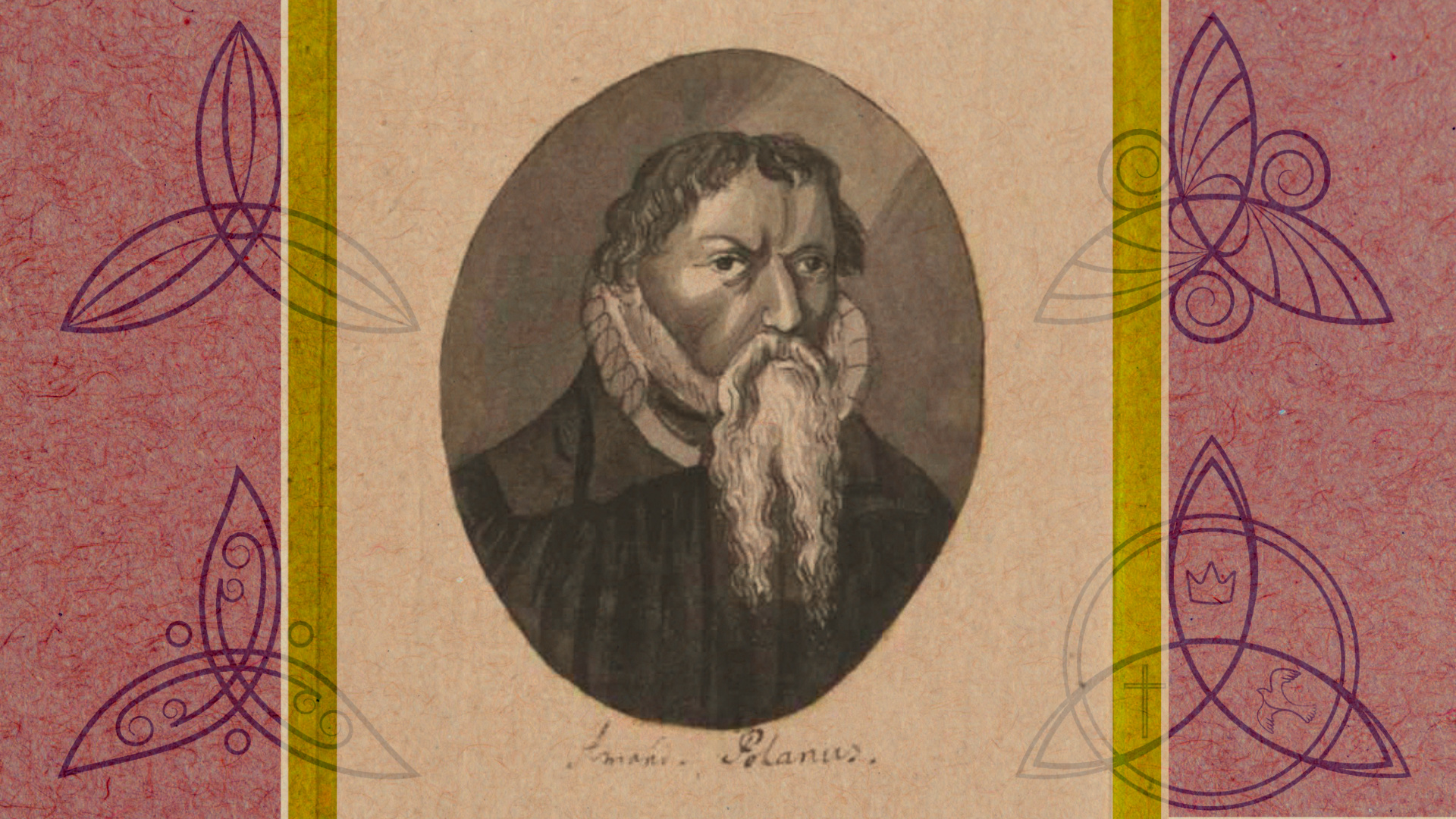
Similarly, if I wanted to learn what influences from church history have shaped the way Reformed theologians describe the triune God, I could just search it up. Yet the better way would be to take up the work of German Reformed theologian Amandus Polanus (1561–1610). Polanus and other Scholastic theologians of the late 16th to 18th centuries lived and served on the heels of the Protestant Reformation.
Polanus’s perspective is invaluable because it draws from both the reformers and the broader Christian tradition in ways that help us understand Scripture and classical doctrines like the Trinity more accurately.
Polanus’s Historical Significance
Polanus lived in a time of transition. As Stephen Tipton observes, theologians during this period pursued a “systematic exposition of the whole of Post-Reformation thought, stressing as appropriate both points of continuity and discontinuity with the past.”
In his Syntagma Theologiae Christianae, Polanus laboriously combs through historic Christian beliefs. Using Aristotelian causal analysis—the philosopher’s theoretical way of interpreting reality—Polanus clearly presents and defends the biblical validity of doctrines such as the Trinity that had been passed down from the church catholic, as well as those like justification by faith and biblical authority that the reformers recovered.
Polanus’s perspective is invaluable because it draws from both the reformers and the broader Christian tradition.
In this way, Polanus and the other Reformed Scholastics were theological consolidators and synthesizers. They clarified the doctrinal similarities between Roman Catholic and Reformed theologies, and they also delineated the distinctions.
Though only small portions of Polanus’s works have been translated into English, his precise axioms offer students a comparably accessible entry point into classical theology. Moreover, Protestant students will find in Polanus an ally who holds high both Reformation theology and classical theism.
Three Truths About the ‘Most Holy Trinity’
In his larger systematic theology, Polanus produced 18 axioms on “the Three Persons of the One Deity.” These axioms summarize traditional, orthodox doctrine into a few briefly stated rules. Here are three that teach us about Trinitarian theology from a classical perspective. They might serve as a beginning catechism for students of systematic theology.
Axiom 1: The sacred Trinity is God—indeed, the single, only God.
In axiom 1, Polanus begins by considering God’s unity in essence. There is one God (Deut. 6:4; Mark 12:29), and God’s divine essence is singular, indivisible, irreducible, and simple. Moreover, the three divine persons each have the identical divine essence and are equally God.
If the Father subsists in the divine essence and is wise (Eph. 3:10–11), then the Son and the Holy Spirit, who subsist in the common divine essence, are also wise. God’s being, will, and power are one. Therefore, the Father, Son, and Holy Spirit possess a numerically singular being, will, and power. The Son and Holy Spirit are consubstantial with the Father (Matt. 28:19; John 10:30; 1 Cor. 2:10–11). So when we consider God as God, everything is singular.
Axiom 2: There is Trinity not in essence, which is single, but in the number of persons and the distinction of them.
The appropriate time to count to three (with real distinctions) is when we number off the divine persons. There are three according to person: the Father, Son, and Holy Spirit. They’re identical according to the divine essence, yet the three persons are really distinct from each other (2 Cor. 13:14).
Axiom 6: The persons of the deity are not distinguished among themselves essentially nor according to existence, which is common because their essence is one. Nevertheless, they are distinguished really, because one person is produced from another. And for that reason the persons differ by an incommunicable property—namely, according to the subsisting which is proper to each person.
We distinguish the persons (or tell them apart) by one incommunicable property: “by the smallest [notion] . . . by relation.” Polanus asserts, “The relation of divine persons is the . . . mode of existence . . . that is proper and incommunicable to each person, and does not compose the person but constitutes and distinguishes him from other persons without composition.”
Why This Matters
I’m grateful my doctoral supervisor introduced me to Polanus. I didn’t know of Polanus at all until I began researching his life and work. Then, I discovered just how significant he is. Recovering and learning from him is important because while he respected the Christian tradition and transmitted orthodox doctrine faithfully, he was also committed to the Reformation’s view of scriptural authority and salvation by grace through faith. He’s a trustworthy source for young theologians because he both drew on church tradition and stood on the Word.
Polanus’s precise axioms offer students a comparably accessible entry point into classical theology.
I appreciate Polanus’s axioms because they keep me from error and lead me to praise. Maintaining the distinctions he outlines is essential so contemporary scholarship doesn’t fall into one of the ancient heresies that diminish the Son’s divinity or wrongly conflate the divine persons.
Studying and remembering the truths in Polanus’s outlines also helps us to know our triune God with greater precision. This is important for worship. If during congregational singing, for example, we lack confidence in the theological accuracy of a song’s lyrics, we might struggle to sing it with a full heart. Yet when we’re convinced the words describe God faithfully, we can wholeheartedly lift up my prayers and praise.
Polanus’s axioms have helped me know God more accurately. And in this way, they’ve also drawn me to love and worship him more wholly.








 New Posts (Home)
 ChatBox
 Popular Posts
  Game Zone
 Top PodCasts