reactormag.com
An Inordinate Fondness for Beetles: Donald A. Wollheim’s “Mimic”
Books
Reading the Weird
An Inordinate Fondness for Beetles: Donald A. Wollheim’s “Mimic”
Could non-human creatures walk among us, hidden in plain view?
By Ruthanna Emrys, Anne M. Pillsworth
|
Published on June 3, 2026
Comment
0
Share New
Share
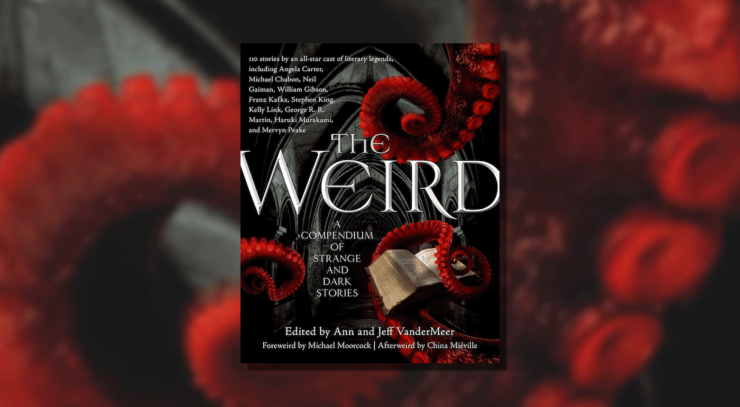
Welcome back to Reading the Weird, in which we get girl cooties all over weird fiction, cosmic horror, and Lovecraftiana—from its historical roots through its most recent branches. This week, we cover Donald A. Wollheim’s “Mimic,” first published in Astonishing Stories in December 1942. You can find it more easily in column-favorite anthology The Weird, edited by Ann and Jeff VanderMeer. Spoilers ahead!
This week’s story opens with a classic preamble about human hubris. We think we know a lot, but half the planet remained undiscovered less than five hundred years ago. Science and technology remain in their infancies—why, the discipline of atomics has barely been born! Many truths lurk unimagined, and “when they are discovered, they may shock us to the bone.”
Our unnamed narrator works as a museum curator’s assistant, “mounting beetles and classifying exhibits of stuffed animals and preserved plants, and hundreds and hundreds of insects from all over.” He soon learns that “Nature is a strange thing.” Look at its fondness for camouflage and mimicry. Soft-bodied moths masquerade as armored wasps. Beetles imitate army ants and march undetected in their all-devouring columns. In all animal groups, there are the killers, the survivors. Lesser species are wise to ape them.
And since man is “the greatest hunter of them all,” the “irresistible master” of the world, why wouldn’t inferior creatures walk among us, hidden in plain view?
When narrator was young, a neighbor rented rooms in a grimy tenement at the end of the street. He appeared twice a day, early morning to head for the elevated train, after nightfall to return home. He always wore a black ankle-length cloak, and a wide-brimmed black hat pulled low over his face. Though he looked like a creature from “some weird story out of the old lands,” he harmed nobody; indeed, he paid attention to nobody. Except, maybe, women. If a woman crossed his path, he’d close his wide, watery blue eyes until she passed. Then he’d march on as if there’d been no such encounter. At Antonio’s grocery he never spoke, only pointing to what he wanted. The kids jeered until they grew bored with his unresponsiveness; then, like their parents, they ignored him.
Only one incident of note occurred during Black-Cloak’s long residence. He dragged sheets of metal into his room, banged on them for several days, then stopped. That was all anyone ever knew until years later, when narrator was grown. Sheer luck found him nearby when the janitor of Black-Cloak’s building ran out shouting for help. Narrator and a policeman followed him to Black-Cloak’s rooms, where he’d heard thuds and screaming. Silence greeted them. Knocking received no answer. At last the policeman and narrator broke in the door.
Beyond lay a room littered with torn papers and garbage. Oddly, it was unfurnished except for a metal box four feet square, screwed and roped shut, its lid sealed with a waxy substance. Black-Cloak lay on the floor, still cloaked though his hat was cast aside. He was dead. Inside the box, something rustled.
The would-be rescuers examined the body, “gradually—horribly” becoming aware of its wrongness. Black-Cloak’s eyes remained open, staring. The eyebrows were mere lines in the flesh of a face with no nose—mottled skin only presented as a nose if unscrutinized. It had no teeth. The “coat” was “a huge black wing sheath, like a beetle”. The thorax underneath had six insectile legs and a hole oozing watery liquid, while the abdomen below was crumpled, reminding narrator of a wasp after egg-laying.
The janitor fled, “gibbering.” The policeman began to pray, but at narrator’s instigation he helped break the seal on the box. Together they lifted the lid. “Noxious vapor” poured out, along with things two or three inches long, dozens flying on gauzy beetle wings. They looked like little men in black suits, with expressionless faces and watery blue eyes. Out the open window they streamed. Narrator ran to watch their exodus. How could people have known about army ant imitators without ever suspecting some creature might disguise itself to look like “the supreme animal himself—man.”
They found bones at the bottom of the box, maybe human—they didn’t try too hard to identify them.
In retrospect, narrator supposes that Black-Cloak was female, the box her nest, the flying throng her offspring. He speculates that Black-Cloak was wary of women because they observe men more closely and could suspect her inhumanity. Or maybe Black-Cloak had an “instinctive feminine jealousy” of potential competitors.
But what shakes narrator most is the thing only he saw, staring after the fliers in the dawn sky. On the roof of a lower building, what looked like a red brick chimney opened two white eyes, unfurled great bat-wings, and peeled away from the real chimney to pursue Black-Cloak’s young.
What’s Cyclopean: Gibbering!
The Degenerate Dutch: “It is less than five hundred years since an entire half of the world was discovered.” Does that mean that First Nations folks already knew about cape-men as well?
Weirdbuilding: Vampires get close by passing as human. But there are a lot of opportunities for monstrous urban camouflage—just ask Fritz Leiber’s smoke ghost. And if you want really terrifying insects (with bonus human mimicry), there’s T. Kingfisher’s new Wolf Worm.
Ruthanna’s Commentary
Humans may be top predators—the army ants of the larger world. But we are also awfully anxious.
Evolve without predators, like the dodo, and you’ll be without fear (or protection). But evolve as a predator—or an adaptable scavenger, which is humanity’s actual niche—and you’re forever aware that something bigger or sharper or smarter might come along any minute. Thus our endless, ant-like stream of b-movie giant insects/tomatoes/amorphous blobs. And thus the fear of predators passing as our own.
It’s interesting that this latter fear barely arises in “Mimic.” Amid the variety of insect-kind, there are species that look like other species so they can eat their young, or lay cuckoo eggs, or just free-ride on the work of busier ants. But Wolheim’s examples involve vulnerable beetles passing as dangerous wasps, or finding safety amid army ant columns.
The man in the black cloak walks among humans, even buys our food, but fears us more than we do her. There’s that bone in the nestbox, of course. But corpses are pretty easy to find in 40s New York, and grave-robbing is probably safer than killing for yourself. A single escaped victim would be a lot more dangerous than a random perceptive woman.
I’m side-eyeing the explanation for the mimic’s femmephobia, by the way. Sure, women are on average socialized to pick up indications that a man might be dangerously… off. But freezing every time one goes by is A Lot, and not a good way to avoid scrutiny. Nor does it seem likely that insectile femininity should find conflict with the mammalian version. Birds get jealous, sure, but they also pick out human “mates” about whom to get territorial. Maybe the mimic is actually an insect-looking bird? It would explain a certain amount, not least the violation of the inverse square law.
But we only rarely fear birds, while insects can raise an instinctive flinch. Like snakes, they’re often-enough venomous that we have our own adaptations—many but not all humans are predisposed to develop phobias. Narrator, oddly, isn’t. He works with insects in the museum, finding more interest than terror in their strangeness. His fear, perhaps, comes more from that knowledge than from uncanny valley reflex, from inferring a whole mimetic ecology from one individual. Or two: there’s that chimney flyer.
And where harmless beetles pass themselves off as army ants, there are probably predators and scavengers as well. There are parasitic breeders with faster and more vicious reproductive cycles than the mimic.
It scares our narrator. But it’s not what scares me. This is New York only a little after Lovecraft’s time there—and no less prone to xenophobia. There may be cape-man beetles every few blocks, but more often there are visitors terrified of unfamiliar languages, human predators taking advantage of immigrants, and white supremacists eager to prove their egos on othered bodies. All of whom would leverage “some supposed people are actually insects” for their own purposes. Not that we need excuses, but any new impetus for dehumanization is terrifying.
Wollheim presumably knew this—it was 1942, and it would be hard to miss. Earlier that same year, the U.S. had entered World War II and sent Japanese-Americans to internment camps. So is the story infavor of identifying the “real” inhuman threats, or is the reader expected to infer the dangers of looking for them?
My head-canon: we never do figure out where cape-man gets her money. I think those “bills” are the most dangerous mimetic predators in the story. They have a symbiotic relationship with the cape-men, helping them scrounge human food in exchange for insertion into the economy. Hapless bodega-owners pass them to landlords or bankers; eventually they’ll fasten onto the richest and most greedy humans. They’ll send feelers, cordyceps-like, into the brains of CEOs, encouraging them to focus on profit alone until the bills reach their final instars in the form of crypto. What happens then, we are only just starting to learn.
Anne’s Commentary
Wollheim’s “Mimic” kicks off with the cautionary reflections of a narrator who has Come to Know Too Much and Seen That Which He Cannot Unsee. After graduating from college (with a degree in biology would be my guess), he may justifiably think he knows a lot, or at least something, about his subject. His studies earn him a museum job, where he assists in curating exhibits and organizing collections, with an apparent emphasis on class Insecta and order Coleoptera. The beetles alone would be humbling, comprising as they do almost 40% of all arthropods. As the story goes, evolutionary biologist J.B.S. Haldane quipped to a group of theologians that God must have “an inordinate fondness for beetles,” but the junior curator assigned to sort through endless drawers of them could be excused for not always sharing that fondness.
And for concluding, like “Mimic’s” narrator, that Nature is a strange thing. The strangeness specific to his story is that Nature revels in camouflage and mimicry. My favorite example of the two combined is Pseudocerastes urarachnoides, the Spider-tailed Horned Viper. Its mottled pattern of creams and browns allow it to hide in plain sight on the arid substrate of the west Iranian mountains. That’s not surprising — camouflage is a common feature of ambush predators. Less common but far from singular is its use of a caudal lure, usually a tail-tip that squirms in imitation of a wormy treat. This snake’s lure, however, sports a bulbous “abdomen” and scales elongated into spidery “legs,” irresistible to its largely avian prey.
This is a form of Peckhamian or aggressive mimicry. The Black-Cloak Man primarily practices another form, though we can’t rule out him keeping some kind of lure under his cloak or wing-protective “suitcoat” elytra. If those bones in his metal box are human, after all….
The stereotypical images of candy-offering pedophiles and alley-lurking flashers come too forcibly for me to speculate further about Black-Cloak lures.
I brake my current train of thought to mention that my appreciation of “Mimic” was several times sidetracked by credulity-stretchers. Also, narrator annoyed me right off with his Anglo-European-centric remark that the Americas were discovered less than five hundred years ago, his time frame. Hello, peoples inhabiting North and South America long before 1492 might have said. If establishing even freaking empires doesn’t count as discovery with you guys, we don’t know what would. I wasn’t inordinately fond, either, of his analysis of why Black-Cloak particularly avoided women. First off, how women may notice men more closely than men do, thus having a greater chance of detecting Black-Cloak’s inhumanity. Men, of course, only notice women. Unless they’re gay men, who didn’t exist in 1940s America, at least not in narrator’s neighborhood. Second off, Black-Cloak turns out to be a she, not a he, which given that males of some inhuman species can tend to their young is not a necessary conclusion.
But allowing Black-Cloak is female, she might experience “some touch of instinctive feminine jealousy” toward women. I can’t. I’m restarting my previous train of thought.
So. Assuming that Black-Cloak is some sort of giant arthropod that has survived to the Age of Superior Humanity and has had time to evolve alongside said Superior Humanity long enough to mimic it, not that really Superior Humanity has been around long, evolutionarily speaking, what advantage does Black-Cloak gain by the deception? They go regularly to the grocery store, and there have been no disappearances of neighborhood kids or pets since their arrival. So, let’s assume they’re not large-scale carnivores needing mimicry to go as “wolves in the fold” among their prey.
We could ask Antonio whether it’s the meat case or the produce section to which Black-Cloak points when they visit his grocery.
Moving on, hypothesis-wise. Narrator mentions army ants and their beetle-mimics among his examples of Nature’s strangeness. Army ants will devour everything in their “marching” path, but the beetles that resemble the ants (probably by tactile and chemical imitation as well as visual) can be engulfed by a column while escaping predation. This is protective mimicry. But if Black-Cloaks need to escape human aggression, do they need to blend in with humans? It would be “cheaper” for them to avoid humans altogether by living in unpeopled areas. Certainly not in big cities.
This suggests that Black-Cloaks gain some advantage exactly by living in much-populated areas, the very strongholds of their models. We’re back to the ants, and creatures that don’t want to beat ants but to join them. Myrmecophiles, “ant-lovers,” are broadly defined as “any organism that is dependent on ants at least during part of its life cycle.” Many myrmecophiles make their homes within ant colonies, or even in the midst of army ant columns, drawing advantages from the protection, resources, and stability these communities provide. Ant guests (inquilines) have relationships with their hosts ranging from the parasitic through the commensal and mutualistic. If Black-Cloaks are live-in myrmecophiles, or rather anthropophiles of a sort, where would they fall on the relationship spectrum? Lacking textual evidence that humans benefit from Black-Cloaks, I’ll go with a commensal one, with Black-Cloaks benefiting from humans and neither hurting nor harming humans (with the possible exception of harvesting the odd human for larva fodder.)
It’s possible that Black-Cloaks aren’t human mimics in the evolutionary sense Wollheim’s going after, which I continue to have problems buying. Maybe they’re aliens with the ability to semi-shapeshift in short order and pass on the shift to offspring. Maybe over time they could perfect their human mimicry. Maybe that bat-winged thing that peeled off the chimney is another alien with cephalopod-level camouflaging ability—it seems unlikely it would have evolved only to imitate brickwork. And maybe Brick-Bat was what put the hole in Black-Cloak’s thorax, preparatory to devouring their succulent hatchlings.
Not that I think the narrator would take greater comfort in finding out that extraterrestrial or interdimensional shapeshifters are real, rather than terrestrially evolved megaroaches and chameleon-bats. Whatever he’s seen, he still Can’t Unsee It.
Next week, Arthur clings to civilization in Chapters 17-18 of The Buffalo Hunter Hunter.[end-mark]
The post An Inordinate Fondness for Beetles: Donald A. Wollheim’s “Mimic” appeared first on Reactor.








 New Posts (Home)
 ChatBox
 Popular Posts
  Game Zone
 Top PodCasts