www.dailysignal.com
For One Night on the Baseball Diamond, Washington Gets It Right
Since 1909, through two world wars, the Great Depression, and every period of political turmoil our country has faced in modern times, Congress has played baseball. That is not an accident. There is something about the game that has always outlasted the moment, that pulls people back to the field no matter what else is happening around them.
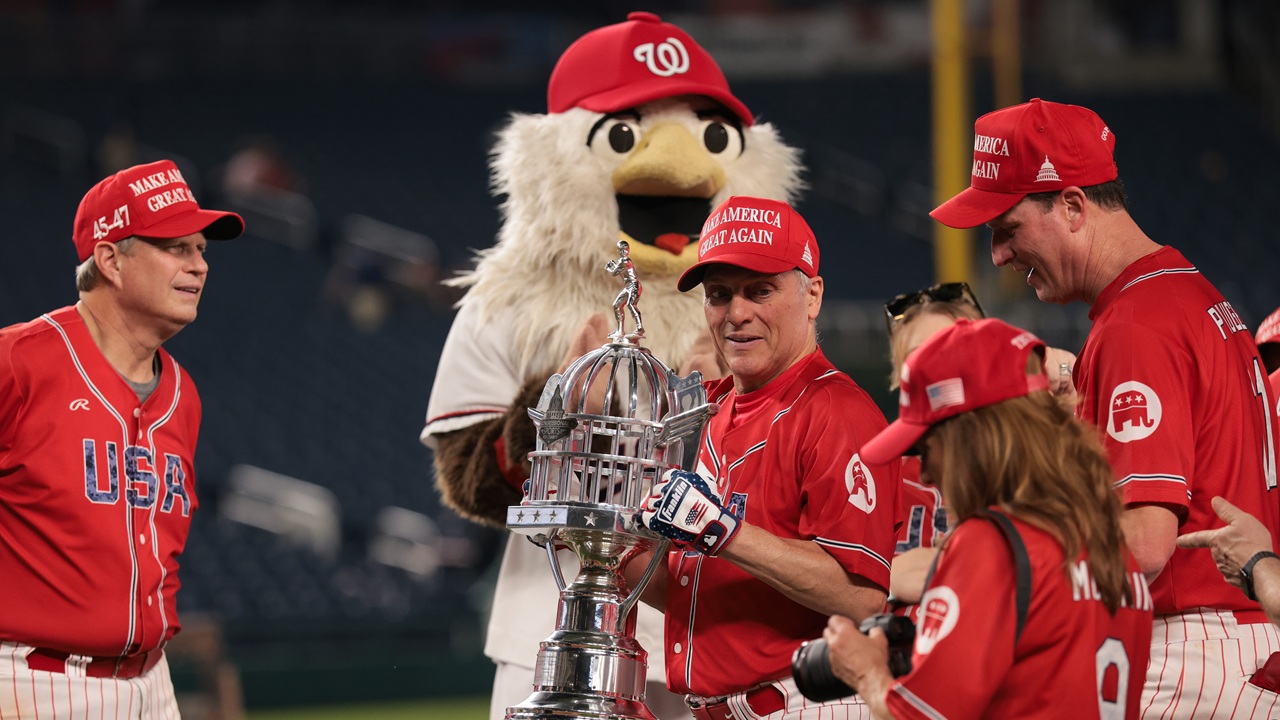
Every June at Nationals Park, members of Congress put on uniforms, walk out onto a diamond, and play seven innings in front of thousands of people. Not as a stunt, not as a photo opportunity, but as a genuine continuation of a tradition that has survived every period of dysfunction and division our country has faced.
Baseball holds a special place in American life that no other sport replicates. It is the game soldiers carried overseas, that cities rebuilt themselves around after hard times, that generations of Americans used to mark the passage of summer. It is a shared inheritance that belongs to everyone who grew up with the smell of a leather glove or the crack of a bat on a summer evening, regardless of party or how they vote.
Nobody understood that better than Coach Roger Williams, a former Atlanta Braves player and Texas Christian University baseball coach who has run the Republican team’s predawn practices for years. He is the reason this team shows up ready to play, dragging members of Congress out of bed before committee hearings to take ground balls at 6 a.m. He has been doing it for years because he believes the tradition is worth protecting, and he is right.
I played throughout my high school years at Central High School in San Angelo, Texas, and into my days at the Air Force Academy. Baseball has been an integral part of my life for as long as I can remember. But what I have learned from the Congressional Baseball Game goes beyond the game itself.
The relationships built in that dugout, the handshakes after a close play, the shared bus rides and early morning practices—we carry those moments back with us to Capitol Hill. In a town where trust is hard to come by, this game quietly builds some, and that matters more than most people in this city are willing to admit.
It’s a game that George H.W. Bush played: one that honors a hard-fought battle—but with civility. It has been reported that Republicans are on a winning streak of five games, but the tradition only works because both sides keep showing up to give it their all.
Last year, the moment that stuck with me was not the final score. It was a diving catch at third base with the bases loaded in the first inning, the kind of small play that shifts momentum and reminds everyone in the dugout why each one came.
Baseball does something that nothing else in Washington can. Nearly 40,000 people were there to see it, and they were not rooting for dysfunction. They were rooting for the game. Together, they helped raise a record $2.81 million for 45 local charities and four college scholarships, proof that this tradition delivers well beyond the box score.
The cynics will say one baseball game a year does not change anything. They are right that it does not pass legislation or fix the broken appropriations process, but that is the wrong standard. The question is whether it reflects something true about the country Congress is supposed to represent.
Americans have always understood that competition and respect are not mutually exclusive. You play hard, you play by the rules, and when it is over, you acknowledge what the other side brought to the field. That ethic is older than this republic, and it is worth preserving in the people who run it.
There is a version of Washington that gets buried under the daily dysfunction, where political opponents are still Americans first, and showing up in good faith is itself a form of patriotism. The Congressional Baseball Game is one of the few places left in this city where that version is still visible.
Wednesday night at Nationals Park, both sides will take the field. Nearly 40,000 Americans will be watching, not because this institution has earned every ounce of their faith, but because they have not given up on it. That is worth honoring.
And for seven innings, we intend to.
We publish a variety of perspectives. Nothing written here is to be construed as representing the views of the Daily Signal.








 New Posts (Home)
 ChatBox
 Popular Posts
  Game Zone
 Top PodCasts