reactormag.com
Found in Translation: Bothayna Al-Essa’s The Book Censor’s Library
Books
Found in Translation
Found in Translation: Bothayna Al-Essa’s The Book Censor’s Library
A satiric dystopia about censorship and art
By Hache Pueyo
|
Published on June 11, 2026
Comment
0
Share New
Share
Found in Translation is a new bimonthly column reviewing books translated to English in a variety of speculative shapes. Some traditional, some experimental, some told through cultural narratives that might seem peculiar if you’re not used to them, but all have the same unifying factor: there is always more out there.
A thing is what it is, a word means itself, and every word has only one meaning, which is the meaning approved by the Censorship Authority.
There’s a contradiction at the heart of all repression. The enemy is so powerful that it can ruin the very fabric of society, therefore must be destroyed—yet must be so easy to vanquish, so disarmed and vulnerable, that one must question where the threat came in the first place. Female politicians who vouch against women’s rights while enjoying the influence and financial benefits brought by their public office; witch hunts against the rise of crime in regimes that lock part of the population in concentration camps and kill; invoking free speech for hate crimes, but supporting the annihilation of all dissent. Censorship is no different—in fact, it’s often where this contradiction can be seen more clearly.
Opening with a note stating that the events of the novel happen somewhere in the future, in a place that resembles every other place, The Book Censor’s Library introduces a claustrophobic dictatorship in which every aspect of human life is controlled. An organ known as the Censorship Authority decides which books will be banned following a manual for correct reading. The rules advise censors against interpretation, encouraging them instead to focus on the words in isolation, and always seeking references to god, sex, and the government. Any book that breaks the rules is mocked, banished, and eventually destroyed.
The new book censor believes in the system. Despite wishing to be an inspector—part of the literary police, with the power to break into bookshops and confiscate their books—he’s avid to grow in his career, but the novel starts with his failure: he wakes up one day and finds himself a reader, mirroring the opening lines of The Metamorphosis. A copy of Kazantzakis’ Zorba the Greek has irreversibly broadened his world. What starts as a discussion of the absurd hypocrisy of the manual (one must never swim in interpretation, he’s told, but the government frequently indulges in it to censor certain books) quickly descends into a metatextual journey of books as his need for reading grows.
Here, imagination is considered a sickness, a remnant of the Old Word, a universe of democracy and information that no one seems to remember, and is deftly compared to a vestigial tailbone. Useless, primitive and to be surgically removed if any additional growth appears. Children who show symptoms of this nearly forgotten past can be taken to rehabilitation centers and never return; their parents might face charges for neglect; and, ironically, once a year, during Purification Day, the population is allowed to play pretend, parading through the streets in costumes in a makeshift carnival, only to come together in a bonfire of censored books and historical effigies.
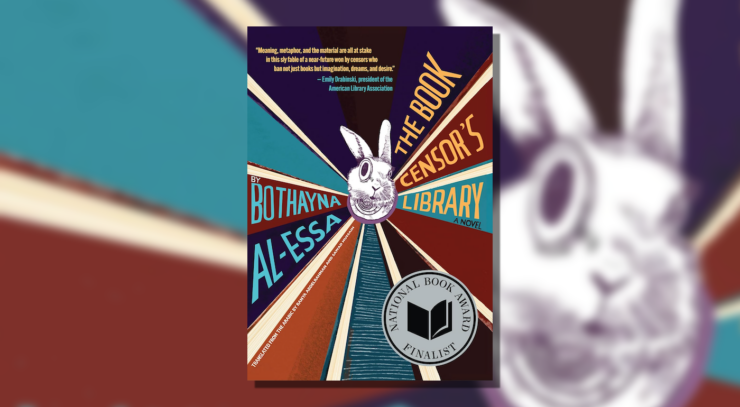
The Book Censor’s Library is more of a satire than a regular dystopia. Readers who look for a structured system of oppression might find that worldbuilding exists only on the surface, and never explains how this society actually works. It’s a matter of expectation; the novel shines when it’s embraced as a parable, a love letter to literature, a statement against censorship and a literary conversation between many different works. The rabbits roaming the corridors of the Censorship Authority invite the character and reader down the hole, both a symbol of irreverence in a building of control and the possibility of freedom.
Orwell’s 1984 is present through the entire book, but it’s with the censor’s five-year-old daughter that the story takes a much darker path. The little girl, brimming with imagination and an inexplicable memory of fairy tales from the past, is an obvious victim to the rehabilitation centers, truly nightmarish factories of punishment and reeducation, not so different to the Ludovico Technique in A Clockwork Orange.
The introduction to the subversive bookseller adds another meta level to the story, recalling Bothayna Al-Essa’s own experience after opening a bookstore in Kuwait in 2016. What started as a passion project became a constant battle with the Ministry of Information. Books that had been previously approved were banned, then approved, sometimes multiple times a year—Zorba the Greek being an infamous example. In the novel, the bookseller is a mysterious figure, a splash of color in an otherwise gray world, the possibility of an imaginative child having a future, a reader turned writer, but even her presence comes as a bleak warning: her resistance might be important, but without collective organization, there’s no way of breaking the system.
The Book Censor’s Library can be heavy-handed at times in the way it presents concepts, but its commitment to the concept makes it an accessible introduction to oppression. Not only that, but every criticism might work in its favor, taking the reader down an irreversible rabbit hole of interpretation.[end-mark]
حارس سطح العالم by Bothayna Al-Essa was originally published in Senegal (Arabic) in 2019, and translated to English in 2024 by Ranya Abdelrahman & Sawad Hussain (Restless Books)
Buy the Book
The Book Censor’s Library
Bothayna Al-Essa
Translated by Ranya Abdelrahman & Sawad Hussain
Buy Book
The Book Censor's Library
Bothayna Al-Essa
Translated by Ranya Abdelrahman & Sawad Hussain
Translated by Ranya Abdelrahman & Sawad Hussain
Buy this book from:
AmazonBarnes and NobleiBooksIndieBoundTarget
The post Found in Translation: Bothayna Al-Essa’s <i>The Book Censor’s Library</i> appeared first on Reactor.








 New Posts (Home)
 ChatBox
 Popular Posts
  Game Zone
 Top PodCasts