reactormag.com
Safer Driving Through Science Fiction
Books
reading recommendations
Safer Driving Through Science Fiction
Surely, issues like traffic jams, speeding, and road rage can be solved through these creative strategies…
By James Davis Nicoll
|
Published on June 11, 2026
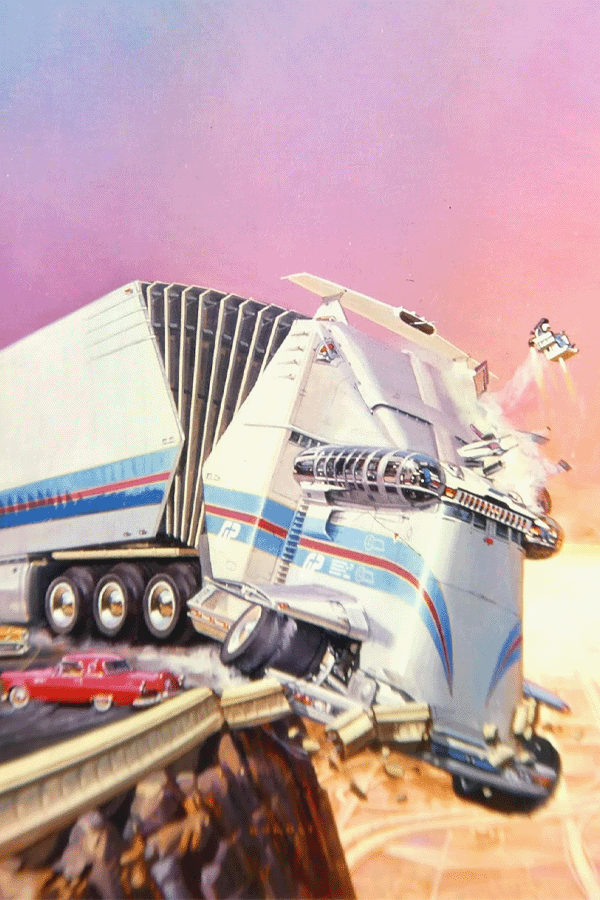
Paradox Alley cover art by James Gurney
Comment
2
Share New
Share
Paradox Alley cover art by James Gurney
The automobile! Arguably the defining invention of the 20th century, the production of which shapes whole economies. As is the case with any technology, cars are the focus of a considerable amount of public policy. However, real-world policy makers are limited by such plebian concerns as “is this even possible” and “will I manage to stay in office if I introduce this regulation?” Thus, for truly visionary solutions, one must turn to SF authors.
Consider these five traffic issues.
Traffic Jams
Who among us has not been caught in traffic jam? Even I, who do not drive, have found myself in a stationary vehicle, trapped in a mass of unmoving cars1. Traffic jams have been a driving hazard since at least November 11, 1921, when an Armistice-Day-related incident left 3000 cars motionless. Since then, great advances have been made: in 2010, for example, China experienced almost two weeks of gridlock stretching over 100 kilometers of the Beijing-Tibet Expressway.
How to manage this issue?
James D. Houston’s 1964 story “Gas Mask” proposed a surprisingly workable approach. Commuter Charlie Bates is caught up in a vast, seemingly endless traffic jam. Air quality plummets and of course certain basic necessities are not available within motionless cars. Bates’ breakthrough is to accept that there is no solution, the jam may never end, and to adjust his lifestyle to that reality.
Crash Safety
It might be possible to make crashes extremely rare. However, the more people out on the road, the more chances there are for unlikely events to occur. Therefore, even if superhuman efforts are made to ensure that crashes are as infrequent as possible, the number will never be zero. Car design must take that into account.
Gerry & Sylvia Anderson’s TV series Captain Scarlet and the Mysterons (1967–1968) featured an especially trying traffic context, given the Mysteron enthusiasm for engineering disasters as part of their convoluted revenge plot2. The Spectrum Pursuit Vehicle design reflected this: drivers sat in rearward-facing seats, steering the windowless car via telescreen images3. This would mitigate the effects of sudden deceleration on the SPV’s driver… although not on any pedestrians who got in the way.
Speed and Distance
Simple logic suggests that the less time one spends on the road, the fewer the opportunities for mishaps. There are only two factors that determine how long one is on the road: speed and distance between origin and destination. SF authors have tackled both.
Rick Raphael’s 1963 Code Three offers a vision of a North America spanned by an advanced road system able to handle speeds of up to four hundred miles an hour. Alas, this vast improvement in speed is not matched to any commensurate improvement in driving skills. Therefore, it falls to the brave, often short-lived North American Thruway Patrol officers to keep the carnage to acceptable levels.
No mundane improvement in speed would suffice in John DeChancie’s 1983 Starrigger. The starrigger routes cover interstellar distances. Conveniently, the so-called tollbooths (AKA Kerr-Tipler objects) scattered by a previous civilization solve the problem. Provided that the trucks survive passage through warped spacetime, they can simply drive from one planet to another as easily as we drive from Toronto to Montreal… if for some reason the 401 were to be subject to metal-shredding tidal forces.
Autonomous Vehicles
Even the best human is flawed. Human drivers ensure human error. Human error leads to mishaps. Removing humans from the equation removes the human element leading to accidents. That’s just simple logic, the sort of reasonable conclusion any Skynet or Colossus might come to.
Among the many benefits offered by the Unification Council in Daniel Keys Moran’s 1989 The Long Run is Automated Traffic Control. Under the system’s watchful eye, passengers could be assured trips would be as safe as possible, not to mention completely documented by the world government. Only a handful of so-called “speedfreaks” objected. The manifest absurdity of their position was made clear when a million-car convoy attempting to circumnavigate the Earth in manually-driven hovercars flew into a storm and perished4.
Communication
Automobiles possess only rudimentary systems for communicating with other vehicles: blinkers, shouts, the one-fingered Mudra of Contempt, and so on. Improved clarity could only improve the situation. No gesture’s meaning is as clear as a gunshot; therefore, arming cars is an obvious possibility.
Alan Dean Foster’s 1971 story “Why Johnny Can’t Speed” offers a utopian vision of a North America in which prudent drivers cruise the streets in heavily armed, heavily armoured cars, ever ready to use lethal violence to prove their right to be on the road. Tragically, Frank and Myrt Merwin’s son Robert prioritized maneuverability over armour or firepower. Frank cannot bring Robert back to life, but he can get a father’s just revenge5.
Perhaps you have your own favourite science-fictional solutions to the opportunities presented by cars. If so, share them in comments.[end-mark]
As I live in KW, I’ve also found myself in a stationary Ion, thanks to the tendency of local drivers to steer into or otherwise impede the Ion. The Ion is our light rail system, which I am sad to say uses neither ions nor rails made from light. ︎The Mysterons were annoyed by the high-handed manner in which Earth’s Captain Black (in an excess of caution) blew an entire city off the face of Mars. Annoying a vastly superior, exceptionally vindictive civilization turns out to be a bad idea. ︎Designers clearly had a lot of faith in the reliability of SPV cameras and telescreens. ︎Those who survived received death sentences and lengthy jail terms, as was the custom at the time. An interesting setting detail that I mention for no particular reason: The Long Run’s UN had weather control technology at their disposal. ︎Did Steve Jackson Games’ Car Wars ever cite its inspirations? Were either “Why Johnny Can’t Speed” or Ellison’s “Along the Scenic Route” among them? ︎
The post Safer Driving Through Science Fiction appeared first on Reactor.








 New Posts (Home)
 ChatBox
 Popular Posts
  Game Zone
 Top PodCasts