flashbak.com
The Origins of Rave in Objects: See the Members Only Cards of 80s and 90s UK Raves
“The Haçienda probably made more money for drug dealers than it ever did for us.”
— Peter Hook
How did we know that moral panic over rave culture had hit the mainstream in the US? The scriptwriters of Beverly Hills 90210 — the Euphoria of its day — devoted two full episodes to rave dangers. If we didn’t catch on the first time (in 1992’s “U4EA”), we sure as hell should have two years later, when a minor character nearly burned alive in a rave fire (1994’s “Injustice For All”).
If what you knew about raves in the 90s came from network television, you were fully prepared for secretive dens of drugs and sin, with dancing and music as sideshows for the main event: the spectacle of near-teenage death. UK parents got the chance to freak out years earlier, when the tabloids sensationalized the so-called “Second Summer of Love” between 1988 and 1989, leading to actual legislation against dance music.
Early UK rave flyers, including The Prodigy’s first business card
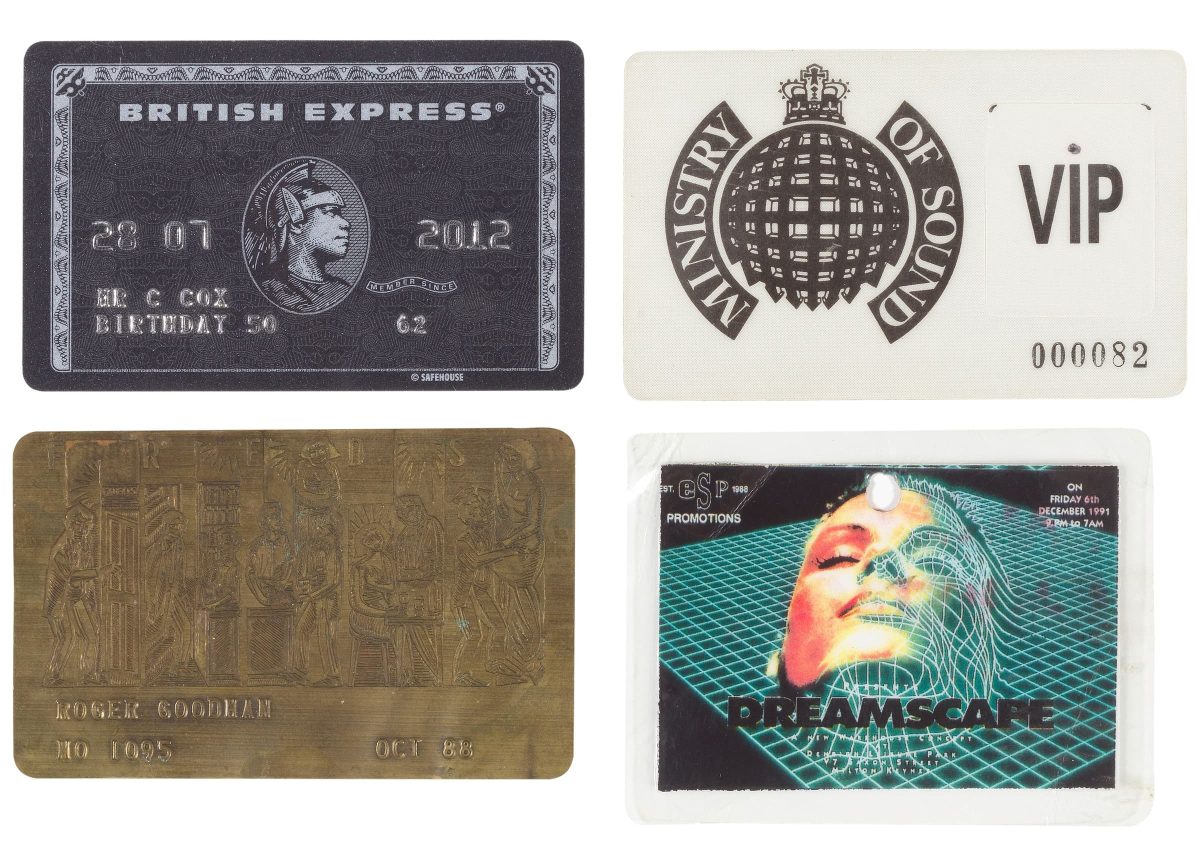
The artefacts you see here come from a “Members Only” Archive currently held for auction at Bonham’s and dating from that pivotal period and the years just following. It is, notes Bonham’s, not only a collection of club memorabilia; “It is effectively a social history of Britain’s late-1980s and 1990s underground music revolution, told through small, disposable objects that were never meant to survive.”
“The collection includes a multitude of preserved physical ephemera from legendary clubs and events like Shoom, Ministry of Sound, Fantazia, Raindance, FAC51 Haçienda, Spectrum, Trip, Amnesia House, Apocalypse Now, Biology, Club UK, Dalston Lane, Destiny, The Eclipse, Empire, The Factory, Fantasia, Future, Genesis, Golden, Helter Skelter, In-Ter-Dance, Jungle Fever, Labrynth, Land of Oz, Quest, Sterns, Sunrise, Taste, 2000 AD and much more.”
The late 80s in England was a time and place when rave culture solidified in a series of huge dance parties, legal and illegal, indoors and out. Some stereotypes are perfectly true. Were there secret parties? Of course; the only way to stay ahead of the police raids was to carefully screen guests with private invitations. Were there lots of drugs? Oh, yeah, loads.
The scene was also, for many, a politically-charged celebration of life, designed expressly in opposition to the anti-life forces that shaped a generation. As one historian of the rave scene argues, the hippie communalism of rave culture appeared contra Margaret Thatcher’s doctrine of “ruthless individualism” that “systematically dismantled working-class communities,” robbing people of livelihood and social life. (The same would happen in Reagan-era Chicago, Detroit, Baltimore, and other cities of post-industrial decay.)
“It’s no coincidence that the first sound systems emerged in industrial areas devastated by those policies. In abandoned factories, empty warehouses, and closed-down mines—these spaces, abandoned by capital, became the temples of a new form of resistance.”
Abandoned factories + soundsystems = instant parties, no superstar DJs needed (though many who now enjoy that status started out in dank illegal warehouses).
Another history refers to origins as diverse (so to speak) as south, and west London, Manchester, Sheffield, and Birmingham (and even Ipswich). Then, there is, of course, the island of Ibiza, where Joy Division became New Order, and also, of course, New York, Chicago and Detroit.
“These competing origin stories tell of rave’s international characters, pilfering the many genres of African-American dance music—disco, electro, house, garage — to filter them through the UK’s subcultural milieu….”
Despite its global nature, however, rave predates the flattening of the internet, and thus each regional scene retained its local character: “Rave meant actually coming from somewhere.” Or, if you didn’t, it meant traveling to somewhere else, perpetually. The best somewhere to be in late 1980s-era rave was certainly the city of Manchester and Factory Records’ legendary Haçienda.
How did the gloomy industrial Manchester of Joy Division and The Smiths become the insanely eclectic electronic dayglo Madchester of the Happy Mondays, more or less overnight? In the same way flower power never happens without Grateful Dead and Ken Kesey spreading acid over San Francisco; or funk never happens without cocaine (at least according to Rick James); there is no rave scene without ecstasy. But hedonism was only one object.
Beats Beyond Borders argues that rave happened because of ecstasy’s ability to erode not only emotional and social inhibitions, but musical ones as well:
“[Ecstacy] did something very specific to music: it dissolved genre loyalty. On ecstasy, the divisions between rock fans, soul fans, and dance fans simply evaporated. What mattered was the rhythm, the bass, the collective physical experience of moving together in a dark room. It turned nightclubs – previously somewhat transactional spaces – into what many people genuinely described as religious experiences.”
One can have a religious experience without drugs, or without religion, for that matter. The rave scene’s melding of underground genres into a universal language of dance and laser light shows may have only come about through chemical means, but it had the power to re-order synapses all on its own, for at least the temporary illusion of a better future than the one on offer.
Read the full details (and place your bid) at Bonhams
The post The Origins of Rave in Objects: See the Members Only Cards of 80s and 90s UK Raves appeared first on Flashbak.








 New Posts (Home)
 ChatBox
 Popular Posts
  Game Zone
 Top PodCasts