www.newsbusters.org
MS NOW’s Elon Trillionaire Meltdown: A 'Clown' Who 'Bought' the 2024 Election for Trump
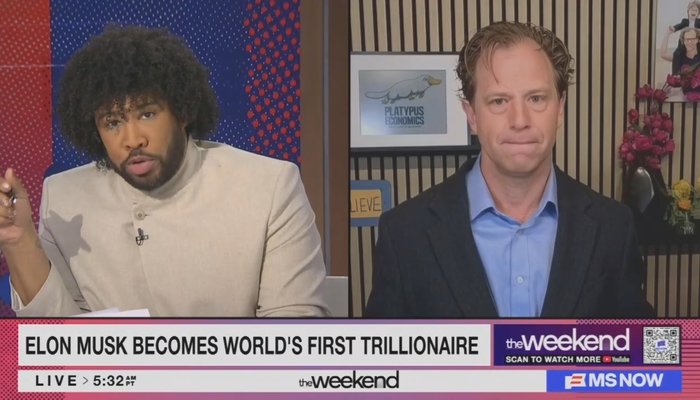
Saturday's edition of MS NOW’s The Weekend offered up a full-throated class-warfare kvetch over Elon Musk becoming the world’s first trillionaire.
Co-host Eugene Daniels grew visibly agitated as economist Justin Wolfers claimed Musk “bought” the 2024 election for Donald Trump with $250 million in campaign spending. Daniels declared the discussion made him “very angry” — not at Wolfers, but at the country for allowing it.
Wolfers argued Musk’s spending was enough to flip the election’s narrow margins in key states and left him with enough wealth to “buy” thousands more. Yet neither Daniels nor Wolfers mentioned that Kamala Harris’s campaign and aligned groups outspent Trump’s by roughly half a billion dollars, with Harris’s side topping nearly $2 billion compared to Trump’s roughly $1.45–1.5 billion.
Daniels piled on, accusing Musk of getting rich by taking business “that used to be done by the federal government.” In reality, NASA itself has estimated that partnering with SpaceX on the Commercial Crew program saved taxpayers $20–30 billion compared to the old cost-plus approach.
Co-host Jonathan Capehart joined the kvetch fest, whining about the “yawning gap between the wealthy and the rest of us”—as if he’s holding down two fast-food jobs to make ends meet. In fact, Capehart has enjoyed a string of cushy gigs, with an estimated MS NOW salary in the million-dollar range and a personal net worth of $2–5 million.
The segment’s overarching theme was classic class-warfare hand-wringing over wealth gaps. Wolfers reserved special contempt for Musk, praising other billionaires for their philanthropy but branding Musk a “clown.”
If Elon's a clown, I'm running off to join the circus.
MS NOW Kvetches About Musk's Trillion pic.twitter.com/TehtEAo6z3
— Mark Finkelstein (@markfinkelstein) June 13, 2026
Conspicuously absent from the outrage: Musk’s wealth creation for thousands of ordinary Americans. SpaceX’s recent IPO has turned more than 4,400 current and former employees into millionaires — including welders, cafeteria workers, and support staff. Estimates suggest that virtually all of the roughly 22,000 employees who worked there for a few years pocketed at least $100,000 in gains.
MS NOW loves to stoke resentment against successful innovators while ignoring the broad prosperity they generate. The real story isn’t oligarchs “buying” elections or stealing from NASA — it’s American enterprise delivering results that government bureaucracies never could.
Here's the transcript.
MS NOW
The Weekend
6/13/16
8:39 am EDT
JACKIE ALEMANY: It's official, Elon Musk is the world's first trillionaire. Friday, Musk's, Musk's is, oh, that's a hard one. His exploration and satellite company, SpaceX, made their NASDAQ debut, and just after shares began trading, its stock topped a hundred and sixty dollars per share, pushing the company's value above two trillion dollars.
Musk's newfound trillionaire status offers a stark contrast to the economic pain that many Americans are feeling because of inflation. Government statistics released this week showed the annual inflation rate hit four point two percent in May, that's the highest in three years. And the latest Economist YouGov poll shows that almost sixty percent of Americans say the economy is getting worse.
Joining us now is Justin Wolfers, professor of economics and public policy at the University of Michigan, and host of the Platypus Economics podcast.
Justin, I, I, I actually am not even sure really what the right question is here. Is that, is he a trillionaire because of inflation, or are there other reasons for sort of the, artificial ballooning of it? I mean, what even is a trillion dollars? I don't know. What do you think we need, what should be our takeaway, in your opinion, from this milestone?
JUSTIN WOLFERS: I love that, because, look, I've done enough media training to have told me no matter what the question, give the answer you want. You just said, "Write your own question."
But I'm gonna take that, I'm gonna take your invitation seriously, 'cause I think there's something really fundamental and really, really important here. So, I'm not gonna start with Musk being worth a trillion, I'm gonna go back to 2024, when he invested $250 million in the American election.
That was almost certainly enough to win Donald Trump the election. Trump's winning margin across the three swing states was only 230,000 votes, so you needed to switch a hundred and fifteen thousand voters.
If Musk's money, even if it was so inefficient, it cost a thousand dollars per vote switch, Musk's money won the election for Donald Trump. That's scary fact number one. We've already got an oligarch who put a billionaire in charge of our country.
Let me blow you away with fact number two. This is where you need to understand the difference between a trillion dollars, that's what the bloke's got, and $250 million, which is what he spent. It's not one percent of his wealth, it's not point one percent of his wealth, it's point zero two five percent of his wealth. Musk bought one American election, and has enough money left over to buy another 3,999 elections.
So they're thinking, we could do the politics of resentment. You know, I don't like a bloke having that much money, it makes me feel bad. But we don't need to. What we really need to do is talk about protecting democracy in an age of this sort of concentration of wealth.
EUGENE DANIELS: Well, Justin, I- this is-- You just made me, very angry talking about that actually. Not at you, but at our country and the fact that this is even possible.
I wanna pull up, some stats, from inequality.org and the Federal Reserve from last year. The top one percent in the United States has thirty-one percent of the wealth share. The bottom ninety percent have thirty-two point six percent of the wealth share.
And on Musk specifically, SpaceX, and the reason that he became a trillionaire, it seems, is because he was taking business, taking on business that used to be in the public-- that, that used to be public, that used to be done by the federal government.
CAPEHART: Justin, you spent a lot of time talking about the fact that Elon Musk, is buying elections, becoming a trillionaire, the gap, the yawning gap between the wealthy and the rest of us.
. . .
WOLFERS: One of the things I've actually always admired about the United States is the super rich here feel that it's their role to give back. There's tremendous philanthropic giving, much more here than in many, many other countries. And so we actually have an enormous number of incredibly admirable billionaires who've really taken their responsibility seriously. And then you got clowns And at the moment, Musk is a clown.








 New Posts (Home)
 ChatBox
 Popular Posts
  Game Zone
 Top PodCasts