reactormag.com
Eternal Sidequests For The Spotless Mind: Thomas Elrod’s The Franchise
Books
book reviews
Eternal Sidequests For The Spotless Mind: Thomas Elrod’s The Franchise
Sasha Bonkowsky reviews a pastiche of doorstopper fantasy and creatively incestuous IP that’s also a vessel to talk about memory and identity.
By Sasha Bonkowsky
|
Published on June 16, 2026
Comment
0
Share New
Share
With a crackle of electricity and a flicker in the LED display, you are no longer yourself. You are now Jack Vassal, a.k.a. “Peasant Extra #3” in the world of Malicarn. Your memories and personality are sequestered in an unused portion of your brain, papered over by a background NPC from an underfunded writers’ room; you’re handed a scythe and allotted twenty acres without knowing the first thing about farming. Congratulations! Welcome to The Franchise.
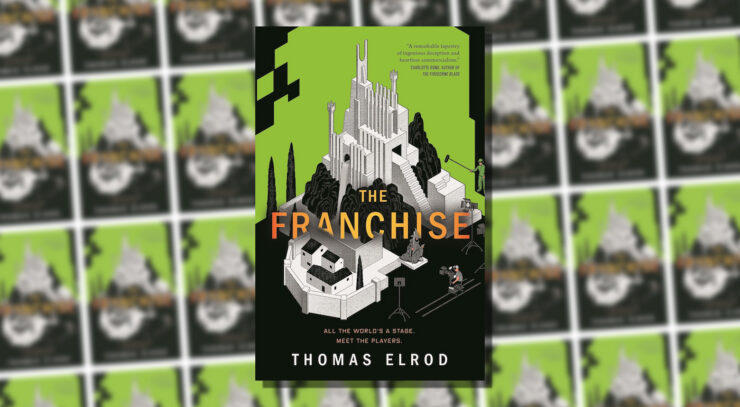
In Thomas Elrod’s new book, Malicarn was created in the 60s by French writer Jean-Danton Souard. Picked up on a whim by the editor of World Science Fiction & Fantasy (during the Cuban Missile Crisis; the fatalistic atmosphere made the publisher willing to take a chance), the lyrical prose, vibrant world, and story of a society thrown into upheaval by the re-emergence of magic was a best-seller. During his lifetime, Souard kept an iron grip on his property, beating back the Hollywood and Mattel vultures. but once he died his son Daniel proved more pliable. Malicarn became a big-budget movie series, a cinematic universe, video games and T-shirts and foam swords—and, starting in 2040, something bigger and stranger. Malicarn became real.
The sets are already permanent constructions, used year-round for tourists and ongoing filming; half the Portuguese island of Madeira is leased out to the film studio. The creative team’s plan—led by the charismatic Jules Walker and the laconic scientist Lilly Kaminsky—is to make the characters permanent, too. Using proprietary neuroscanners, personalities can be uploaded to actors, keeping them in character for months at a time; all their emotions, from love to hope to terror and guilt, will be completely genuine. The grandest and most immersive form of storytelling, Jules calls it.
Anyway, this new technology all works out great! Right up until the Malicarn, and all its visionary dreams, begins to fall apart.
Elrod tells the story across a dozen different characters, jumping around in time and the fiction of the Malicarn. There’s Buck Douglas, a struggling mason flirting with revolutionary ideals, and Queen Hannah I, seventeen years old and stifled by her overbearing regents; by The Franchise’s present of 2060, they’re the first generation of children born into the Malicarn and knowing no other world. There’s Glenn Mackey and Brian Doyle, also known as the wizard Gregorian and Captain of the Guard Kreek, professional actors whose brains remain their own, recruited to help “guide” the Malicarn towards the most entertaining storylines. On the technical side, readers can watch Lilly Kaminsky and Jules Walker pry people’s brains apart, sprinkle in a dash of trauma or grief to round out a character, then stand back for the fallout; and more distant still from the story are the fans and directors and MI6 agents watching the Malicarn unfold.
A running theme throughout The Franchise is that none of these characters have ever read the original Souard books. They offer up various excuses—too long, wasn’t interested, ADHD made it impossible—but it all works out to the same thing. The sets Jules builds, the mythology he passes onto the characters; the personalities Lilly grafts onto actors and extras; the gravitas Glenn exudes in his portrayal of Gregorian; all that is based on nothing more than a half-remembered dream. It’s a curious dynamic: As the Malicarn becomes more real (physical, a larger scope), it also becomes less real (true to itself).
Maybe that’s inevitable. We’re living in an era of sequels and bigger-than-ever IP; according to box-office data, sequels are taking up more of the money in film than ever before.
Data via Stephen Follows and The-Numbers. Total dataset (including both sequels and non-sequels, covers 58,900 feature films released in the US between 1974 and 2023, inclusive. Box office refers to US/Canada box office.
One common criticism of these late entries into an IP—Marvel’s Thunderbolts follows thirty-five other films and fourteen television shows in its shared universe, for example—is that they cease to be anything but self-referential. The first Star Wars films were inspired by Seven Samurai, Flash Gordon, Edgar Rice Burroughs, and more; how much does The Mandalorian and Grogu, fifty years later, draw on anything but other Star Wars media? But at least we choose if and how we want to experience these sort of overly self-referential media properties; the poor saps of The Franchise are stuck living it!
It’s an experience I hadn’t thought about until reading this book: What is the rich inner life of a character who wasn’t written to have one? How do a person’s mind and memories develop when all they’re seeded with is a single sentence of background (“farmer’s son”, “bricklayer’s daughter,” “apprentice alchemist washout”, “fought in the Great Wizarding War”) and a single specific memory for flavor? Elrod does a wonderful job playing with his Malicarnian characters’ interiority, then showing us how they’re constructed piece by piece.
Buy the Book
The Franchise
Thomas Elrod
Buy Book
The Franchise
Thomas Elrod
Buy this book from:
AmazonBarnes and NobleiBooksIndieBoundTarget
Frank Douglas, Buck’s father, is introduced (and killed off) in the first chapter as a bitter, alcoholic war veteran, whose most vivid memory is searching a village for rogue mages when a child, hiding in a storage closet, shot his commander with an arrow. Later we meet “Frank” at Comic-Con, before he ever entered the Malicarn: a broke, aimless fan named Terry whose eyes light up at the prospect of a) getting paid to b) join his favorite show; later still Lilly, grumbling at a silly request from the writers’ room, uploads one of her father’s stories from the Iraq War—finding a child in a storage closet who shot his captain with a gun—into the extras. Last, and the one that sticks with me, is the chapter from Frank’s perspective. Ten pages of second-person perspective, an overwhelming feeling of being trapped in the wrong body, the wrong role, a sort of childlike despair: You thought you’d be a different person.
I loved The Franchise. It’s clever and intricate, it’s a pastiche of doorstopper fantasy and creatively incestuous IP that’s also a vessel to talk about memory and identity—and I hope you, Reactor Magazine reader, will love it too. If not? Well, I’ve got this lovely neuroscanner here that might change your outlook…[end-mark]
The Franchise is published by Tor Books.Read an excerpt.
The post Eternal Sidequests For The Spotless Mind: Thomas Elrod’s <i>The Franchise</i> appeared first on Reactor.








 New Posts (Home)
 ChatBox
 Popular Posts
  Game Zone
 Top PodCasts