reactormag.com
Cosmos: Stopping By Woods on a Momentous Evening
Column
Science Fiction Film Club
Cosmos: Stopping By Woods on a Momentous Evening
Three amateur astronomers pick up a mysterious signal that no one else seems to be hearing…
By Kali Wallace
|
Published on June 17, 2026
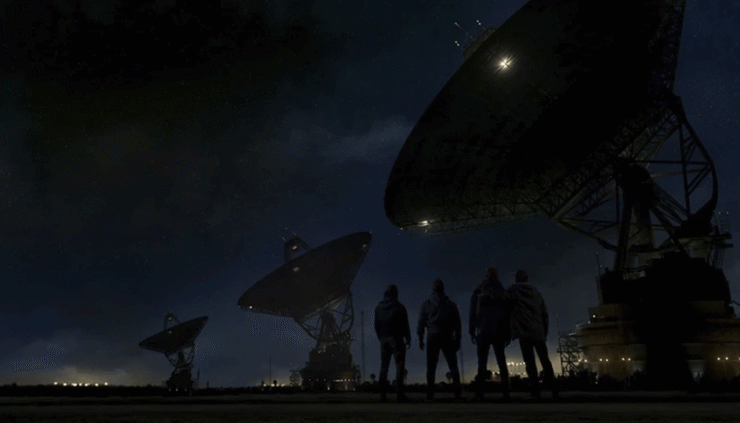
Credit: Elliander Pictures
Comment
0
Share New
Share
Credit: Elliander Pictures
Cosmos (2019) Written and directed by Elliot and Zander Weaver. Starring Tom England, Joshua Ford, and Arjun Singh Panam.
When I picked the theme for this month’s film club, I didn’t know it would coincide with a few weeks when the “low budget” films Backrooms and Obsession are big news in the film world. Of course, what counts as “low” is extremely subjective, but I do think the success of those films—with budgets of $10 million and $750,000 respectively—is generating some interesting conversation about what movies actually cost to make, why horror is almost always a good bet, who gets paid and who doesn’t when films succeed, and where all the money goes in movies that cost a lot more.
On the other hand: That’s still more money than most people in the world will ever have access to. I could buy a very nice house with $750,000! (Even in Portland!) Most people can’t just decide to make that movie—and they don’t. Most filmmakers don’t start with Hollywood’s idea of “low budget,” not even those touted as breakout success stories. Just a couple of years ago, Curry Barker, the director of Obsession, made a slasher film for a few hundred bucks, and of course Backrooms director Kane Parsons made an entire series on YouTube before Hollywood came calling. We don’t have to dig very deep to find out what kind of films people make when all they have access to is a cheap camera and some editing software.
And maybe their dad’s station wagon.
Filmmakers Elliot and Zander Weaver are brothers from the English city of Birmingham. They’ve been making movies since they were kids, and when they finished secondary school they decided to get into the business for real. Unfortunately for them, the kind of movies they love are big, earnest sci fi films; in one interview they cite E.T. (1982) as a formative influence. Those types of movies do not generally lend themselves as well to ultra low budgets as found footage, slashers, or even arthouse films do.
The Weavers wrote a script for a film called Encounter and spent a few years trying to get it made, but nobody wanted to risk a few million pounds on unknown filmmakers. While they were shopping it around, they created a small production company and did work making science and history documentaries for television. After a couple years of hearing “we’ll give you money to make a feature film after you’ve proven you can make a feature film,” the Weavers found themselves thinking: If Robert Rodriguez could make El Mariachi (1992) for a few thousand dollars with an amateur cast, then wasn’t it worth it to try?
So they brainstormed a film that would fit inside the constraints of their situation. What did they have? A Blackmagic Pocket Camera with 1080p resolution. A mom with work experience in TV hair and makeup. A bunch of computer equipment. Their dad’s station wagon. A friend with a garage they could turn into a makeshift soundstage.
And a lot of patience. You need a lot of patience if you want to make a movie with no money. Their crew contained all of five (5) people: the Weavers, their mother Lesley Weaver for hair and makeup, composer Chris Davey for the soundtrack, and two credited production assistants. (Their father wanted to help out as well, but he sadly passed away before filming began.)
That was the whole crew. The Weavers handled everything else. Writing, storyboarding, set building, directing, filming, editing, color grading, sound design, visual effects, everything. From their interviews, it sounds like it started that way because of necessity, as they couldn’t afford to hire anyone even though they knew professionals in the industry, but over time it became an exercise in learning the ins and outs of every aspect of filmmaking.
That made certain parts of the production terribly inefficient. For example, the majority of the film takes place inside a car parked in the woods at night. Going out to film in the woods would be difficult and inconvenient, so they borrowed a garage from a friend to use during the daytime as a sound stage for their scenes inside the car. But the car they use in the film is a family car, their family car, which means they were driving it to and from that garage every day, which means they had to set up and break down the interior set every day they were filming.
I didn’t know any of that before I watched the movie. All I knew was that Cosmos comes up when people talk about micro-budget sci fi films and its title makes it very difficult to research online. I suspect that knowing how and why it was made might have changed how I watched it, although the problems I have with the film aren’t in the production, which looks and feels quite clean and professional, but in the writing, which has some rather annoying fumbles.
Cosmos is about three amateur astronomers who go out to the woods for what they think will be a normal night of stargazing. All three work in the aerospace industry; Harry (Joshua Ford) and Roy (Arjun Singh Panam) are former colleagues, while Mike (Tom England) is tagging along in hopes of proving that his data processing system for radio telescopes is good enough to convince his company to extend his project funding. They set up their telescopes and settle in for a night of observation and data collection.
[Note: My personal knowledge of the U.K. aerospace industry is limited to that one time I did a gin tasting at a small distillery located within the SaxaVord satellite launch facility on Unst (the northernmost of the Shetland Islands), so I have no idea if any of those establishing details are believable or realistic. You could tell me anything about the U.K. aerospace industry and as long as it’s not as weird as making gin at a spaceport on Unst, I’ll believe it.]
Mike picks up a curious signal on his umbrella-sized radio telescope (I think the prop is an actual umbrella), one that falls right into the “water hole” of radio frequencies between 1420 Mhz and 1666 MHz where cosmic noise across the universe is relatively quiet. Even though the signal doesn’t seem to be much of anything, he replies to it with a sort of half-serious “Welcome to Earth” message. Meanwhile, a satellite that Roy is tracking seems to blip out of view for a few seconds, but they chalk that up to machine error and move on.
All three become more interested when Mike’s message is returned to them in a creepily distorted format. They go through all the possibilities—signals bouncing back and so on—in an attempt to find a simple explanation, but nothing quite fits. Mike calls a colleague (played by Ben Vardy) at a nearby radio telescope array to find out if anybody else is seeing or hearing anything strange, but nobody else is picking up anything. These three guys seem to be the only people in the world receiving this message.
This is where the film’s story starts to run into a bit of trouble. There are some pacing problems before this point, and some of the characterization comes across as a bit awkward, but none of those are serious problems. I was very much engaged during the whole series of scenes from Mike first picking up a strange signal, all the rational ideas and tests to explain it away, and finally realizing nobody else is hearing it.
The problem is I was engaged because it’s weird, and I like weird. It’s weird that amateur astronomers can hear something that a whole radio telescope array located just a few miles away (close enough to get there within a twenty-minute drive, anyway) can’t hear even when they are listening to the exact same frequency at the exact same time. It’s weird that a satellite disappears from view. It’s weird that the return message is distorted and disjointed. It’s weird that something damages Mike’s computer setup.
All of that led me to think there was something strange and uncanny going on. Maybe something that was, for some reason, focused on these three guys. That feeling was bolstered when the guys do some astronomy things to get a better signal, which involves Roy and Harry going out into the woods in a sequence that is filmed to be deliberately creepy. I genuinely thought the movie was setting up some kind of close encounter in the woods or some other spooky twist.
Alas, that was not the case. The movie set up Chekhov’s gun (or Chekhov’s alien encounter in the forest?) and utterly failed to fire it. As soon as it became clear the movie wasn’t going to use all that setup, my interest pretty much vanished.
The guys figure out there is another signal along with the spooky remix of Mike’s message. It’s a binary signal that they quickly realize is a response to the Arecibo message, a binary signal sent from the Arecibo Observatory in 1974. They also figure out that Roy’s satellite is vanishing from sight because something in closer orbit is blocking it. And, finally, Mike’s colleague confirms that other people around the world are noticing something strange too.
The final twenty or thirty minutes of the film devolve into an extremely silly and wholly unnecessary race to preserve their discovery before power runs out. Nothing about it makes any sense, they waste so much time for no reason, and the stakes of needing to prove they heard the signal first feel extremely ridiculous in comparison to the entire world now knowing there are aliens up there. It’s a disappointing climax for a film that really did create some nice set-up along the way.
I always try to watch movies on their own terms and interpret them for what they are rather than what I wish they would be. But, man, I can’t help but feel like Cosmos squandered an opportunity to be something else. The parts of it that are really quite good are those that involve setting up a spooky space mystery that three smart but otherwise ordinary guys are encountering alone in a dark, claustrophobic setting. The film prior to the climax isn’t perfect, but if the payoff had been something strange and unexpected, something unique to the characters and their nerves on that one night, I really would not have minded the other flaws.
Learning that the movie began life as a proof-of-concept project for the filmmakers to learn the craft doesn’t excuse the disappointing story climax, but it does put a lot of those choices into context. I just wish the story had taken a bolder, weirder direction there at the end, one that gave us a satisfying payoff for the tension that builds quite nicely when the characters are trying to work out what’s going on.
Poking around online, it looks like the Weavers have some more micro-budget sci fi projects in various stages of production, including a film that seems to be a combination of folk legends and UFO visitation, which they shot the old-fashioned way on 16mm film. It looks like a lot of fun, with an enticingly eerie atmosphere, and I’ll be keeping an eye out for it. I’m very curious to see how their filmmaking and style evolve through different movies.
What do you think of Cosmos? And about this particular type of sci fi film that comes from a couple of people with a camera and not much else?
Next week: We’re heading around the world to watch an example of micro-budget Japanese nagamawashi film—movies that are edited to look as though they are made in a single long shot. Watch Beyond the Infinite Two Minutes online.[end-mark]
The post <i>Cosmos</i>: Stopping By Woods on a Momentous Evening appeared first on Reactor.








 New Posts (Home)
 ChatBox
 Popular Posts
  Game Zone
 Top PodCasts