reactormag.com
Five Anime for Fans of John Carpenter
Column
Anime Spotlight
Five Anime for Fans of John Carpenter
From wise-cracking antiheroes to shapeshifting aliens to dystopian hellscapes…
By Leah Thomas
|
Published on June 18, 2026
Credit: Madhouse
Comment
0
Share New
Share
Credit: Madhouse
In 2026, John Carpenter isn’t making movies. Instead, he’s doing everything else.
He’s attending conventions, scoring FPS video games, or touring with his synthesizer. He’s working on comic books with accompanying heavy metal albums. He’s watching sports and playing video games.
This all… sounds about right. John Carpenter is the kind of creator whose appeal has always been tough to pigeonhole, based at least in part in his ability to combine the bizarre and unusual and the totally mundane in unique and unlikely ways. Sure, you can clock a John Carpenter film immediately based on the font and synth alone, but beyond that, his movies run the gamut when it comes to content and genre. Carpenter isn’t precious about his legacy. In interviews, he’s joked that he’s happy for anyone to make remakes of his films so long as he gets paid for it—what’s better than getting paid for doing nothing? Besides, he’s made a remake or two himself.
But a legacy he has cultivated all the same—it can be hard to quantify the impact one odd-duck director has had on pop culture across the past 50 years, but Carpenter has certainly left his mark in a number of ways.
I think it’s safe to wonder whether a bit of overlap exists between John Carpenter’s legions of fans and anime otaku: Frenetic energy and overblown sci-fi concepts exist happily in both spheres. So if you’re a diehard fan of Halloween but haven’t watched much anime, or if you love Shinichirō Watanabe but haven’t been exposed to the wonderful world of weird ’80s films, consider these humble suggestions for an eclectic Carpenter/anime cultural exchange…
For Fans of Big Trouble in Little China — Space Dandy
Credit: Bones
While most Watanabe fans will point straight to Cowboy Bebop when asked to recommend a Space Western, that’s not today’s assignment. Carpenter has a long-abiding admiration for Westerns that manifests in his soundtracks or in his lawless main characters, but he’s never actually made an actual Western. Instead, he sticks Wild West types into other genres and puts them to work. Jack Burton is a trucker, not a cowboy, but he’s certainly found himself in a new frontier.
Big Trouble in Little China is great, but much of that greatness comes down to it being completely goofy. And the goofy sibling to Cowboy Bebop is Space Dandy.
A self-proclaimed alien hunter, Dandy spends his days searching for rare species so he can collect a bounty and enjoy his time at his favorite space Breastaurant. Dandy is not a heroic character, but he tends to find himself at the center of all kinds of action. Over the course of the series, he casually explodes entire planets by mistake, gets turned into a zombie (along with the rest of the universe), accidentally travels billions of years into the future, and opens up a black hole or two. All of these things weigh on him no more than another morning commute, and this isn’t because he has hidden depths: Dandy is incapable of introspection. Dandy has to be a joke, even till the end when the universe is destroyed and he turns down an offer to become the god of a rebooted universe. He’s just a dingus who wants to get paid and hang out at BooBies.
Because Dandy is ignorant of the terrors of the universe, he is immune to fearing them. Similarly, Jack Burton doesn’t have enough knowledge or curiosity about the underground world of sorcery and mysticism in Chinatown to fear it. David Lo Pan is not terrifying to Jack Burton; he’s an old weirdo with lightning fingers. Burton just wants his truck back. An underground society rife with ancient sorcery and immortal martial artists doesn’t really concern him, apart from that. He is reckless when it comes to participating in fights in the underworld beneath San Francisco and gets in the way of fights involving the movie’s real hero, Wang. Jack spends much of the movie’s climactic battle unconscious after he shoots the ceiling in an attempt at bravado and some debris falls on his head. “I’m a reasonable guy,” Jack says, “but I’ve just experienced some very unreasonable things.” At the end of the film, when offered the choice, he chooses his truck, not the girl.
The more I think about these two assholes, the more I think they are subversive as hell. Both skate by the abyss, sustained by swagger and sarcasm.
For Fans of They Live — Parasyte: The Maxim
Credit: Madhouse
“Why do we worship greed?”
They Live is memorable for many reasons. That one genius fight scene in the alley goes on forever, doesn’t it? And heck if one-liners like “I have come here to chew bubblegum and kick ass, and I’m all out of bubblegum” and “Life’s a bitch… and she’s back in heat” didn’t define an era. The plodding, steady soundtrack is a driving force, and the visual elements are unforgettable: those ghoulish, rubbery masks in red, white and blue, with those bared teeth and gleaming asterisk eyes; the billboards peeled back to reveal subliminal messaging in stark font: Obey, Consume, Stay Asleep. But arguably, it’s the eternally relevant message of They Live that remains its most potent and memorable aspect. The aliens in They Live hide among human beings and profit from a capitalist society that preys on the disenfranchised. And why should anyone believe the poor who protest in the slums of Los Angeles? The wealthy monsters already run the world.
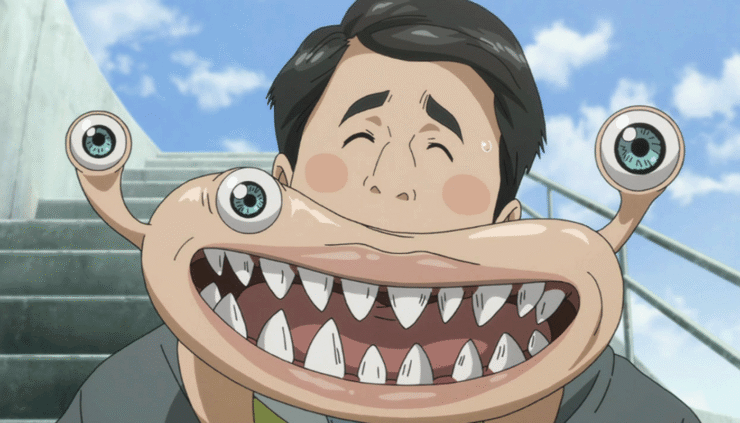
In Parasyte, a manga classic that began serialization in 1989, the aliens are already among us, too, wearing the bodies of salarymen and career women in 1980s Japan. Whereas They Live is directly inspired by the avarice of Reagan-era America, Parasyte began as commentary on human egotism and the conviction that human beings are superior simply because they eat everything else. Mangaka Hitoshi Iwaaki wanted to write a story in which human beings are no more important than any other species in the eyes of alien invaders.
When one alien parasite descends from the sky and attempts to infect a nerdy teenager named Shinichi, it fails to reach his brain because a headphone cable cuts off Shinichi’s circulation, trapping the parasite in his hand. The parasite—named Migi because he replaces Shinichi’s right hand—retains its own consciousness and the ability to reason with Shinichi, but lacks empathy for humanity. After all, do human beings empathize with their chicken dinners? A little, perhaps, with some coaxing… Migi informs Shinichi that other parasites have invaded human society, replacing the brains of their human hosts, and when they sense that Shinichi retains his human brain, the parasites will destroy them both. An unlikely partnership is born, and two disparate minds must cooperate in order to survive.
Although the aliens in They Live aren’t shapeshifters, the alien designs in Parasyte are highly influenced by monsters of Japanese folklore. The parasites can reshape the flesh of their hosts, malforming skulls into blades with eyes while leaving humanoid bodies intact. Arguably, it’s more reminiscent of The Thing than They Live, but thematically, They Live is the stronger comparison.
In They Live, alien invaders are an analogy for the dehumanizing nature of capitalism. In Parasyte, alien invaders inspire philosophical questions about humanity and empathy. Differences aside, both of these ’80s classics plead with viewers to question the tiny monstrosities and casual inhumanity we normalize every single day.
For Fans of The Thing — To Your Eternity
Credit: Brain’s Base
While there are certainly more egregious examples of shows that completely squandered a great start (staring at you, The Promised Neverland), it’s no secret that To Your Eternity promises its audience more than it can deliver. Even so, dizzying ambition and a harrowing pilot episode have kept it on my mind. I feel as though author Yoshitoki Ōima watched The Thing and wondered, “What if said Thing lived long enough to become an actual person?”
The Thing is the closest thing to a perfect film that Carpenter ever made, and To Your Eternity exemplifies flawed execution, but they are kindred spirits. Both stories begin in an isolated tundra. In The Thing, an alien entity mutates the body of a dog at a research facility; in To Your Eternity, an alien entity transforms into a wolf and becomes companion to a boy left alone in an abandoned village. In both, the alien can adopt the appearance of other creatures it makes contact with. While this is used to scale superb heights of horror in The Thing, in To Your Eternity this ability is used to reinterpret grief. The boy cannot escape the snow, and when he dies alone in his hut, the thing takes on his appearance and lives on in his place, immortalizing a human being who otherwise would have been forgotten. The Thing is a creature that cannot learn empathy; Fushi, the immortal at the center of To Your Eternity, must do so to find purpose in its existence. Somehow, pairing these two stories creates a means for exploring two very different angles of a classic sci-fi trope.
For Fans of Halloween — Monster
Credit: Madhouse
Halloween is widely considered the prototypical slasher film. Upon its release in 1978, the concept of a horror franchise being centered on a serial killer did not exist. It is easy to dismiss the franchise now, given how many terrible sequels have diluted its impact, but even that—the idea that one horror movie would spawn decades of profitable sequels—was groundbreaking. Michael Myers stalked so Freddy Krueger could claw and Jason Voorhees could slice.
“Slashers” in the colloquial sense do appear in anime sometimes, but usually within the context of a wider story. There are serial killer plotlines in several seinen series—Durarara!!, Erased, and Psycho-Pass come to mind. But in general, horror in an anime context manifests much differently than it does in many American films. Usually, there’s a supernatural element to the violence. While that’s true for slasher films in general, it’s important to remember that Halloween was devoid of ghosts or magic. Michael Myers is terrifying because he is an actual person, not a creature. In that first film, he has fewer than ten minutes of screentime, but his presence looms large over that suburban neighborhood.
Serial killer horror, to be effective, has to practice the art of restraint. Anime is not especially known for this.
But Monster is not like most anime. Written by award-winning mangaka Naoki Urasawa, it has been admired on an international scale, receiving accolades such as the Tezuka Award and multiple Eisner nominations. The story’s chief antagonist, Johan Liebert, does not need to appear in most episodes to make his impact felt. He manipulates others from the shadows and torments our protagonist, the disgraced surgeon Dr. Tenma, by surrounding him with disaster. Dr. Tenma made the mistake of saving Johan Liebert’s life when he was a boy, not realizing he was saving the life of a calculating psychopath.
The psychological terror in both Halloween and Monster can be distilled as follows: the most terrifying monster of all is man, and also? All men were once children. Michael Myers, subject to apparent abuse (though that’s not apparent in the original film), killed his own sister. Johan, a born murderer, killed his own parents in front of his twin sister. Both men revisit the sources of their childhood torment in order to wreak chaos upon them.
It’s hard to explain how very different Monster feels from virtually every other anime, even twenty years on. Like Halloween, it set a new standard for what horror stories could accomplish.
For Fans of Escape from New York — Blood Blockade Battlefront
Credit: Bones
Say what you will about the terrible disappointment that was Escape from LA, but Snake Plissken is one fabulous guy, and Escape from New York is one fun film. The concept is a bit ludicrous—in the far-flung future year of 1997, Manhattan is no longer a city, but a high-security prison. Some convicts have managed to hijack Air Force One and trap the president! Since this is a work of fiction unrelated to our current reality, in the context of the movie, the president is a guy that has to be saved. Snake Plissken is a special agent with an eyepatch and an attitude, and he’s breaking into Manhattan on a rescue mission.
In another vision of New York, a deity pierces an interdimensional rift and exchanges some kid named Leo’s eyes for god-tier weapons at the cost of his sister’s sight; it’s not a great deal for anyone. This New York, renamed Hellsalem’s Lot, isn’t full of convicts, but it is pretty damn lawless. A new population of paranormal immigrants from the Beyond have moved in and reshaped the boroughs. Our boy Leo joins up with a crew of oddball investigators known as Libra and helps them take care of the conflict that inevitably arises in a vibrant city going through a major cultural shift.
Created by Trigun mastermind Yasuhiro Nightow, Blood Blockade Battlefront is a show that’s grounded in a specific, if slightly unconvincing, setting. Escape from New York was not filmed in New York, and it took a lot of clever camera work, matte paintings, and models to sell the illusion that it was. Blood Blockade Battlefront was created not by a New York native, but by an enthusiast from afar who probably watched movies like Escape from New York in his younger years. Don’t we all have an illusory vision of New York and other major cities, informed by art and media and diluted endlessly by other creators and their works, that we never replace until we finally visit the places and see them for ourselves?
Both Blood Blockade Battlefront and Escape from New York rely on settings that balloon out of control but remain grounded by compelling characters and a sense of unexpected playfulness. And both of these stories pay homage to a city that is endlessly inspiring new and unlikely ideas.
John Carpenter isn’t making movies anymore, and that’s a shame, though we can certainly enjoy whatever else he decides to make in the meantime, too. While his unique brand of filmmaking—slapdash and dark and strange and, well, pretty great—is hard to imitate, it’s good to know that when it comes to telling stories that toe the line between weird horror and timeless camp, anime has us covered.[end-mark]
The post Five Anime for Fans of John Carpenter appeared first on Reactor.








 New Posts (Home)
 ChatBox
 Popular Posts
  Game Zone
 Top PodCasts