reactormag.com
The Black Cauldron: The Dark Fantasy Disney Tried to Bury
Column
80s Fantasy Film Club
The Black Cauldron: The Dark Fantasy Disney Tried to Bury
Intrepid young adventurers, a bard, some witches, and a bit of necromancy — how did this adaptation go so wrong?
By Tyler Dean
|
Published on June 23, 2026
Credit: Walt Disney Studios
Comment
0
Share New
Share
Credit: Walt Disney Studios
In this column, we’re looking back at the 1980s as their own particular age of fantasy movies—a legacy that largely disappeared in the ’90s only to resurface in the 2000s, though in many ways, the fantasy films of the Eighties are far weirder and less polished than what we got in the aughts. In each of these articles, we’ll explore a canonical fantasy movie released between 1980 and 1989 and discuss whatever enduring legacy the film has maintained in the decades since.
For a more in-depth introduction to this series of articles, you can find the first installment here, focusing on 1981’s Dragonslayer. Last time we looked at Terry Gilliam’s beloved flop The Adventures of Baron Munchausen; this time we’re delving into a flop the studio tried to memory-hole out of existence with 1985’s surprisingly dark (at least for Disney) adaptation of The Black Cauldron.
I first saw The Black Cauldron in my late twenties on a friend’s burned DVD that also contained its fellow Disney lost-media film, Song of the South (1946). Seeing them in a double-feature was a fascinating exploration of the varied reasons Disney might try to erase the existence of one of its movies (more on that later). Despite obvious differences in the time these films were made, the propriety of its content, and the quality of the filmmaking, the pairing made intuitive sense precisely because of Disney’s infamous aversion to acknowledging and distributing either film. We’ll get into some of that minutiae further down in the article as we discuss its legacy, but that first viewing was, for me and likely for many millennials, accompanied by the added thrill of seeing something the world’s most powerful children’s entertainment company didn’t want you to see…
The film was adapted from the first two of Lloyd Alexander’s beloved Chronicles of Prydain novels (1964’s The Book of Three and 1965’s The Black Cauldron) which follow the adventures of a young swineherd, Taran, in a fantasy kingdom that draws heavily on Welsh mythology. The film begins with the pig-keeper who, despite his desire to become a storied warrior, is saddled with the care of Hen Wen, a pig with the ability to impart visions of the future and secret information to those who beseech her. After learning that the Horned Lord, a vicious despot, seeks Hen Wen in order to discover the location of the Black Cauldron—a lost artifact of terrifying necromantic power—Taran is sent away to find the Cauldron before the Horned Lord can.
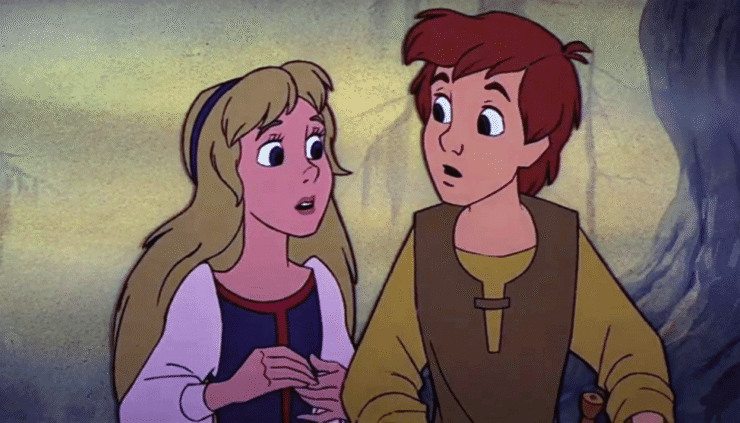
He is almost immediately captured by the Horned Lord but is freed from captivity by the intervention of Princess Eilonwy and the aging bard, Fflewddur Fflam. They search for Hen Wen while the Horned Lord and his comic-relief goblin lieutenant, Creeper, pursue our heroes in the hope that they will lead them to the location of the Cauldron. Along the way, Taran and company befriend Gurgi, a cowardly, thieving were-terrier with a penchant for obvious and amusing lies, and Doli, a grumpy, long-suffering faerie. Hen Wen is found and kept hidden and safe by the Fair Folk while our heroes follow her prophetic advice and confront the three witches who hold the Cauldron in their swampy cottage.
After Taran trades away his magic sword, our heroes obtain the Cauldron but are told by the witches that it cannot be used unless it receives a willing blood sacrifice. The Horned Lord’s men show up and bring the Cauldron back to his castle where they proceed to use it to raise an army of the dead. Gurgi sacrifices himself to stop the Cauldron and the Horned Lord is dragged into the Cauldron and consumed, as his castle collapses around them. Taran bargains with the witches, demanding that Gurgi be returned to life in exchange for the Cauldron and everyone journeys home, happier and wiser.
The film was, as previously stated, a massive flop, grossing $21 million against a budget that the film’s production manager cited as being more than twice that amount. It’s often referred to as “the film that almost killed Disney” and was considered to have permanently marred the reputation of the media empire’s animation department—a legacy only reversed by the storied success of The Little Mermaid four years later, ushering in the Disney Renaissance. It is for this reason that The Black Cauldron gained its reputation as a lost-media phantom (even if that wasn’t really the case). I was shocked to discover that it had, in fact, been released on home video a few different times in Disney’s history. The catch is that it took thirteen years for it to be released the first time—it wasn’t released on VHS in the UK until 1997, and in the US the following year.
But has absence made the heart grow fonder? Is The Black Cauldron a misunderstood masterpiece or does it live up to its reputation as Disney’s worst animated film? The short answer is that it’s neither of those things. It’s pretty bad, but it’s not necessarily worse than other Disney fare from the era—The Fox and the Hound and The Rescuers may be your personal favorites but from an objective standpoint they are equally uneven and, box office take aside, I don’t see much of a difference in overall quality.
What The Black Cauldron is, above all else, is boring. Its scenes are long and often dialogue heavy, committing that cardinal sin of telling rather than showing. Had it been a musical, some of these scenes of exposition might have been replaced by songs (and, in a movie that has a bard as a central character, they had a built-in device for including musical elements). As it stands, Taran spends a lot of time declaring what he wants and relatively little time taking actions that reflect or further those desires. It’s also worth noting that Taran kind of sucks. He’s venal, whiny, and conflicted about his duty in a way that makes him seem profoundly selfish. In my article on Labyrinth, I discussed how great it is that Sarah is allowed to be a snotty teenager, warts and all. That might have been the aim here but the writing and performance really don’t sell it. When Taran gives up his magic sword to obtain the Cauldron and uses his only wish to bring Gurgi back, it should seem like growth but it feels jarringly out of character instead.
There are better characters. Stalwart British stage actor Nigel Hawthorne is charming and warm as the bumbling bard, Fflewddur Fflam and John Byner’s Gurgi brings some much-needed humor to the otherwise dull proceedings. Towering over this is John Hurt’s performance as the Horned Lord. The design of the character is somewhat darker and more intense than you’d expect from typical Disney fare, but without Hurt’s raspy growl bringing him to life the villain could be dismissed as a slightly more menacing Skeletor. Hurt imbues the character with a sense of real dread and a slightly effete, wry quality that is perfect when he’s called upon to deliver lines like “I presume my boy, that you are the keeper of this oracular pig.” The film works at all because Hurt makes the Horned Lord scary enough to carry most of it. That’s more than can be said for a trio of fairies voiced by children who were so unintelligible that I had to turn on the subtitles to follow the scene.
The animation remains beautiful as always. There is a gritty depth of detail that makes Prydain feel lived in, impoverished, and frightening in a way that few Disney films manage to achieve. There are no shortcuts taken with its (mostly) hand-drawn animation, and the film is notable for being one of the first Disney features to incorporate computer-generated imagery to create certain effects. When Eilonwy first shows up, she brings her glowing “bauble”—a will-o’-the-wisp-esque glowing sphere that the film never explains—and the complicated shadows it casts around the room are subtle, spectacular, and realistic in a way that speaks to the level of the animators’ artistic talents.
But, as with Eilonwy’s bauble, a lot of helpful context and basic information seems to have been left out of the film, despite being so diligently animated. Fflewddur Fflam has a magic harp whose strings break whenever he tells a lie, but the film never explains this, and so it just seems like his harp malfunctions often. The titular Cauldron is powered by corpses being brought into the Horned Lord’s castle from the sites of recent battles, but that has to be learned through inference. Much of this might be attributable to then-studio chairman (and future Dreamworks co-founder) Jeffrey Katzenberg personally excising twelve minutes out of the final film. Some of those cut minutes contained scenes from the climax deemed too scary for children, but others were reported to be extended dialogue. I know that I complained about there being too much exposition earlier, but having zero explanation for certain elements makes the film feel unfinished.
Lloyd Alexander stated, in one of the most withering backhanded compliments ever, that “there is no resemblance between the movie and the book. Having said that, the movie in itself, purely as a movie, I found to be very enjoyable. I had fun watching it. What I would hope is that anyone who sees the movie would certainly enjoy it, but I’d also hope that they’d actually read the book. The book is quite different. It’s a very powerful, very moving story, and I think people would find a lot more depth in the book.” Respectfully, however, I disagree. This movie is not very enjoyable.
So did this film leave behind a legacy at all? Given how consciously it was memory-holed for the majority of my childhood it seems unlikely. This brings us back to my experience of the double feature that paired it with Song of the South. Despite being the clearly less palatable (and, obviously, far more racist) of the two films, Song of the South became part of the indelible fabric of the Disney brand. Removed from its original context, “Zip-A-Dee-Doo-Dah” became a beloved tune used across tons of Disney media. Up until 2023, Disneyland’s iconic log flume ride, Splash Mountain, was themed around the adventures of Brer Rabbit and Brer Bear long after the film had been removed from distribution.
By contrast, The Black Cauldron was all but ripped from the Disney brand, root and stem. Tokyo Disney had a Black Cauldron-themed walkthrough attraction that was open from 1986 through 2006, but that was the only direct evidence of its existence in Disney parks or merchandising until its home video release in 1998. But, even if it did not receive the sort of support from the Disney Empire that most of their other films receive, it did continue to influence some of their later movies. I’m fairly certain that some of the animation for Creeper was recycled for Fidget, the similarly unctuous bat sidekick of the villainous Ratigan in The Great Mouse Detective (1986). More notably, the designs of the Horned Lord’s bandits and mercenaries were mined for the far more comical ruffians in Disney’s 2010 retelling of Rapunzel, Tangled.
Outside of the Disney canon, Andy Serkis’ performance of Sméagol in Peter Jackson’s Lord of the Rings films often feels directly inspired by John Byner’s portrayal of Gurgi—both sound like a more intelligible, slyer, and less wrathful take on Donald Duck. Serkis maintains that Sméagol’s voice was based on the sound of his cat coughing up a hairball but it seems impossible that a little bit of Gurgi wasn’t lurking in the back of the mo-cap maestro’s throat. And hey, The Black Cauldron hired John Huston as the narrator for its opening prologue, in what seems like a direct reference to the Rankin/Bass Hobbit film, so it all comes full circle anyway….
But what do you think? Did you see The Black Cauldron in theaters? Did you, like me, grow up during through its long penance, locked away in the Disney Vault? Or was this part of your childhood rotation? Let me know your thoughts on this (or anything else about the film) in the comments! And be sure to join us next time when we move from a lackluster take on Welsh mythology to a much more coked-out adaptation of Welsh myth and legend with John Boorman’s glittery, glamorous Excalibur (1981)![end-mark]
The post <i>The Black Cauldron</i>: The Dark Fantasy Disney Tried to Bury appeared first on Reactor.








 New Posts (Home)
 ChatBox
 Popular Posts
  Game Zone
 Top PodCasts