reactormag.com
Bored of the Swords: The Rebirth of Sword & Sorcery and the Death of the Weird
Books
Sword and Sorcery
Bored of the Swords: The Rebirth of Sword & Sorcery and the Death of the Weird
S&S is making a comeback in a very narrow way — we need to restore the genre’s essential weirdness.
By Cynthia Ward
|
Published on June 23, 2026
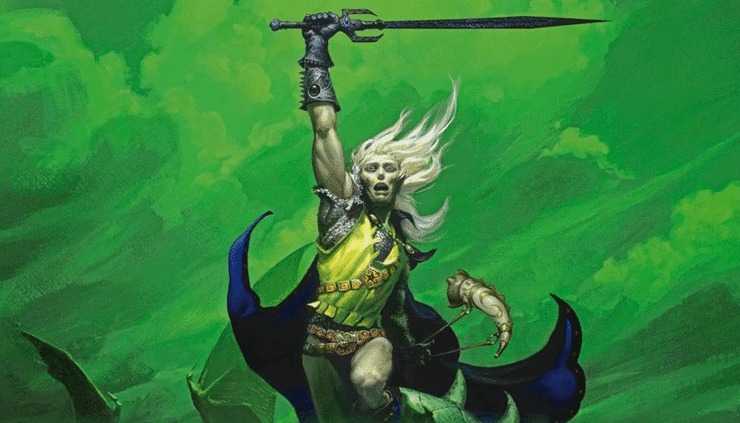
Stormbringer cover art by Michael Whelan (S&S/Saga Press, 2022)
Comment
0
Share New
Share
Stormbringer cover art by Michael Whelan (S&S/Saga Press, 2022)
Recently, I sent my best friend a text stating “SiriusXM is reminding me how boring I find grunge.”
Do I find grunge boring? No, in fact, I do not.
That wasn’t, per se, my point. My point, which I knew the BFF would understand, is that the grunge sound completely dominates what is now labeled alternative rock. One can spend hours on the SXM app listening to their contemporary alternative channels and never realize that synthesizers were once an important element of modern rock, or that New Wave, punk, ska, goth, jangle pop, neo-swing, EDM, and a couple of dozen other subgenres used to appear regularly on Rock of the ‘80s/’90s radio stations.
The term “alternative rock” was coined for DIY/indie rock music in the ‘90s, when grunge was exploding. In response to the boom, major labels signed grunge acts and put the squeeze on established acts to sound grunge, even as performers inspired by the nascent genre formed or became grunge bands. Of course, the more the grunge sound dominates alternative music, the more alternative fans lose access to other sounds, in a feedback loop which can sometimes turn listening to Lithium and the contemporary altSXM channels into a chore.
So, in a world throttled by algorithmic manipulation and trend simulation, you can imagine this old-school sword & sorcery fan’s pleasure at discovering the 21st century revival of S&S, which had almost disappeared during the epic fantasy boom of the ‘80s and was now returning from the edges.
I am thrilled to discover there is so much great new sword & sorcery out there. Excellent new work from 21st-century authors like Milton Davis and Bryn Hammond and Dariel R.A. Quiogue and many others. Excellent new work from Second Wave veterans like Glen Cook and Michael Moorcock and David C. Smith and others. And, as the late skald of speculative fiction, Poul Anderson, hoped in his classic essay “On Thud and Blunder” (Swords Against Darkness III, 1978), the new S&S is “drawing [more] inspiration from other [i.e., non-European] milieus—Oriental, Near Eastern, North and Black African, Amerindian, Polynesian, an entire world.”
I’m pleased to see S&S has gotten more diverse since the mid-twentieth century.
I’m less pleased to see that it’s also gotten less diverse since the mid-twentieth century.
By “less diverse,” I mean that the definition of S&S has considerably narrowed.
I began reading and writing S&S mid-century because, damn, was it weird! S&S prose and comics had barbarians and Amazons and nomads. Sorcerers and witches and priests. Mercenaries and pirates and thieves. Demons and gods and dinosaurs. Peasants and princesses and kings. Elves and dwarves and mer-folk. Bards and spear-women and serial killers. The disabled and the maimed and the accursed. And any of these characters could have a starring role, and many of the stars occupied more than one category (most famously, Elric of Melniboné, the disabled nonhuman prince granted strength by a demonic sword, and Conan of Cimmeria, barbarian, thief, mercenary, pirate, king, and more). The star might even be a cat (Mark E. Rogers’s Samurai Cat) or an aardvark (Dave Sim’s Cerebus the Aardvark).
Visions of a space-faring future might be glimpsed, as in Marvel Comics’ Conan the Barbarian #1 (1970), or a character might pass back and forth between our modern world and a mystic realm—and between different ages of her own body—as DC Comics’ Amethyst, Princess of Gemworld does. An alien might fall to earth, as in Robert E. Howard’s Conan story “The Tower of the Elephant” (1933; adapted by Marvel Comics twice in the 1970s), or in Clark Ashton Smith’s tale “The Beast of Averoigne” (1933). A romance might transcend time, as does that of Conan and 1970s cab driver Danette in What If? issue #13 (1978). Eldritch Lovecraftian horrors might intrude (or worse), as when John Jakes’ Brak the Barbarian faces Yob-Haggoth, or Richard L. Tierney’s gladiator/mage Simon of Gitta (a.k.a. Simon Magus) deals in matters both Mythic and Gnostic. An elf’s quest might meet with another elf hatching from an egg (“Weirdworld,” Marvel Super Action #1, 1976). And the visuals could get distinctly trippy, as evidenced by Eerie Magazine’s recurring adult comic El Cid.
No wonder S&S in the ’70s and early ’80s—like fantasy and science fiction more generally in that era—was read predominantly, if not exclusively, by freaks and geeks.
No wonder I loved it.
And, given that the modern S&S revival is arising from the margins and is still largely an underground scene, I expected a return of that old-school unpredictability.
But it turns out that with S&S, as with alternative rock, things have grown distinctly less loosey-goosey.
Now, I very much doubt the operating logic of the modern S&S reader, viewer, or creator is “let’s be more formulaic!”
But I do have to wonder what’s going on when I encounter increasingly narrow definitions of S&S being increasingly prescribed or enforced.
When I see so many arguing in online fora that “real” S&S just simply cannot have epic scale, or nonhuman sentient races, or a quest, or too much magic, or any element that might suggest science fiction instead of fantasy.
When it seems like almost every new character is a warrior.
Who is almost inevitably whole and able-bodied.
Who is frequently a barbarian.
Who typically wields a sword.
And who usually has a straight white cisgender male identity.
At this point, what is weird?
Nothing.
And I haven’t even touched on the latter-day arguments I’ve seen—rare but there—that S&S is a man’s literature; nor touched on the new-zine editorial which describes S&S in “chest-thumping” warrior terms and tells fans we “follow in the footsteps of great men” (Battleborn #1, ARC, forthcoming May 2026); nor touched on a recent how-to-write-S&S handbook (Arcane Arts and Cold Steel: Writing Sword-and-Sorcery Fiction by David C. Smith, 2025) which explicitly dismisses the entirety of the female-writer-dominated Sword & Sorceress anthology series (34 volumes) as “only ostensibly sword-and-sorcery fiction”…
…Even though women have been writing S&S since 1934, when C.L. (Catherine Lucille) Moore introduced Jirel of Joiry, medieval ruler and woman warrior, in “The Black God’s Kiss” (Weird Tales, 1934). Moore’s Jirel adventures were, according to Wikipedia, “among the first sword and sorcery stories of any kind [and] introduced a female protagonist to the genre.” You can get some information on the series’ and the author’s original reception, often warm, and not only from men, at the critic Bobby Derie’s blog, On an Underwood No. 5.
Women have been involved with S&S ever since—and we did yeoman work to keep it alive, particularly in the droughts between pre-war pulp and the 1960s, and between the 1980s and the modern revival. Discussing every woman involved would require a far longer article (or, more accurately, a book), but I’ll mention four.
In the mid-twentieth century, Cele Goldsmith (later Cele Lalli), editor of Fantastic, took the uncommercial gamble of commissioning Fritz Leiber to resume his Fafhrd and the Gray Mouser series and “in so doing she improved the climate and conditions that allowed sword-and-sorcery to reach full flower later in the decade [1960s]” (“The Fantastic S&S contributions of Cele Goldsmith,” The Silver Key, 2021). The writer and editor Jessica Amanda Salmonson not only turned the historical woman samurai Tomoe Gozen into a classic S&S character and trilogy, but edited Amazons! (1979), which received the World Fantasy Award for Best Anthology in 1980, and Amazons II (1982), the first heroic fantasy anthologies to focus on female protagonists, which were also unusual in having a female majority of contributors; one contribution to Amazons!, Elizabeth A. Lynn’s “The Woman Who Loved the Moon,” tied for the World Fantasy Award for Short Fiction in 1980, in the same year that Lynn’s heroic fantasy novel Watchtower won the World Fantasy Award for Best Novel.
Reprehensible as she has turned out to be, the late writer/editor Marion Zimmer Bradley wielded enormous influence on S&S in the second half of the twentieth century. She created the once immensely popular Darkover planetary romance series, which influenced many later S&S writers. She also created Lythande, the cross-dressing bladeswoman/magician who originated in the first volume of the first modern shared-world series, Thieves’ World (launched in 1979), and is arguably S&S’s first major lesbian character. In addition, she edited the first twenty books of the female-centric Sword & Sorceress anthology series, with fourteen postmortem volumes appearing from other female editors; as well, she edited Marion Zimmer Bradley’s Fantasy Magazine, which also published S&S works.
Given that it was mostly women who contributed to MZBfm, Sword & Sorceress, and Amazons; given that the evidence indicates their audiences were female-majority; and given that many women writers were publishing S&S novels and series in the 1970s-1990s, I think it is fair to state that S&S was kept alive through the decades of the millennium-spanning drought predominantly by women and girls.
Yet in the current quest for “true” S&S, we see increasing efforts to exclude this entire population of practitioners and fans.
It’s ironic. When I first encountered S&S, the fan base was so tiny, newcomers were welcomed into the fold that helped us nonconformists survive and even thrive in a dominant culture which bluntly labeled us a deviant subculture…when, that is, the outsiders were being polite (this is not to say that every individual in the S&S world then was welcoming, but the overall vibe was). Now, in some quarters, S&S is quite ready to exclude some of its own in order to police an intensifying conformity.
These days, I find myself speculating about the iconic S&S character Elric of Melniboné, who was created by Michael Moorcock and who made his first appearance in the novella “The Dreaming City” (1961). An inhuman, antiheroic, multiverse-tripping, doomed albino princeling who is weak and effete, Elric is also a druggie, a fuck-up, and a demon-master and demon’s slave. Had he been introduced in the 2020s, I am convinced many would reject him out of hand as sword & sorcery.
From the available evidence, Joanna Russ’ pivotal S&S character, the assassin/thief/time traveler Alyx the Adventurer, was excised from S&S decades ago, despite a dalliance with Fritz Leiber’s beloved barbarian character, Fafhrd, in one of Russ’s stories and one of Leiber’s.
Manifestly, purity is overrated.
The fewer ideas and perceptions and influences you allow into the gene pool, the smaller it gets. And the smaller the gene pool, the weaker the population.
For the arts, homogenization leads not only to stagnation and retrogression, but boredom.
And if you think the pool’s not going to get any smaller, I’ve already witnessed an exclusion from S&S of the preeminent 21st-century S&S series, the Chronicles of Hanuvar, written by the late and much-lamented Howard Andrew Jones—who, as writer, editor, and critic, was the most important figure in modern S&S until his untimely passing.
To be clear, I’m fine with a definition of S&S that doesn’t want a lot of SF elements or a lot of grand fantasy quests or a lot of world-saving or multiverse-traveling. That’s reasonable. We want people to understand what we mean when we recommend something as S&S.
And I’m fine reading about white cisgender barbarian swordsmen. I’m currently reading Battlepug: The Compugdium, an omnibus graphic novel featuring exactly such a character. It’s a lot of fun—fun that respects and subverts and sends up the trope—and it embeds its lead, the Warrior, in a lot of weirdness.
What I’m not fine with is having one character type or one identity increasingly foreclose other possibilities.
I’m not fine with Jirel of Joiry and Cugel the Clever and Imaro of the Ilyassai and Tomoe Gozen and Corum Jhaelen Irsei and Alyx the Adventurer and Stalker and Jaisel and Tyndall of Klarn and Frostflower and Cutter Kinseeker and Dossouye and Paksenarrion Dorthansdottir and Sorren and Luc de Chaudronnier and Kerowyn and entire identities being excluded from the definition, practice, and history of S&S.
That’s even more boring than song after song grunging up my app feed.
With mass media now the dominant means of introduction to speculative fiction, I suspect many (if not most) S&S fans are introduced to S&S by the Conan and Red Sonja comics, movies, cartoons, and games. These have made Conan an archetype as well-known and influential as Tarzan, James Bond, and Sherlock Holmes. Which is wonderful! But it’s lost to later generations, just how weird a barbarian hero used to be. And it’s no surprise the newcomer to S&S would not only expect, but would in many cases demand, more barbarian swordsmen.
Barbarian swordsmen are a good starting place, to be sure; but they shouldn’t also be the ending place.
Sword & sorcery was, can be, and should be way weirder than that.
In the David Lynch movie Wild at Heart (1990), Lula Fortune observes, “This whole world’s wild at heart and weird on top.”
S&S was, and surely can again be, wilder and weirder yet.
If we restore S&S’s heirloom strangeness to the globally aware 21st-century S&S renaissance, we’re in for one hell of a time.[end-mark]
The post Bored of the Swords: The Rebirth of Sword & Sorcery and the Death of the Weird appeared first on Reactor.








 New Posts (Home)
 ChatBox
 Popular Posts
  Game Zone
 Top PodCasts