reactormag.com
Further Adventures in Classic, Quirky Anthologies — Galactic Empires: Volume Two
Books
Front Lines and Frontiers
Further Adventures in Classic, Quirky Anthologies — Galactic Empires: Volume Two
A second round of stories exploring power, politics, and survival… in space!!!
By Alan Brown
|
Published on June 23, 2026
Comment
0
Share New
Share
In this bi-weekly series reviewing classic science fiction and fantasy books, Alan Brown looks at the front lines and frontiers of the field; books about soldiers and spacers, scientists and engineers, explorers and adventurers. Stories full of what Shakespeare used to refer to as “alarums and excursions”: battles, chases, clashes, and the stuff of excitement.
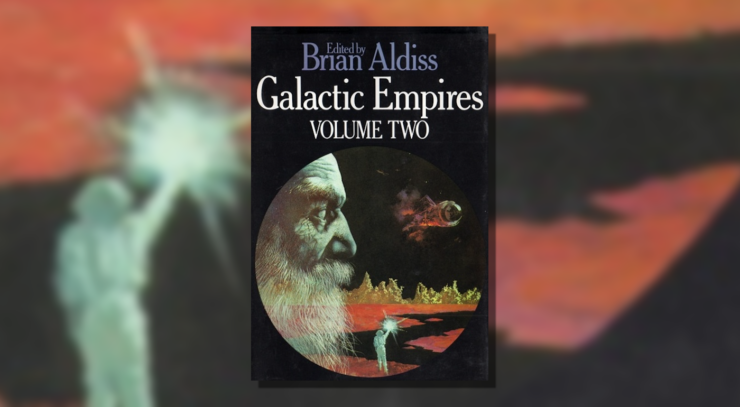
A few weeks ago, I reviewed a themed anthology, Galactic Empires: Volume One, edited by Brian Aldiss. It was a quirky anthology of interesting tales, and I found them so compelling that I immediately looked on the internet, found Volume Two, and ordered it. I acquired a copy in fair condition at a very reasonable price, only to find it lacked a dust jacket, and the copyright page had been torn out. I could live without the dust jacket, but the lack of copyright information means I have no insight into the original publication, which is frustrating. This new volume is very much a companion to the first, featuring a diverse mix of tales that range from fantasy to science fiction, and from thought-provoking to more visceral.
About the Author
Brian Aldiss (1925-2017) was a noted British author of science fiction and fantasy, who was also an editor, critic, and artist. You can find more on his career here, in my review of the first volume of this anthology.
The Rise and Fall of Great Powers
Humanity has long watched the flood and ebb of empires, as rulers have pushed to expand their control over wider territories, only to see those efforts inevitably come to naught as new empires supplanted the old. And as long as they have watched this process, scholars have argued how and why it takes place.
Over three decades ago, while I was doing graduate work in International Relations, I encountered The Rise and Fall of the Great Powers, a book by Yale professor Paul Kennedy. Having spent my youth reading science fiction tales that examined the grand sweep of history, and witnessing the static bi-polar stalemate of the Cold War teetering on the brink of change, I found his work fascinating. Before that, my scholarly reference point for the rise and fall of political systems were books like Edward Gibbon’s The History of the Decline and Fall of the Roman Empire, and Arnold Toynbee’s A Study of History. Kennedy’s work looked at history from a perspective that differed from those earlier scholars, who looked at rulers, treaties, and battles as determining national power. His thesis was that logistics and economic power decided wars, with the coalitions that developed the strongest economies generally prevailing. This showed the importance of nations building and maintaining strong and healthy economies, and also the importance of strong alliances.
Kennedy warned that nations with waning influence were prone to something called “imperial overstretch,” as changes in relative economic strength were generally not the result of their economies shrinking, but the economies of their rivals growing more quickly. Moreover, nations with waning influence had a tendency to ignore the importance of alliances, or take their allies for granted. As the Soviet Union fell, and as the United States has seen its relative strength diminishing after a series of inconclusive clashes in the Middle East, I have thought about Kennedy’s theories from time to time. And lately, the idea that the United States is in a state of imperial overstretch has become nearly impossible to ignore.
While reading fiction, I love tales where bravery and strife change the balance of history, but I have a feeling that the much more mundane world of commerce has greater power to shape our future.
Galactic Empires: Volume Two
I’m not going to give background information on every author in this anthology, but for those who might want more biographical information, where I have reviewed an author in this column before, I have tagged their name with a link to the latest of those reviews.
The “Introduction” to this volume discusses how editor John Campbell’s ideas contrasted with those of other magazine editors, who were often willing to have more fun with concepts like galactic empires. After the “Introduction,” the volume starts with a continuation of a section that carries over from Volume One, “Maturity or Bust.” The four tales that follow come under the heading “You Can’t Impose Civilization by Force,” which Aldiss introduces with an essay looking at the difficulties posed by building a civilization that spans stars.
The first story that follows, “Escape to Chaos,” by John D. MacDonald, is a showstopper, and one of the best in the collection. I had not realized MacDonald had written science fiction, having always associated him with mystery books, such as his series about the detective Travis McGee. This story gives us a battle between a decadent emperor, Shain, and his son, Andro, which reminded me of the biblical tale of King David and his son Absalom (although in this case, we are led to sympathize with the son rather than the father). Andro is headstrong, and starts his rebellion before his forces are fully prepared. He is trapped and dying from numerous wounds when he mysteriously disappears. At this point, the setting turns from fairly stock space opera into something more. It turns out that Andro’s universe is one of twenty-six parallel realities that are tended by Field Teams from a Bureau of Socionetics, an organization based in the City of Transition, which has discovered how to travel between realities, and whose goal is to knit these realities into a single polity.
The rescue of Andro was effected by Calna, a field agent who was expected to use him as a pawn in moving his reality toward other realities, but who has become romantically attached to him. Her boss wants Andro kept in suspended animation, as his resurrection could cause his reality to diverge from the other realities, but Calna rescues him and brings him back to his home. And then MacDonald takes things to yet another level, implying that there might be yet another reality that is manipulating the reality of the Field Teams, and by bringing Calna home in a way that makes her think her time with Andro might have been a dream. MacDonald, after building a fascinating setting and furnishing us with some sympathetic characters, ends the story with a rush of ideas that leave the reader wondering what in the story was real, and invoking the chaos mentioned in the title. I was a bit frustrated by the ideas overwhelming the characters in the end, but had to admire MacDonald’s audacity and vision.
In the next story, “Concealment,” by A.E. van Vogt, an Earth exploration ship finds a mysterious space station staffed by a single man, called the Watcher. They kill him, but the captain of the ship (who, surprisingly for tales in this era, is a woman) has his body reconstitutes in order to question him, to find out who he represents. I often find van Vogt’s work a bit on the strange side, and this story is built around a twist that didn’t quite work for me.
“To Civilize” by Algis Budrys follows colonists from Earth as they are sent home from the planet where they had been living among another culture. There doesn’t seem to be a reason why they were invited, and are now being evicted, but all becomes clear in the end.
In his notes, Aldiss makes it clear that “Beep,” by James Blish, is one of his favorite stories in the collection. The Security Service of an interstellar human civilization strangely expends quite a bit of effort making sure certain people meet and fall in love. The story then flashes back, and shows how the civilization uses something called Dirac transmitters to communicate over interstellar distances, and how the speed of these transmissions gives the Security Service an edge in anticipating threats. But then someone comes along who can predict the future even more accurately, and the Security Service needs to know why. It all comes down to a previously undiscovered aspect of those Dirac transmitters. This is a scientific puzzle story, and once you get past the fact that much of the science is either outdated or implausible, is actually quite clever. Blish presents a strange, new technology, and then looks at what the implications of such a technology might be.
The next three short tales in this section come under the heading “The Other End of the Stick,” looking at those who suffer under imperial rule. The first and best of these is “Down the River,” by Mack Reynolds. Humanity discovers they are part of a vast interstellar empire that has transferred ownership of the planet. They had been treating the planet as a kind of nature preserve, but the new owners will be aggressively exploiting its population and resources. When the humans complain, the ambassador, who has been watching the Earth, gives a litany of the many occasions human empires did the same thing.
“The Bounty Hunter” by Avram Davidson is the story of an old trapper who does his best to hunt ethically and preserve the animals he hunts. There is a quick, and somewhat predicable, twist at the end, but because of the quality of the writing, the story stands out.
Alien slavers find the Earth in “Not Yet the End” by Fredric Brown and humanity is only saved by an improbable and fortunate coincidence.
The next section of the book is entitled “Decline and Free Fall,” where the first two stories come under the heading “All Things are Cyclic.” What follows is my favorite tale in the collection, a swashbuckler, “Tonight the Stars Revolt!” by Gardner F. Fox (an author more widely known for his contributions in the early days of DC Comics than his science fiction stories). It is a lurid tale that wears the vivid colors of purple prose like a badge of honor. If you replaced the veneer of spaceships and technology with magic, it could easily have been a story starring Conan the Barbarian…
Angus the Red is a space pirate, hired by the Heirarch, the leader of a group of imprisoned scientists, to assassinate an evil ruler, the Diktor of Karr. Angus fails and is captured, but a beautiful slave, Moana, whose family he had once helped, frees him and takes him to Stasor, a god-like creature who turns out to be an avatar of an ancient and powerful race. Stasor tasks Angus to travel across the Car Carolan Sea and through the Land of Living Flame to the City of the Ancients, where he will find the Book of Nard, which contains ancient scientific secrets that can help bring down the Diktor. But Angus discovers that the Heirarch is just as corrupt and power-hungry as the Diktor, and builds a rebellion to free the people from both leaders. He is betrayed, but just as his rebellion is on the brink of disaster, he remembers scientific secrets from the Book of Nard, uses them to prevail, and rescues Moana, who falls into his happy embrace. The story is a delight from beginning to end.
In “Final Encounter” by Harry Harrison, after years of searching, humanity finds a beacon that allows them to make contact with an intelligent alien race, only to find they are not so alien after all. And the crew that meets the aliens is quite unique themselves, with the ship’s crew being from the race of Man, an all-male species, while the scientists are from a bisexual human race made up of both males and females.
The final heading of the collection is “Big Ancestors and Descendants,” which starts with “Lord of a Thousand Suns,” by Poul Anderson, the one author to have a story in both volumes of Galactic Empires—a fitting choice since so much of Anderson’s work dealt with empires and star-spanning civilizations. The story takes the form of a tale recounted over drinks in an Explorer’s Club, told by a man who claims he encountered and was possessed by an alien from an ancient race, was captured by enemy forces, and then had to fight for control of his own body. And now he and the alien, who share a body, have big plans to influence the future of humanity. It is a fascinating tale, and well told, a nice example of Anderson at his best.
“Big Ancestor,” by F.L. Wallace, is the story of an expedition made up of people from a wide range of different human species, who are exploring a planet full of ruins. They have taken on an alien “ribboneer” to replace their pilot at the last minute, and his delightfully different personality gives the story a unique perspective. But in the end, there is a twist that is unfortunately a bit too predictable.
Human colonists finally encounter the most powerful alien race in the galaxy in “The Interlopers,” by Roger Dee. They have heard that the race judges all they encounter, and are terrified, but persevere in traveling to the world they want to make their new home. Like many stories in the anthology, this one has a twist at the end, but it is a twist that works well, and ends the volume on a satisfying note.
Final Thoughts
Galactic Empires: Volume Two, like Volume One, contains a loosely connected group of tales, although the stories did seem to be more cohesively related to the topic of the rise and fall of empires. “Tonight the Stars Revolt!” by Gardner F. Fox was my favorite, an excellent tale of rebellion and planetary romance. John D. MacDonald’s “Escape to Chaos” was a close second because of its richly imagined setting, which could easily have supported an entire novel.
And now I turn the floor over to you, so you can share your thoughts on Galactic Empires: Volume Two, (or either volume of the collection, for that matter). And also your impressions on the tales they contain if you’ve read them elsewhere, or your thoughts on compelling stories of galactic empires in general.[end-mark]
The post Further Adventures in Classic, Quirky Anthologies — <i>Galactic Empires: Volume Two</i> appeared first on Reactor.








 New Posts (Home)
 ChatBox
 Popular Posts
  Game Zone
 Top PodCasts