reactormag.com
Life Continues On: Earth 7 by Deb Olin Unferth
Books
book reviews
Life Continues On: Earth 7 by Deb Olin Unferth
Unferth plays with scope and scale in her new novel.
By Matthew Keeley
|
Published on June 23, 2026
Comment
0
Share New
Share
Deb Oli Unferth’s novel Earth 7 promises multiplicity in its title: an abundance of Earths. But this oddly paced, darkly beautiful, and wryly comic novel serves as a reminder that, as environmentalists remind us, “there Is No Planet B.” Even if the planet is beyond saving, the author seems to suggest, we still have a duty to see it and to love it.
Unferth is a restless writer; whatever philosophical, political, or thematic concerns may unite her various publications, she seems in no danger of writing the same book twice. Her previous novel, Barn 8, was a vegan’s heist story about stealing a million chickens from a factory farm; Taika Waititi hopes to direct a film adaptation. Other books include two story collections, an illustrated fable, and a memoir of her youthful attempt to join the Revolution in Latin America.
As the novel begins at some unspecified future date, our poor Earth 1 is in bad shape. Two waves of “depop” have killed much of the population. Many species are extinct; there are no fish in the sea and few birds in the air. Trees are vanishingly rare, and most of the planet seems to be irradiated desert. There doesn’t seem to be much government beyond a sinister and unnamed “company.”
Protagonist Dylan Stein gets off to an unusual start in life: She spends most of her childhood with her mother in an underwater pod. Though the cluster of pods are intended to form a new kind of community and offer a chance for residents to watch the ocean’s rebirth, the community falters and the fish fail to return. Dylan’s mother, Rosemary, isn’t much given to human interaction, spending most of her time on inscrutable scientific work while Dylan gazes out at the empty sea and dreams of the surface. She falls into correspondence with a Martian, a descendant of humans who colonized the red planet. Although her dreams of being lofted away to Mars come to naught, she does eventually leave the pod and finds herself utterly unsuited for what remains of the world above.
Once a resident of the ocean, Dylan becomes a groundskeeper at a research institute where scientists attempt to preserve Earth’s dwindling genetic heritage through cryopreservation and DNA splicing. This scientific archive is dubbed Earth 6; Earths 2 through 5, have, Dylan knows, already been lost. Dylan spends much of her time sweeping sand away from doors and windows; sand represents a continuity between her old and new lives, and, being her mother’s daughter, she begins a haphazard but productive scientific study of sand and its microscopic inhabitants. Eventually, she devises an unusual way to create an Earth 7.
Buy the Book
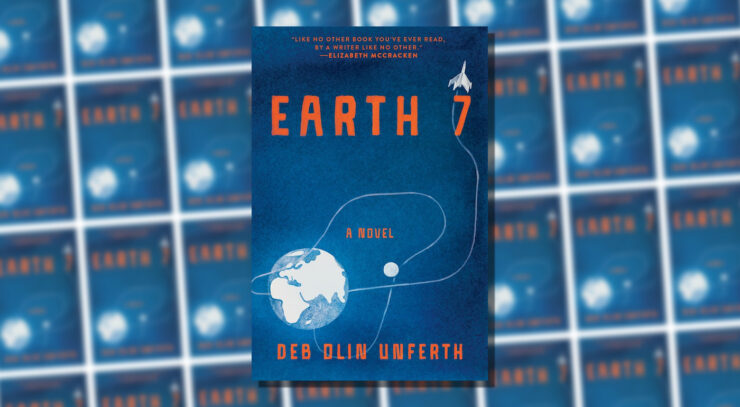
Earth 7
Deb Olin Unferth
Buy Book
Earth 7
Deb Olin Unferth
Buy this book from:
AmazonBarnes and NobleiBooksIndieBoundTarget
On an otherwise ill-advised vacation, a birthday gift from her institute colleagues, Dylan meets the love of her life. Melanie works at Vacationland for Singles, a post-apocalyptic Club Med with VR-augmented skies “terraformed” to look like pre-disaster Earth. Every other guest at Vacationland is convinced that Melanie, with her too-beautiful body, her too-shiny skin, her over-symmetrical face, is a robot. In childhood, Melanie had been plucked from orphaned obscurity to appear on a television show, Celebrity Plastics, “the most frequently recurring guest on the show.” Yes, even in the midst of the apocalypse, there is bad reality television. The unnamed “celebrity surgeon” left Melanie beautiful and artificial, “vulnerable to spontaneous combustion” and with “permanent alloys, acrylics, nanomaterials-filler implants that were almost as old as she was and that anchored onto disintegrating bone.” She ages at a glacial pace and, thanks to a more than usually experimental procedure and a device called the Regenerator, her individual molecules may become conscious.
If Earth 7 is science fiction, it’s science fiction so “soft” that it edges into fable or magical realism. Our planet’s sad fate is never much in doubt; what suspense there is comes from seeing whether Melanie and Dylan might build a life together on their dying world. Then, in the book’s last forty-odd pages, Unferth widens the scope and scale of her novel. She attempts the sublime and may in fact achieve it. First decades pass in sentences, then millennia go by in paragraphs. The Mars colony fails, modest new life arises on Earth, Earth vanishes in some galactic conflagration. As humans leave Earth, in rockets and as digitized minds, the narrator reflects:
They left because they could see Earth wasn’t much more than a piece of burned coal anymore. They’d used her up. Well, they’d used each other up, really, Earth and humans. Earth had gotten the best the universe had to offer, in all categories, and the achievement had nearly killed her, and humans had gotten the best that Earth had to give, and that had nearly killed them too.
Unferth closes Earth 7 with a series of leaps through time. Though Dylan’s “Earth 7” ultimately proves as futile as she expects it to be, it permits the Martians to re-create one of our planet’s ephemeral glories. The Martians, starved for sensation on their dusty red rock, appreciate this transient beauty in a way most of their Earthling ancestors did not.
Exhausted critics will, more often than they should, reach for jewels when they praise a book. A book is “gemlike,” it “sparkles” with a sensibility “hard as diamond,” its precision brings to mind a stone cut, sanded, and polished to perfection. Earth 7 calls to mind a humbler mineral. It is not a ruby, an emerald, a sapphire, or a diamond. Rather, it is a grain of sand, improbable and unique, in which the reader can see the whole world.[end-mark]
Earth 7 is published by Graywolf Press.
The post Life Continues On: <i>Earth 7</i> by Deb Olin Unferth appeared first on Reactor.








 New Posts (Home)
 ChatBox
 Popular Posts
  Game Zone
 Top PodCasts