www.thegospelcoalition.org
Parents Might Like ‘Toy Story 5’ More than Kids Do. That’s OK.
A few weeks ago, at my son’s kindergarten graduation ceremony, the eighth-grade student body president at the K–8 Christian school gave a speech to his youngest schoolmates.
At one point he said, “I’m one of only a handful of eighth graders who still doesn’t have a smartphone. I’m grateful for that.” He publicly thanked his parents for their countercultural choice, which, in his words, “allowed [him] to be a kid for a bit longer.” He then challenged the kindergartners to live without phones as long as possible, celebrating childhood play and innocence without the distractions of scrolling life.
I cheered loudly. Most parents in the room likewise applauded—more evidence, perhaps, that the tide is turning in awareness of the dangers of screens. Toy Story 5 is another sign this message is gaining traction. The film’s whole premise is essentially the “Wait Until 8th” campaign tagline: “Let kids be kids a little longer.”
As I watched the movie with my three older kids this past weekend, I relished it for its beautiful story and admired it for its timely message. But I also wondered how much of the “point” landed with my kids.
Or is the movie mostly for the parents?
Let Kids Be Kids
Toy Story 5’s popularity at the box office—the biggest opening in the franchise’s three-decade history—speaks to the way Pixar is finally “reading the room” of our cultural moment. After a string of agenda-driven, creatively underwhelming entries (including the disastrous Toy Story spinoff Lightyear), Toy Story 5 returns to Pixar’s winning formula: old-school storytelling that’s fun for kids, moving for adults, and rendered in masterful animation.
Many parents today were kids when the original Toy Story came out in 1995. They grew up in the Pixar heyday of the late ’90s and early ’00s. But in recent years, some parents have lost trust in the Pixar brand. Toy Story 5 is an attempt to regain it.
Some parents have lost trust in the Pixar brand. Toy Story 5 is an attempt to regain it.
The film’s embrace of more traditional values helps. There are no same-sex kisses or lesbian traffic cops in this story. No “my body, my choice” messages of bodily autonomy. Instead, the movie rightly recognizes that children’s entertainment isn’t an appropriate venue for adult themes of sexual orientation.
Refreshingly, Toy Story 5 (directed by Andrew Stanton, who helmed WALL-E) embraces the wholesome message that kids should be allowed to be kids and protected from all that would end their innocence.
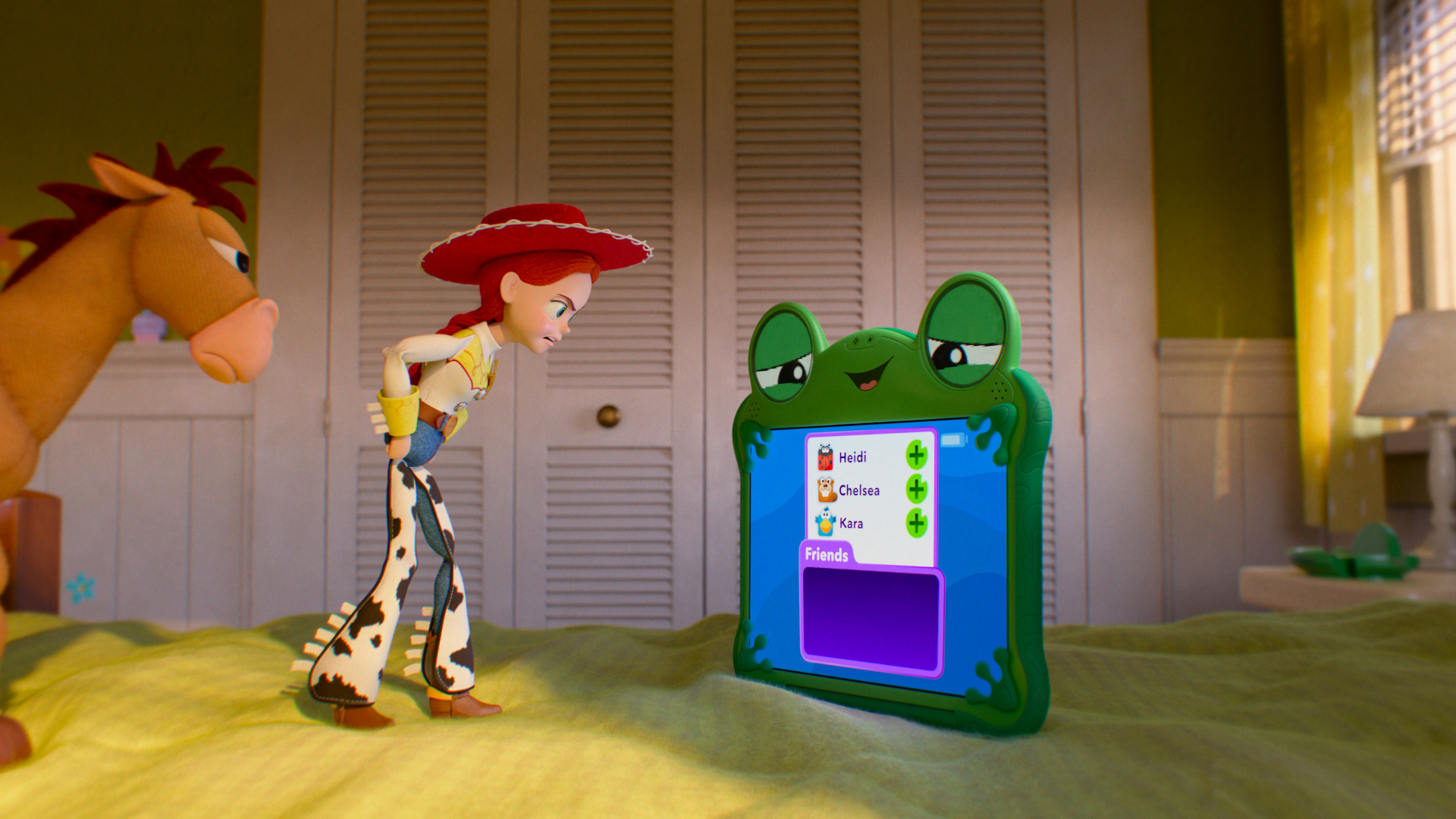
Tech is a big part of the “end of innocence” for children today. That’s why in Toy Story 5, the villain is a kid’s tablet called Lilypad (Greta Lee). The device is given to lonely, shy Bonnie (the child protagonist also featured in Toy Story 3 and 4) by her parents as a way for her to “make connections.” But that’s not how things turn out.
Photo courtesy of Pixar. © 2026 Disney/Pixar. All Rights Reserved.
The “friends” Bonnie makes through the device’s online chat end up being screen-addicted kids who “act older” and pressure Bonnie to do the same. She quickly grows embarrassed by her “antique” toys—Jessie (Joan Cusack), Buzz Lightyear (Tim Allen), Forky (Tony Hale), and the rest. As Jessie laments, the new tech devices make kids “change so fast.” Every parent knows: Childhood already goes by in the blink of an eye. We don’t need tech to make it end faster.
Can Toys Compete with Tech?
Much of the film’s comedy comes as Bonnie’s analog toys realize what the introduction of Lilypad means for them. “The age of toys is over,” they lament. “Once tech invades your home, you’re dead where you lie.” Jessie wants to believe “it’s just a phase,” and that her beloved Bonnie will still play with her. Yet soon she and the other toys realize they can’t compete with the wonders of a screen-based device. As Woody (Tom Hanks) remarks in an ominous-but-accurate line, “Toys are for play, but tech is for everything.”
That line hit me hard. Part of why it’s hard to keep devices from kids these days is because they see us grown-ups—parents, grandparents, older siblings—always on these devices, using them for everything. Toy Story 5 shows parents frequently scrolling phones or in Zoom meetings. Kids pick up on this and wonder, If these devices are so important to everything grown-ups are doing, shouldn’t I see them as important for me too?
Kids are imitators. What their parents seem to value, they come to value. This is the catch-22 I struggle with. My wife and I want our kids to play with analog toys. We want them to prefer imaginative outdoor adventures over screen-based entertainment. But when our remote jobs and optimized lives require us to be glued to screens for large chunks of the day, even if we’d prefer it otherwise, it feels like “rules for thee, but not for me” to tell our kids they shouldn’t be on screens themselves. What parents model with our own devices ultimately matters more than what we say to our kids about them.
The same is true about play. If we tell our kids, “Go outside and play! It’s good for you!” but never practice this in our own lives—always choosing scrolling over strolling, gazing at screens over looking at the sky, optimization over rest—our admonition will fall on deaf ears.
I have to preach this to myself often: prioritize in my own life the habits I want my kids to pick up.
Get Kids Playing Again
One thing I loved about Toy Story 5 is how it explores the difference between “play” and “game.” Playing is imagination-based, active, wide open. Gaming is algorithm-fueled, addictive, passive, often confined to a screen.
Photo courtesy of Pixar. © 2026 Disney/Pixar. All Rights Reserved.
The toys of Toy Story 5—led by Jessie, Buzz, and Woody—want to get Bonnie playing again. This isn’t only self-serving (wanting Bonnie to play with them); it’s also because they know play is good for her. Bonnie will make real friends not by sitting in the same room as other kids, each glued to his or her own device (“How’s she supposed to make friends if they aren’t even looking at each other?”). Rather, she’ll forge connections by looking up and seeing the real world, exploring its adventures and imaginative possibilities face-to-face, side-by-side, with fellow adventurers.
What parents model with our own devices ultimately matters more than what we say to our kids about them.
How do we encourage kids toward tangible exploration in a world so saturated with screens and addictive dopamine media? Toy Story 5 doesn’t propose we ditch devices entirely. It suggests that the best use of tech is to make connections that flourish offline: screens not as ends unto themselves but as resources for spurring IRL experiences. (Check out these 44 ideas to encourage imaginative, screen-free play.)
Being a Disney production—and a movie people watch on screens—Toy Story 5 can’t bash screen-based entertainment too much. It’s ironic that the film encourages IRL play in a format that requires kids to look at a screen for a couple hours. The question is this: Will the whimsical toyland depicted in the film inspire young viewers to practice imaginative play? Or will it just lead them to want to watch more Disney movies and TV shows?
Fun for Kids, Galvanizing for Parents
My kids liked Toy Story 5. But it was more for me than for them.
The film’s final image is of a tire swing hanging from a tree, drenched in summertime sun. The image left me emotionally stirred not only for what it means in the context of the story (Jessie’s own history with former kid Emily, which packs the film’s biggest emotional wallop), but for what it symbolizes more broadly.
A tire swing epitomizes the sort of “free range” analog childhoods many of today’s parents had when they were kids. The image evokes nostalgia for the type of embodied, outdoor play we had and we want our own kids to have.
I enjoyed watching the movie with my kids, but I left it longing for them to enjoy the world outside the theater more. It left me even more convinced of Jonathan Haidt’s thesis in The Anxious Generation: We’ve overprotected kids in the real world and underprotected them in the virtual world. It left me newly convicted about wanting to get my kids actively using their imaginations and engaging the real world rather than defaulting to passive screens. It left me thinking about how I can model wise tech habits better in my own life, especially as we enter the new age of AI. I hope the movie inspires other parents in the same way.








 New Posts (Home)
 ChatBox
 Popular Posts
  Game Zone
 Top PodCasts