www.wearethemighty.com
What happened on the final flight of the namesake for Edwards Air Force Base
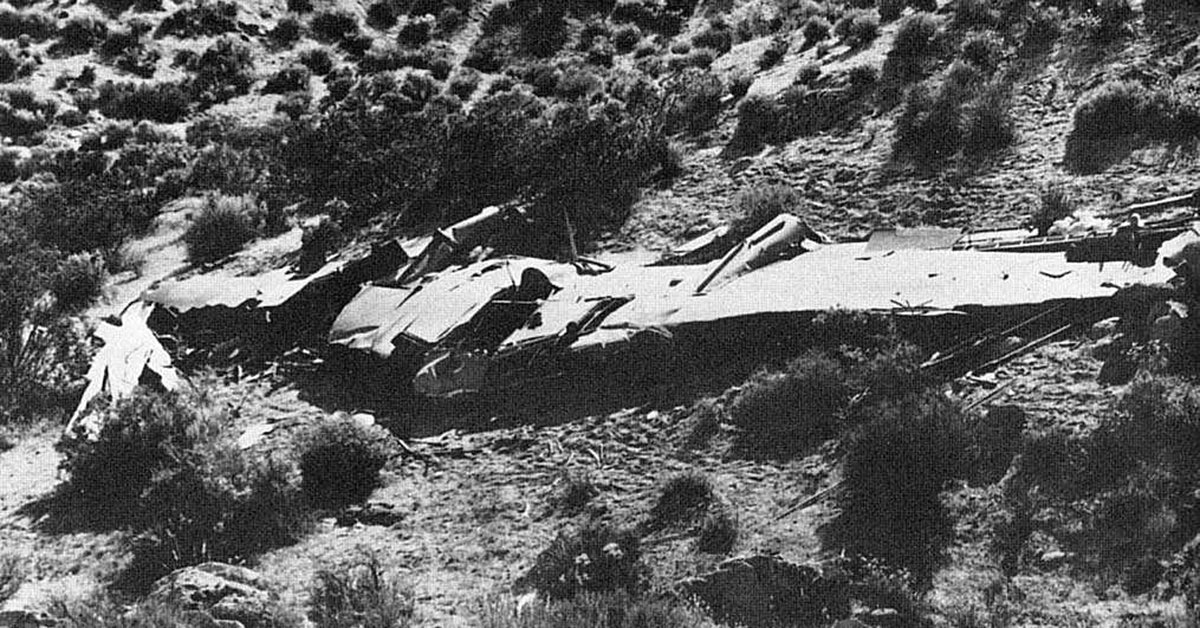
On Friday, June 4, 1948, Air Force test pilot Glen Edwards felt slightly frustrated.Maj. Daniel Forbes Jr. was perturbed, too. With Forbes as the pilot and Edwards as his co-pilot, they tested a jet-propelled, heavy bomber prototype known as YB-49 No. 2. The YB-49 was a Flying Wing with eight turbojet engines and four vertical stabilizers. It had no fuselage or tails. For all of its sleek design, the YB-49 sometimes proved difficult to control in the air.Also Read: How Mel Brooks kept his sense of humor while serving in World War IIEdwards, who kept a diary while serving during World War II and his career as a test pilot, expressed his annoyance with the YB-49 in writing.“Got two flights off today with doubtful success,” Edwards once wrote, according to Daniel Ford’s 1997 article in the Smithsonian magazine. “Darnedest airplane I ever tried to do anything with. Quite uncontrollable at times. Hope to be more favorably impressed as time goes on.”Refusing to wait until after the weekend, Edwards and Forbes pulled together a crew and added a flight on Saturday, June 5. They wanted to improve their comfort level flying the YB-49 No. 2. That last-minute flight never landed as the prototype came apart in midair and crashed in the Mojave Desert, killing all five on board.
A 19-Minute Combat Mission
A U.S. destroyer cuts through the wake of a U.S. aircraft carrier on patrol during the first day of fighting off North Africa, November 8, 1942. (U.S. Navy)
Born in 1916 in Medicine Hat, Alberta, Canada, Edwards moved with his family to California as a teenager. Shortly after graduating from the University of California at Berkeley with a bachelor’s degree in chemical engineering, Edwards joined the military as an aviation cadet.The Army Air Forces placed Edwards with the 86th Light Bombardment Squadron of the 47th Bombardment Group. He saw action during Operation Torch, the Allied invasion of North Africa. Later, at the Battle of Kasserine Pass in Tunisia, Edwards’ squadron flew 11 missions in one day. One of those lasted, from start to finish, all of 19 minutes.Edwards also participated in the invasion of Sicily, completing his wartime service with 50 combat missions. After earning four Distinguished Flying Crosses and six Air Medals as a military aviator, Edwards came back to the U.S. and became a test pilot.Edwards, who rose to the rank of captain, distinguished himself in that burgeoning specialty. On December 8, 1945, Edwards and Lt. Col. Henry E. Warden took off from Long Beach, California, in a Douglas XB-42 Mixmaster. They arrived in Washington, D.C., 5 hours, 17 minutes, 34 seconds later with an average speed of 433.6 mph.That flight established a transcontinental speed record, a milestone that only added another notch to Edwards’ well-earned reputation. He was so highly respected within the test-pilot community that higher-ups strongly considered him as a candidate to become the first pilot to attempt to break the speed of sound. They bypassed Edwards, though, and went with Chuck Yeager.That was no slight on Edwards’ abilities. Other opportunities awaited him.
Testing the YB-49
Gen. Reuben C. Hood (left), deputy chief of Air Staff, congratulates Capt. Glen Edwards (right), the co-pilot, and Lt. Col. Henry Warden, the pilot, on their record-setting transcontinental flight on December 8, 1945. (Getty Images)
Besides the Douglas XB-42 Mixmaster, Edwards also gained experience in another prototype bomber, the Convair XB-46. He also flew the Northrop N-9M, an experimental Flying Wing.Each aircraft presented its own challenges for Edwards. The highly decorated airman, who earned a master’s degree in aeronautical engineering from Princeton in 1947, normally figured things out.So it was that the Air Force relocated Edwards from Wright Field in Ohio to Muroc Air Force Base in California the following year to test the YB-49, Smithsonian magazine noted.“Then this evening all heck broke loose,” Edwards detailed in his diary. “Seems like I’m bound for Muroc tomorrow by fastest means possible. Plan to run stability [tests] on the YB-49… what fun! Sounds like I’ll be there for awhile. Packing like mad tonight.”After Edwards arrived on the West Coast, he soon realized why the YB-49 created varying degrees of concern. Even its designer, acclaimed aviation engineer Jack Northrop, expressed reservations about how it flew under certain conditions, Ford wrote in Smithsonian magazine.Once Edwards flew the YB-49, he tended to agree.“I flew the airplane and must confess it is somewhat of an experience,” Edwards said in his diary. “Stability is poor all around—landing is peculiar. Has a great tendency to float.”
A Fatal High-Speed Spin
The YB-49 was a Flying Wing, a jet-propelled, heavy bomber prototype. (U.S. Air Force)
On Edwards’ first flight, he and Forbes took off from Muroc Air Force Base shortly before 7 a.m. As Ford recounted, they passed over Bakersfield and then over the Antelope Valley before encountering serious issues.The Smithsonian magazine writer couldn’t say with 100% certainty what caused what happened next. With Edwards, Forbes, Lt. Edward Swindell, and two civilian engineers aboard, the YB-49 apparently went into a high-speed downward or sideways spin.Its outer wings tore off as a result. The Flying Wing broke apart 10 miles northwest of Muroc. The Air Force renamed Muroc posthumously for Edwards, who was 32 years old at the time of his death, on December 8, 1949. The service performs all testing of its developmental aircraft at Edwards Air Force Base, which is approximately a hundred miles from Los Angeles.
Don’t Miss the Best of We Are The Mighty
• An all gain, no pain infantry-ready workout, from beginner to advanced• The Chief of Staff’s Bible is one of the least-known Air Force traditions• Before 3 tours in Vietnam, this fighter pilot dropped nearly 20 miles from high above
Featured
World War II
What happened on the final flight of the namesake for Edwards Air Force Base
By Stephen Ruiz
Coast Guard
A close look at the Coast Guard’s biggest rescue ever besides Hurricane Katrina
By Stephen Ruiz
Entertainment
Navy veteran David Ayer honors fellow sailor in “Heart of the Beast”
By Miguel Ortiz
History
Why ‘the father of the Air Force’ was court-martialed
By Stephen Ruiz
History
What went wrong when the Navy first attempted to fly nonstop to Hawaii
By Stephen Ruiz
The post What happened on the final flight of the namesake for Edwards Air Force Base appeared first on We Are The Mighty.








 New Posts (Home)
 ChatBox
 Popular Posts
  Game Zone
 Top PodCasts