reactormag.com
A Bus Full of Ghosts: The Vampire Lestat, “The Devil’s Road”
Movies & TV
The Vampire Lestat
A Bus Full of Ghosts: The Vampire Lestat, “The Devil’s Road”
“The wheels on the bus go me, me, me …”
By Molly Templeton
|
Published on June 29, 2026
Image: Sophie Giraud/AMC
Comment
0
Share New
Share
Image: Sophie Giraud/AMC
While I find many things about the vampire Gabriella quite frustrating at this point in this (otherwise excellent) season, I do have to admit that there is something funny about a vampire rock star on the road who is calling, incessantly, for his mother. It’s funny-weird, not funny-ha-ha. It’s tragic and lonely. It’s fairly upsetting.
And it made me think back to the beginning of this season, and to why Lestat’s elaborate recorded diary begins when it does. It’s not the start of his tour. It’s not when he first learned about Daniel’s book. It’s not even the first attempt on Lestat’s life. It’s the moment Gabriella shows up—well, with a little prelude, first, so that we know what he’s been dealing with. This “omniscient history” picks up when Gabriella, with her tiresome interest in evil, enters the scene.
Is there an evil older than you? she asked Armand last week. (“Just checking” cracked me up.) Now she’s on about creating Dante’s hell on earth. Perhaps I am a little jaded given the current state of world affairs, but that seems sort of… boring. And every time anyone mentions the Great Conversion, I think about what they’re going to eat. We’ve been given plenty of hints, what with Killer’s bathtub snacks and the reference to a blood farm, but I can’t help it: I hear Spike from Buffy calling humans “Happy Meals with legs.” It’s a weird relationship: We become them, but then they still need us. The would-be murderer’s manifesto was not entirely wrong. (I hate saying this. I hate murderer manifestos.)
But because this is The Vampire Lestat, and because this is Lestat’s version of history, and because this man is narrating his own dissolution, I am withholding judgement. I am waiting to see what exactly we’re doing here. I am waiting impatiently, and excitedly, and with a slight edge of worry. But I also have a reasonable amount of faith.
And also a lot to talk about. This week’s narrative dances especially compellingly from Lestat to Daniel to Louis and back again, and I think I want to take each little thread of story and pull it loose from the rest this time.
First: Alex. Alex who doesn’t call this guy he met his sponsor, no, he’s not using that word. But the guy is like a god. The guy took away all the shit that Alex had been unloading on his bandmates and friends. Alex, bud, do you mean this, like, literally? Did Armand go fishing in your mind and take the big fish home for dinner? Alex has not come clean to his bandmates about his new pal, but he also doesn’t look the least bit surprised when Lestat calls out the vampire Armand mid-concert. He knows who he’s dealing with. Or he thinks he does.
Image: Sophie Giraud/AMC
I have a lot of questions about Armand and his amends-making tour. The first is practical: making amends is step nine. I know we haven’t seen Armand for a minute, but how long has he been going to meetings? Was this actually a regular thing or just something he did while stalking Alex? Does he mean any of it or is he just borrowing the language and process of recovery to seem more sincere? (Also: what higher power does he appeal to? What does he think he’s addicted to?)
Because I love the way Assad Zaman turns Armand’s fragility to ferocity in a split second; because I love that wide-eyed gremlin stare; because I am a sucker for exactly this kind of character, I want to believe him. But I don’t. I’m not really supposed to: Armand has rarely given anyone any reason to trust him. And if this is all Lestat’s story, then Armand’s amends are even more suspect.
Still, there is sincerity there. I can’t decide if there’s more of it with Daniel or Lestat, but at the same time, in both exchanges, Armand does something that calls all of the rest of his words into question.
With Daniel, it’s the way he talks about love. It’s his denial that there was any theater in their exchanges in Dubai, and that he says it was not love for Louis that made him behave the way he did there. It comes out of left field and it effectively disarms Daniel—who has, until that moment, really had it in for Armand in both their interactions, vicious and angry and blaming the vampire for literally every problem in Daniel’s life. Daniel’s professionally antagonistic personality goes to 11 when he turns it on Armand. Everything is personal. His transformational trauma is on full display. Eric Bogosian in full rant mode is a beautiful thing to see—especially when you can see how much it takes out of Daniel to do that. There’s no satisfaction anywhere.
Image: Sophie Giraud/AMC
(I know that these two are canon in the books. I just don’t think we’ve seen anything on the show to sell the idea. Yet. But, of course, that doesn’t mean it hasn’t happened.)
With Lestat, Armand undermines himself at the end, when Lestat already knows exactly what he’s going to say about how he ought to stop playing music, stop putting himself out there, stop everything because it’s dangerous. This is why Armand turns up on the tour bus. He can’t take his eyes off Lestat, but he’s also perfectly willing to leave his letter—written from the depths of his soul! So full of flattery!—behind so long as he can get that little warning off.
Armand keeps his true motivation close. Lestat says Armand will do more damage than the Queen (capitalized in the subtitles; he’s always talking about Akasha) ever did. Or has he done that much already? What does he think, in that gleefully awkward concert scene, when someone yells “Armand told the truth”?
Despite my iffiness about Gabriella, I have to return to the question I always return to: Is this really her? Or is this Lestat’s version of her? There’s so much here that I cannot get a handle on, because Jennifer Ehle’s performance is so slippery. And because from Lestat’s perspective, everything she does is about him.
Image: Sophie Giraud/AMC
Or, you could say, everything she does is about using him. She leaves him alone, she comes back, she makes him miss her, she makes him beg for her to come back; she fucks with his head (and his body double); in flashback, we see that she’s been having extravagantly loud sex in his earshot ever since ye olden days. When he was a child, she was as close as he got to safety in his home. Once she became as powerful as him, she stopped being safe. The entire scene in the inn is distressing in concept, but the execution is breathtakingly horrifying: Ehle and Sam Reid play it so intensely, so viscerally, so nakedly.
A huge part of what makes this show so bold and powerful—beyond the messy immortal bitch drama; beyond the full-throated commitment to this season’s rock star lifestyle and incredible stage performances and lavish details—is the way it is committed to showing people containing multitudes. You can be an arrogant rock star and a wounded little boy, a murderous fiend and a heartbroken lover, a capitalist and a vampire, a vengeance-seeker stuck on grief, a manipulative schemer who longs for love and creates impossible art. Humans reinvent ourselves all the time. Vampires just get more time to do it. More versions of themselves to be.
Gabriella, though, feels one-note. Manipulative, conniving, performing sultriness, withholding, alluring yet annoying. This show is too smart to have slipped, to have left her this way unintentionally, and so I am constantly trying to figure out why she feels so monotone. Is it because for Lestat, she is and can be only his mother, lover, basis for so many of his problems? Can someone with his screwed-up childhood ever see a parent as a full person—a person with her own traumas and terrible history—even when she’s explicitly rejected the role of parent?
It is actually, genuinely, impossible to talk about Gabriella without talking about Lestat, because the writers have so elegantly bound them up in each other. Mostly, what Lestat does this episode is come apart at the seams. He has his great little moment with the cop, and he throws himself full-bodily into that performance for and at Armand (in Baby Lu pigtails, no less). But half the time, his past bleeds into his present; the ghosts aren’t even just muses anymore, but minor figures, like a man he spoke to once in an Italian inn a century ago. He leaves the decision of which record label to choose up to Dee and dissolves into unstable chaos—though he does still manage to fend off Daniel, to whom he continues to lie about his mother.
Image: Sophie Giraud/AMC
Lestat’s stories are carefully tuned. Nicki was his first love, not his great love. Louis was full of lies. And Gabriella certainly wasn’t the original wound in the core of his little vampire heart, the first one to leave him after professing her love for him. The beach where she did it butts into the episode repeatedly, the waves crashing, the night empty. It’s almost too pat, the way everything ties back to her abandonment, and the power she has when she comes back. I am forever waiting for the other chopped-off hand to drop. (Nicolas, meanwhile, ghosts moonily about and asks if he comes in third when Louis and Gabriella are missing. Nicki’s ghost is not having nearly as much fun as he was at last week’s concert.)
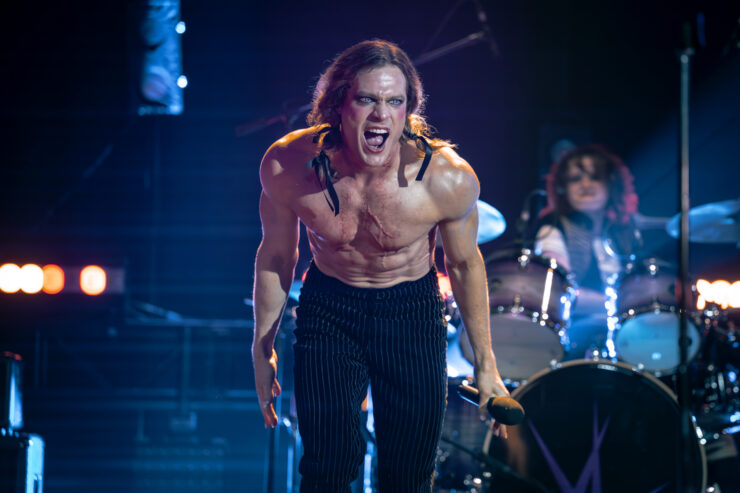
Lestat pulls himself together for the next show, and what we see of it is blistering and ridiculous. Every line of “Big Boss” is calculated to do the most damage to Armand’s psyche (“You’ve got a lot of rules for a theater kid.”) and the stage banter is even worse (“Look deep into his uwu Japanime eyes as he mind-cocks you off a cliff”). And Sam Reid just owns that stage. The physicality with which he embodies this role constantly astonishes me, whether it’s the fraught expression with which he stares at Gabriella or the way he powders that policeman’s nose or that cocky, luxuriant blood shower. Even just the way he sits (in that shirt with its blood-colored pattern!) while deflecting Daniel’s jibes. Every detail is masterful.
The assassination attempt is quick and horrible and I’m really glad Christine isn’t dead. Lestat, not-so-mortally wounded, just keeps flashing back to his mother leaving him right after the planned world domination. Now, everyone leaves him again, or so he tells Gabriella when she shows up. (To be honest, I assume he sent them away for their own safety.)
Once again, Gabriella is not here because Lestat needs her, but because she wants something. She has been hanging out with “the voices.” The voices listen to Lestat’s songs. The voices think he is speaking to them. They are longing for communion. She just wants him back on stage—but for her own purposes. He’s a tool to her, like he always has been. And he’s so incapable of seeing through her maneuvering that he might just do what she wants, even if he doesn’t really mean to.
Image: Sophie Giraud/AMC
By the end he and the band are in the studio, finally making that album that he said they would make when they were ready. Is this before or after the last five shows? Did the last five shows get cancelled? Will there be a post-assassination attempt comeback in grandiose style? (I wouldn’t be mad if the show at the end of The Vampire Lestat, the novel, became the show at the end of The Vampire Lestat, the first season.)
I wasn’t intending to save Louis for last, but this thread just wrecked me. The defining emotion of the end of Louis’ human life was grief for his brother. There’s an argument being made this season that the defining emotion or trauma of the end of every vampire’s human life remains key to their psyche forever: Lestat’s abuse and nonconsensual transformation at the hands of Magnus, Daniel’s rage at Armand, Gabriella’s warped feelings for her child-turned-savior.
Louis couldn’t do anything about losing his brother, or the way the rest of his family slipped away as they aged and he didn’t. He tried to do something about what happened to Claudia, but it’s pretty clear that none of the murders—not in Paris, not in Detroit—have brought him any peace. So he tries again, this time with the opposite tack. He tries making a connection. He’s damaged and hurting and haunted by loss, but he tries.
Image: Sophie Giraud/AMC
But he’s kind of trying to play a player. Delainey Hayles is excellent in this role, entirely un-Claudia-like, brazen, observant: the minute Regina called out Louis’ cashmere sweatsuit, I started to notice just how nice, how perfectly cut, even his most casual clothing is. Against the chaos of Lestat’s unraveling, their moments in the diner have an almost refuge-like quality, even if it’s all fake. It’s all Louis projecting, and Regina trying to figure out what exactly this very rich, very gay man wants, if not her ass.
“It’s mental,” is her initial response to realizing why Louis is there. She kicks him out and tells him to turn into a bat (bless). But she’s canny and street-smart and she knows he’s the 566th richest man in the world (or thereabouts) and that this is an opportunity.
And when she calms her face, stares directly into the camera, and says, “What now, Daddy Lou?” I shrieked. I thought he wanted company. I did not necessarily think we were headed to well-paid role-play. But it’s totally in keeping for Louis, who has been paying people for companionship as long as we’ve known him.
But: Last week, when Louis went on his Talamasca-encouraged murder bender, there was no voiceover. It was not entirely clear if we were still in Lestat’s narration, though I assume everything this season is Lestat’s version of history. This time, though, Lestat sets up the situation, saying that “he who licenses or franchises the night” can work wherever he likes, so he works in this diner with this not-Claudia. “Being in the same space with her was satisfying in a way the destruction of the vampire Bruce was not,” Lestat tells us. “He told himself he was in control. We all did, that year.”
Image: Sophie Giraud/AMC
Two things to say about that: One, the swelling score that comes in for Louis’ last encounter with Regina is the same swelling score that happens when Lestat and Gabriella are making their plans on the beach, and we know how well that turned out for Lestat.
And two: How does he know? I know this is the question for all of it. How does Lestat know about any of the things for which he is not present? But for some reason, the moments where he’s in Louis’ head jar me the most. It is an “omniscient history,” but how does our narrator become ever so omniscient?
Regardless, Louis’ experiment with Regina ends one of two ways: She becomes the vampire Regina, her own person with her own history of psyche-forming trauma, or she ages and dies. Maybe the latter would give Louis some sense of phantom closure.
LITTLE SIPS
Image: Sophie Giraud/AMC
The opening tour-chaos scene was all entirely great and I’m a little obsessed with the little red scarf-hood Lestat is wearing in it. Through the woods to encounter the big bad wolf?
THE VAMPIRE BOURDAIN. I kind of can’t believe they put that in here. Two years ago, Playbill asked Bogosian about the Bourdain comparisons, and I loved his response: “I’d say both of us owe tribute to Lou Reed, in terms of black leather jackets, curly black hair, and that certain tone of voice that’s sort of baked in sarcasm.”
The good doctor Fareed is reading Italo Calvino’s novel The Castle of Crossed Destinies, which is apparently a story in which a group of travelers lose the power of speech after passing through a forest, and thus try to communicate using tarot cards. A very interesting choice for a show in which everyone’s story is being filtered through one perspective, no? And our second Calvino reference so far.
The voice at the end of the opening titles that asks “Do you hear that, Armand?”—who is it? Is it Lestat? It doesn’t sound quite like him.
Adding “Chipottle” to the list of Lestat’s best pronunciations along with “Reddeeeet” and whatever the hell he did to Saskatchewan.
Whyyyyyyyyy was the Talamasca paying to push that video—”the deepfake Antichrist”!—to go viral? Can we get Raglan James back to answer some questions?
“Can I eat this much cocaine?”
Daniel announces his strikes with the names of Pulitzer winners. Dork.
It’s really very interesting that Armand says he can’t control the way everyone vanishes when he and Daniel are around one another. But he can wave off two followers on the street with a literal wave of his hand.
In case you want to know what Louis’ new penthouse theoretically looks like: this is Domino Square.
The boss yelling at Regina sounds a lot like Eric Bogosian.
“Because you are a fuck cloud, Armand.”[end-mark]
The post A Bus Full of Ghosts: <i>The Vampire Lestat</i>, “The Devil’s Road” appeared first on Reactor.








 New Posts (Home)
 ChatBox
 Popular Posts
  Game Zone
 Top PodCasts