reactormag.com
The Triumph of Rand al’Thor and Why I Named My Inner Voice Moridin
Books
The Wheel of Time
The Triumph of Rand al’Thor and Why I Named My Inner Voice Moridin
Sylas discusses mental health struggles in the context of the Wheel of Time.
By Sylas K Barrett
|
Published on June 30, 2026
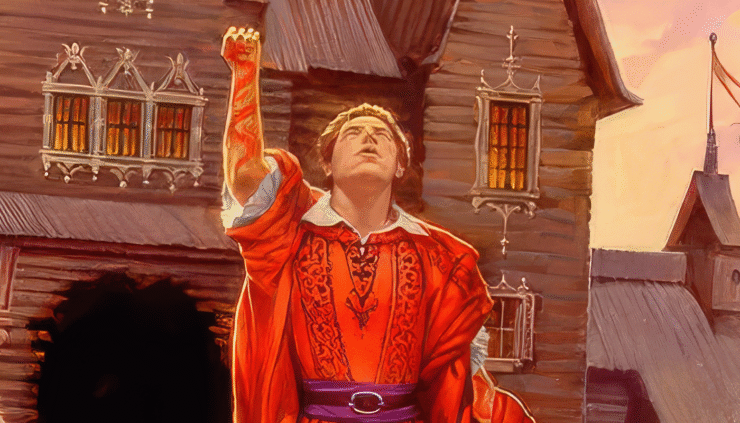
The Gathering Storm cover art by Darrell K Sweet
Comment
0
Share New
Share
The Gathering Storm cover art by Darrell K Sweet
When I was little, I somehow internalized the idea that when I made a mistake, or did something wrong, or didn’t succeed at something I was trying to accomplish, it was reflective of something I was, rather than something I did. This thought distortion began at such a young age that I didn’t have the knowledge to understand the feeling, or the language to explain it to the adults in my life. By the time I was old enough to be able to interrogate the concept, it was too late. The feeling had cemented into an identity, one that would shape much of my adolescence and my adult life.
Looking back, I can identify many moments and experiences growing up where something happened to further reinforce that childhood sense of self. Some were normal growing up experiences, like friction in childhood friendships or figuring out how to navigate the requirements of the public education system. Some were more intense, such as growing up queer and neurodivergent—conditions that society views as deviant and other—in a small, rural town in the 90s and early aughts. But before all that, before the painful social interactions of youth or societal messages that told me that conformity and success were the only ways to define one’s worth, there existed a simple childhood misunderstanding that was never caught or corrected by the adults around me. The message I thought I was receiving from the world didn’t literally exist in the way I believed it too, but it was no less powerful for the fact that it came from a misinterpretation.
Recently, my therapist suggested that I give a name to the voice in the back of my mind that whispers that I am wrong, a mistake, a failure, even before I have made a mistake or failed at a task. He suggested that this might help me stop believing the voice as something true and intrinsic to me, and see it instead as an interloper, whispering lies and trying to bring me down.
In answer, I immediately started talking about Rand al’Thor.
I was just finishing up my read of The Gathering Storm at the time, and thinking a lot about themes of identity within The Wheel of Time, and specifically what they mean for Rand and his journey into becoming the kind of man who can be the Dragon Reborn. Despite the fantastical nature of many of Rand’s struggles, there is much to relate to him, as evidenced by the fact that this is now the third essay I have written comparing my mental health journey with his.
Like me, Rand had his sense of identity formed for him before he even knew who he was. I am not referring to his identity as Rand the shepherd, of course, but his identity as the Dragon Reborn.
Even in his far-flung village, Rand grew up hearing tales and superstitions about the Dragon Reborn. People knew little about the truth of the Dragon and Breaking of the world, but they knew enough to fear the Dragon and associate him with Evil. The dragon’s fang was scrawled on the door of suspected Darkfriends. Men who could channel were shunned or attacked even after they had been gentled and could no longer touch saidin.
When Moiraine came to Emond’s Field, Rand left the Two Rivers with his friends and began to learn more about the Dragon Reborn. He encountered people with more nuanced prejudices and fears about who, and what, the Dragon Reborn was supposed to be. He learned about being ta’veren, about fate and the will of the Wheel, and he learned a little about the Karaethon Cycle. Even before Rand discovered that it was he, not Mat or Perrin, who was the Dragon Reborn, he already “knew” that the Dragon was dangerous, destined to break the world, to go mad, and that everyone in power, especially the Aes Sedai, would try to control him.
That last bit, of course, was planted in his mind by Ba’alzamon.
Of course, most of Rand’s paranoia, self-defensiveness, and anger are also rooted in responses to things that have happened to him over the course of the series. He has been pursued by Darkfriends and by Mordeth-Fain. He was given supernaturally unhealing wounds by two different enemies. He experienced the fear and prejudice of people who knew much more about who, and what, the Dragon Reborn was supposed to be than Rand himself did. He was captured, tortured, and locked in a box. He read the Karaethon Cycle and studied words that he believed foretold his death. He lost Moiraine.
He was also affected by the taint on saidin, exposed to the corruption of the Dark One’s touch every time he seized the male half of the One Power, driven mad slowly but surely by a decaying force that nearly always brings those affected by it to a mental state dominated by destructive rage and violent paranoia so great that they lash out even at those they love most.
So it is no wonder that Rand fears and mistrusts everyone around him by the time we reach the events of The Gathering Storm. Even without the influence of the taint madness, and even more so with it, it’s easy to see why he would feel isolated, betrayed, and mistrustful. It’s a subject I’ve frequently explored throughout my read of the series. But as I read the last few chapters of The Gathering Storm, I found myself thinking back to those early days of Ba’alzamon whispering in Rand’s dreaming mind, and to how everything that happened to Rand afterwards watered the seeds that Ishamael planted there.
Masquerading as the Dark One himself, Ishamael marauded through Rand’s dreaming mind, warning him over and over that the Aes Sedai would use him for their own ends, that they would make him their puppet and their slave. He also spent a great deal of time attempting to convince Rand that defeat was inevitable, that the Dark One was guaranteed to win. He worked hard to sow fear in Rand’s mind and despair in his heart even before Rand ever touched saidin, never mind proved that he, not Perrin or Mat, was the Dragon Reborn.
The effectiveness of that time in Rand’s mind can’t be overstated, I think. Rand was already suspicious and afraid of most Aes Sedai long before Galina and the others captured him; their actions merely enhanced and solidified that fear. Rand already doubted his own strength in the face of the Dark even before he found the dead body of a little girl and tried unsuccessfully to use Callandor to bring her back to life. When Rand read the fateful lines in the Karaethon Cycle about how his blood would stain the rocks of Shayol Ghul, he never considered that this prophecy might refer to anything other than his death.
I don’t blame Rand for giving up hope—the burden he carries is almost too enormous to contemplate—but I do see how effective Ishamael was at getting into his head, and setting him up to doubt his own strength and see defeat looming in every possible misstep or failure.
Betrayer of Hope, indeed.
Of course, Ishamael is not the only voice inside Rand’s head. Lews Therin is literally a voice in Rand’s mind, a separate consciousness with its own opinions and designs that do not always agree with Rand’s own. Lews Therin has mostly been an antagonist to Rand since he first began speaking in Rand’s mind, filling Rand’s head with his grief and paranoia, screaming at Rand to take actions Rand doesn’t want to take, ranting or sobbing distractingly, and even trying to seize saidin away from Rand. However, as the series has progressed—and as Rand’s own madness grew—Lews Therin became more helpful, and seemingly more sane. Then, in Rand’s darkest hour, he provided exactly what Rand needed.
As Rand al’Thor stood on Dragonmount, finally confronting the emotions of anger, grief, and hopelessness that had been building in him since he accepted his identity as the Dragon Reborn, and particularly since the death of Moiraine, he was so lost to pain and despair, so consumed by the trauma he could no longer repress, that he actually prepared to end the world, drawing enough power from the Choedan Kal to potentially destroy the Pattern itself, breaking the Wheel and bringing the cycle of death and rebirth to a halt forever. And yet, as he stood on the brink of the destruction of everything, it was Lews Therin’s voice that not only brought him back from the brink but also gave Rand hope again, and a reason to live.
I have long wondered whether Lews Therin’s presence in Rand’s mind was literal, in the sense that he was a separate consciousness somehow ported or leaked into Rand’s head to exist beside Rand’s own awareness, or if the identity of Lews Therin was something Rand’s madness assigned to his own thoughts, the two blurring badly in part because of Rand’s ability to access some of the memories and skills he had in his previous life. It is fun and interesting to ponder, and I don’t believe we will ever truly know the answer, but for our purposes here today, and for Rand’s, it doesn’t really matter. Because in the end, after Rand has destroyed the Choedan Kal and found laughter and hope again, he realizes something else. He realizes that he and Lews Therin are not two separate people, and never were.
I think we all have a voice inside us that could be analogous to Lews Therin, at least sometimes. A voice that reminds us of the last time we fell and urges us not to try again, to stay safe instead of risking the same injury a second time. A voice that replays our mistakes or embarrassing moments over for us in our heads as we try to go to sleep at night. A voice that keeps us trapped in grief or negative thoughts when we would really just like to let go for a moment, to come up for air and breathe. That voice might be focused on the wrong thing, but it is ultimately a protective voice, one that we might do well to acknowledge as our own. It may be giving the wrong advice, acting out of fear or PTSD, but it is a voice that is trying to keep us safe. We do not have to listen to its direction in order to acknowledge its intent, and accept its role in our lives.
But the voice in my head that tells me that I am wrong or bad, the voice that warns me to hide behind people-pleasing and perfectionism lest someone see the truth of me, has no redeeming side. It isn’t trying to protect me, the way fear or anxiety do. It is just a bad thought, a deep-seated belief that is neither true nor helpful. Just as Rand believed that he must harden himself, turn off his feelings of compassion and empathy and grief, so did I believe that I had to make a mask to cover the truth of myself, and hide those messy, weak parts of me from the rest of the world. I truly believed that if I didn’t, I would be destroyed.
That voice is the whisper in a dark dream that tells me no one can be trusted, that I might as well turn to the Dark because that is what everyone will see in me anyway. It is Ba’alzamon, it is Ishamael, it is the Betrayer of Hope.
In the end, I could pick one of those names or titles for the voice in my head, but Ba’alzamon and Ishamael were such larger than life, terrifying figures, ones that Rand believed to be the actual Dark One for a while. Choosing one of those names feels like giving that inner voice too much prestige. I am not the Rand al’Thor of The Eye of the World, young, confused, and untried against much more powerful opponents. I am a later Rand, perhaps even the Rand at the end of The Gathering Storm, one who is facing my demons and learning how to laugh and cry, to open myself up to the experiences of the world and find strength and resilience without becoming so hard that I make myself brittle.
One of the many names for the Dark One is “Father of Lies.” It’s appropriate, though like a lot of the titles people and cultures use, it anthropomorphizes the Dark One, giving it a gender and a human-like function as a “father.” The Dark One is a source of many terrible things—corruption and decay and lies and betrayal—but he needs agents within the world to enact and spread his darkness, as he himself cannot interact with the world directly. Even after the drilling of the Bore, he can only touch the world in a very limited fashion. Ishamael, as his most powerful (and insane) agent, is himself a sort of “father” or “source” of lies, as he enacts the Dark One’s will across the world.
And Moridin, though he is the same soul as Ishamael, is a smaller creature than the Betrayer of Hope. Already defeated by Rand more than once, killed and brought back into a new, less horrifically altered body, he gives off the air of a sad emo boy more than a demonic opponent. He is still powerful, of course, and much more dangerous than he appears, and I suspect we will have a very intense confrontation between him and Rand before the series is over. But in some ways, he is also just a man, a sad, confused soul who seems more defeated than anything else, at least when Rand spoke to him in Moridin’s Dream.
I like the idea of giving this inner voice, this inner liar, a name that is evocative of the power it has had over me but also suggests that it is diminished in some way, less than it was before, when I did not yet understand it or identify it as the distortion it was. Moridin is such a silly name, after all, a word that simply means “death.” (Although nothing will ever be as silly as Mordeth.) At once both powerful and pathetic, a dangerous antagonist and yet one who, in many ways, belongs to a past version of me, I think Moridin is the perfect name and identity to give to the voice that seeks to defeat me in my life.
Rand has yet to face Moridin for the last time, and my own struggle with my inner Moridin remains ongoing, but I think we are now both better positioned than we ever have to defeat this former friend turned betrayer, and to trust in ourselves that our own strength and our own love will prevail.
Tune in to Reading The Wheel of Time next week for the first installment of my read of Towers of Midnight. You can find my other two articles on Rand and mental health here and here.[end-mark]
The post The Triumph of Rand al’Thor and Why I Named My Inner Voice Moridin appeared first on Reactor.








 New Posts (Home)
 ChatBox
 Popular Posts
  Game Zone
 Top PodCasts