www.upworthy.com
A poet sold the lyrics to America’s iconic ‘Battle Hymn of the Republic’ for just $5
This July 4, America will celebrate its milestone 250th birthday. Besides “The Star-Spangled Banner,” another patriotic song will likely be blaring through speakers in celebration of America: the famous “Battle Hymn of the Republic.”
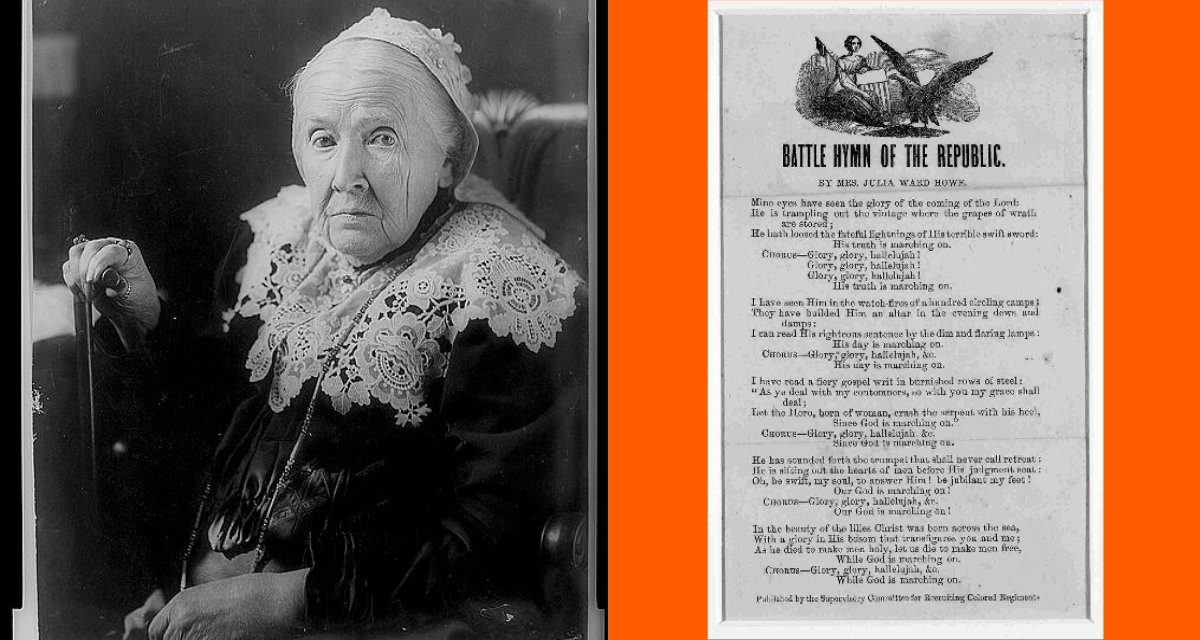
The song’s lyrics, still sung today, were written by poet Julia Ward Howe, an abolitionist who wrote them during the Civil War.
However, her words were not the original lyrics to the famous song.
Evolution of the ‘Battle Hymn of the Republic’
Before the Civil War, in 1856, a man named William Steffe wrote the melody and the original lyrics to what we know today as the “Battle Hymn of the Republic,” according to the Library of Congress:
Say brothers, will you meet us?Say brothers, will you meet us?Say brothers, will you meet us?On Canaan’s happy shore?
Glory, glory hallelujah!Glory, glory hallelujah!Glory, glory hallelujah!For ever, evermore!
At that time, the song was adopted by churches among free Black communities as a Methodist camp meeting song, particularly around Charleston, South Carolina. It became an abolitionist anthem following the raid on Harpers Ferry, led by abolitionist John Brown, on October 16, 1859.
Brown attempted to lead a small group in a failed slave revolt, which resulted in his execution. The words to Steffe’s song were changed to honor Brown, and it became a famous marching song known as “John Brown’s Body” among the Union Army, especially among Black troops:
John Brown’s body lies a-mouldering in the grave,John Brown’s body lies a-mouldering in the grave,John Brown’s body lies a-mouldering in the grave,His soul is marching on!
Julia Ward Howe’s lyrics
During a visit with her husband to Washington, D.C., in November 1861, Howe heard Union troops singing “John Brown’s Body” as they marched into battle in nearby Virginia. The story goes that a preacher standing with Howe urged her to write new lyrics for the song, something she had always wanted to do.
She wrote:
“I… awoke the next morning in the gray of the early dawn, and to my astonishment found that the wished-for lines were arranging themselves in my brain. I lay quite still until the last verse had completed itself in my thoughts, then hastily arose, saying to myself, I shall lose this if I don’t write it down immediately. I… began to scrawl the lines almost without looking…. Having completed this, I lay down again and fell asleep, but not before feeling that something of importance had happened to me.”
Howe infused the song with anti-slavery and Biblical references, and she sold her poem to the Atlantic Monthly for just $5 in February 1862. Her version was adopted into use and still lives on today:
Mine eyes have seen the glory of the coming of the Lord:He is trampling out the vintage where the grapes of wrath are stored;He hath loosed the fateful lightning of His terrible swift sword:His truth is marching on.
(Chorus) Glory, glory, hallelujah! Glory, glory, hallelujah! Glory, glory hallelujah! His truth is marching on.
After the Civil War, Howe continued her work as a suffragist dedicated to helping women win the right to vote, co-founding the National Woman Suffrage Association. She died in 1910.
The post A poet sold the lyrics to America’s iconic ‘Battle Hymn of the Republic’ for just $5 appeared first on Upworthy.








 New Posts (Home)
 ChatBox
 Popular Posts
  Game Zone
 Top PodCasts