www.newsbusters.org
MS NOW Touts Justice Jackson’s ‘Moving’ Birthright Citizenship Opinion
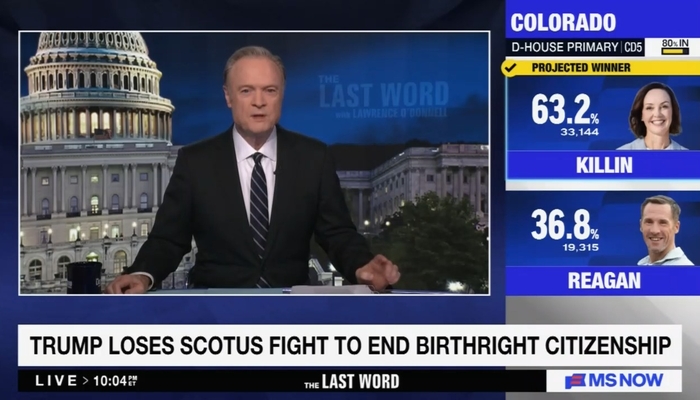
As the Supreme Court released their decision to uphold birthright citizenship, the leftist media celebrated President Trump’s defeat, though they still found plenty to complain about. MS NOW’s Lawrence O’Donnell and his guests on Monday’s The Last Word, Professor Laurence Tribe, Professor David Blight, and Senator Cory Booker (D-NJ) ripped into the dissenting Justices while misinterpreting American history and… (wait for it)... lavishing praise upon Justice Ketanji Brown Jackson.
“Can you explain to us why all nine Justices could not read that simple language of birthright citizenship the same way?” O’Donnell asked Tribe, teeing him up to attack the dissenting Justices.
“Well, they certainly could read it the same way if they were being honest lawyers without any agenda. . .” Tribe replied. “Four Supreme Court Justices just couldn't seem to read the language or the history the way anybody who has studied this subject outside the context of wanting to please Donald Trump and the revisionists understood it to mean.”
.@Harvard_Law professor Laurence (what kind of spelling is that?) Tribe calls the dissenting Justices of Trump v. Barbara dishonest lawyers: pic.twitter.com/4K3BVQfT9q
— Cici Marie (@Cici_Marie_1776) July 1, 2026
In his answer, Blight later told O’Donnell, “Section One of the 14th Amendment is what holds this country together,” and that, “it's like the angel hovering over us that whatever else we do wrong, whatever, you know, missteps we make in the world, we've still got that. It still holds us together as a community, whatever we are, whoever we are, color, religion, anything.”
Birthright citizenship is the only thing holding America together?
Miss me with that one, ya old geezer. pic.twitter.com/1H8jvHG7H0
— Cici Marie (@Cici_Marie_1776) July 1, 2026
The two Ivy League professors also expressed their horror that anyone dissented from what they felt was a self-evident principle:
TRIBE: What we did not know, what I think very few people predicted, was that on the basic Constitutional issue, this Court would rule 5 to 4. . . it is frightening because it represents the views of all but one of - you know, it's views of four Justices. All it takes is a shift of one.
(...)
BLIGHT: I can't answer for what's exactly in Samuel Alito's head, or Clarence Thomas's or Kavanaugh's, but what they really have is essentially a political and racial ideology. They have a racial vision of this country. They have a political and racial ideology in search of a history that's not there. But they're going to insist on finding one.
They weren't thoughtful or analytical or managed to look into the deeper meaning behind the law... they were just Trump suck-ups pic.twitter.com/nh6WlHaY6w
— Cici Marie (@Cici_Marie_1776) July 1, 2026
O’Donnell tried to make the point that anyone who was born in the United States, even those born to American citizens, had birthright citizenship:
My great-grandfather moved his family here when my grandfather was about eight years old. And my grandfather then was able to become a citizen. And then his children then had birthright citizenship. And I'm the second generation of birthright citizenship here. And it seems - one just wonders what - how Samuel Alito thinks he got his citizenship in this country.
Unfortunately Lawrence O'Donnell is a citizen of the US (even though he clearly hates the country) not because he was born here but because his parents were American citizens.
That should be the only definition of "birthright citizenship" pic.twitter.com/Dp5Hd1fg9t
— Cici Marie (@Cici_Marie_1776) July 1, 2026
Justice Alito’s parents were American citizens, and that’s how he got his citizenship, not just because he was born here. The same applies to O’Donnell.
When they weren’t ripping on the dissenting Justices, O’Donnell and company were rushing to kneel before Jackson, the woman who can’t define what a woman is.
“She's writing opinions that are so pointed, so powerful, that she is not just speaking to the high-minded intellectual legal scholars. She is speaking to the very idea of America,” Senator Booker gushed.
Insufferable: @SenBooker worshipping Ketanji Brown Jackson
She only had a "brutal" confirmation hearing because SHE couldn't define what a woman was! pic.twitter.com/wV29X8xAZ7
— Cici Marie (@Cici_Marie_1776) July 1, 2026
“It reads like a historical essay,” Blight referred to Jackson’s opinion. “It is a historical essay, it's deeply researched, she not only quotes from me or quotes Frederick Douglass several times, but six, seven other historians, the best historians of Reconstruction."
How humble Blight was to associate himself with Frederick Douglass, and in the same sentence classify himself within the top seven Reconstruction historians of all time.
Real humble, there: Yale professor David Blight places himself up on Frederick Douglass's level and classifies himself within the top 7 Reconstruction historians ever.
He also wants Jackson's opinion in a scholarly journal.
The Ivy League is now a clown show. pic.twitter.com/BFAtzbR8Oo
— Cici Marie (@Cici_Marie_1776) July 1, 2026
In case you doubted that Ivy League schools had completely lost their intellectual prowess, these professors touted Jackson, who used the TikTok phrase “understood the assignment” in the first section of her concurring opinion. Yet, Blight immediately wanted to put that embarrassing document into a scholarly journal:
I already emailed the Executive Director of the Organization of American Historians, and I said, 'Is there any way we could put Jackson's opinion in the next issue of the Journal of American History?’
To top off all the delusional ranting, they stuffed in a little court-packing propaganda:
TRIBE: We really have to think seriously about reforming the Court when we have the votes to do it, because the Court is now stacked in a direction that is profoundly ahistorical, profoundly anti-Constitutional.
BOOKER: We must put term limits on the court. Take people that have been there for more than 18 years, limit their jurisdiction, and create a fair court where every president has two appointments to that Supreme Court, those two reforms, these are bills I'm on with my colleague, Senator Whitehouse. Those two reforms could bring this court back in alignment with the people and not just the powerful.
As an American who has all the basic rights she needs.... nah, bro.
Source: @CoryBooker on @MSNOWNews's The Last Word, 6/30/26 pic.twitter.com/rKlEiIamrq
— Cici Marie (@Cici_Marie_1776) July 1, 2026
If the Democrats do take back the government, it’s possible they would shove these anti-Constitutional reforms through to poison the Court from within.
The transcripts are below. Click "expand" to read:
MS NOW's The Last Word with Lawrence O'Donnell
6/30/26
10:12:21 p.m. Eastern
(...)
LAWRENCE O'DONNELL: And leading off our coverage tonight is Professor Laurence Tribe, who has taught Constitutional Law at Harvard Law School for five decades.
Professor Tribe, I know you've been waiting for this decision, as we all have, since it was - the Court agreed to take the case in the first place. Were you - can you explain to us why all nine Justices could not read that simple language of birthright citizenship the same way?
LAURENCE TRIBE: Well, they certainly could read it the same way if they were being honest lawyers without any agenda.
Nobody took seriously this strange argument that the 14th Amendment doesn't mean what it says, that the language 'subject to the jurisdiction thereof,' means something other than being subject to the power of the United States, which applies to everybody born here, unless they happen to be born in a foreign embassy or in a foreign military encampment, they could all read it.
But gradually, what sociologists and philosophers call 'the Overton window,' the range of argument that is considered at least worth taking seriously, gradually that shifted. It shifted because Donald Trump and Stephen Miller wanted to find lawyers who would argue this completely ahistorical position, atextual, ahistorical, inconsistent with what Ketanji Brown Jackson rightly described as the 'second founding' of the country. They wanted to find lawyers who would read it in this odd, different way. And sure enough, they did.
I didn't expect this decision to be unanimous. Even before the argument, we knew that there were indications in some of the writings of Clarence Thomas in particular, but also Samuel Alito, who suggested they might come up with some way to agree with the revisionist lawyers. What we did not know, what I think very few people predicted, was that on the basic Constitutional issue, this Court would rule five to four.
In fact, a lot of the reporting of the decision misses the point. Some of them say, 'Well, it was five and a half to three and a half because Justice Kavanaugh dissented only in part.' No, no, no. He was very clear on the Constitutional question. He agreed with Clarence Thomas and with Justice Gorsuch and Justice Alito.
And so, four Justices, four Supreme Court Justices just couldn't seem to read the language or the history the way anybody who has studied this subject outside the context of wanting to please Donald Trump and the revisionists, understood it to mean. So it was five to four.
That means that we are a heartbeat away from basically repealing the core part of the 14th Amendment, the part that defines what America is, that America is a nation where each human being is valued for him or herself, where it is not who your parents were or where they came from, but who you are. Were you born here? Then you're a citizen. Were you naturalized? Then you're a citizen. It's not a matter of ancestry. It's not a matter of ethnicity or race.
And I think Justice Jackson hit the nail on the head when she said, 'It's supremely ironic for the Justice, who most vividly insists that ours is a colorblind constitution to transmute what was a fundamental principle about being an American into a specific remedy for a racially odious decision, Dred Scott v. Sandford.'
Five to four. It's really - that's the news. That's the sad news.
O'DONNELL: Justice Alito seems to think that the invention of the jet engine should therefore have changed the Constitution, because he believes now that it's just too easy for a pregnant woman to get on a plane and get to this country and give birth in this country and thereby obtain citizenship for that child.
But he should know that his ancestors were - and ours were coming over to this country on ships now, for hundreds of years, pregnant women were arriving on these shores for hundreds of years from impoverished places on the planet, hoping that there might be more food here than the place they left.
TRIBE: Well, that's true, and he's discovered something that most people have known for hundreds of years. Yes, a pregnant woman can come to the United States of America, have a baby, and that baby is an American.
If he doesn't like it, he can propose a Constitutional Amendment that would get rid of it. But you don't get rid of it by executive order. You don't get rid of it by statute, which is something that Justice Kavanaugh seems to think you could do, because he doesn't think the Constitution means what it says.
The fact that somebody can come here and have a baby and the baby is an American is part of the nature of this country. We are to that extent, a country that is built on land, not on blood.
They have this idea, the revisionists, that it is the DNA or the - your ancestry, where you came from.
We're all equal. They don't seem to understand that, as Justice Jackson pointed out, the point of this language was to ensure that the premise of the Declaration of Independence about equality was a promise that we could really begin to meet.
That's why people think of it as the second founding, the Great Emancipator Abraham Lincoln recognized when he read Dred Scott that that was a terrible, odious decision, not just because of what it said about slaves and former slaves, not just because it dehumanized Black people in this country, but because it created a caste system. It obliterated the idea that all people are equal.
The core idea that the Declaration of Independence said was self-evidently true, but it's not self-evidently true, it seems, to those Justices who want to reconstruct a hierarchical society.
In fact, the dissenters accuse the Chief Justice and Justice Ketanji Brown Jackson and Justice Barrett and Justice Sotomayor and Justice Kagan of a return to feudalism because they make things turn on the land. They don't seem to understand what feudalism is.
The ahistorical character as well as the legally blind and illiterate character of the dissenting views in this case is astonishing, but it is frightening because it represents the views of all but one of - you know, it's views of four Justices. All it takes is a shift of one.
That's why I think we really have to think seriously about reforming the Court when we have the votes to do it, because the Court is now stacked in a direction that is profoundly ahistorical, profoundly anti-Constitutional.
O'DONNELL: Harvard Law Professor Laurence Tribe, thank you very much for starting off our coverage tonight.
TRIBE: Thank you for having me, Lawrence.
MS NOW's The Last Word with Lawrence O'Donnell
6/30/26
10:27:45 p.m.
(...)
LAWRENCE O'DONNELL: And joining us now is David Blight, Yale University Professor of History and Black Studies. He's the author of the Pulitzer Prize winning book, Frederick Douglass: Prophet of Freedom.
And Professor Blight, Justice Jackson quoted your book and your writing in her opinion today. We just heard Professor Tribe talk about the historical references made by the Justices. And I know this is always an interesting exercise for you to read the amateur historian work done in Supreme Court opinions.
What was your reading of this one today?
DAVID BLIGHT: Justice Jackson was not an amateur today. Quite, quite the opposite in fact.
I already emailed the Executive Director of the Organization of American Historians, and I said, 'Is there any way we could put Jackson's opinion in the next issue of the Journal of American History?' Because, frankly, Lawrence, it reads like a historical essay. It is a historical essay, it's deeply researched, she not only quotes from me or quotes Frederick Douglass several times, but six, seven other historians, the best historians of Reconstruction.
And, you know, it sets up her essential argument, which is that Section One of the 14th - and especially birthright citizenship, is rooted in universalist principles.
And she even ends by not only quoting Douglass, which, by the way, at least three of the nine Justices did in today's opinions. Thomas did too, of course. Thomas loves Frederick Douglass for his own peculiar ways. But even Justice Roberts quoted Douglass at the very beginning.
But Justice Jackson ends by going to a section in my book. It was so moving to me, I must tell you, where I - it's 1866, Frederick Douglass is out on the circuit, he's arguing for the 14th Amendment. He's making the case that the country has to get behind this. And he does what he always did. He went to the Old Testament, he went to Genesis.
And Justice Jackson quotes the passage from Genesis 18-19, where it's God wrecking holy Hell on Sodom and Gomorrah, and there's nothing left of the towns. It's just all burnt, burnt Earth. And then he has Abraham, the prophet, overlooking the scene and saying, 'Nations must have memories. Nations must remember this.'
Of course, the metaphor is, Americans have just experienced their Civil War, and they're now remaking themselves. 'Remember, as you remake yourselves.' That was Jackson going to a source to make a universalist point, a universalist argument about the meaning of birthright citizenship.
And I have to say, she took on her colleague Justice Thomas directly. She took him to the shed. I mean, she ripped him for his misuses of history and his, frankly, 80-whatever page meandering analysis of this idea of domicile and this idea that 'The jurisdiction thereof' and this idea that it's going to be wandering foreigners, and, he even uses that term 'strangers,' 'foreigners wandering through this country demanding citizenship.' It was such an ugly, in Thomas's case, an ugly kind of argument against immigration. He converted his 80-some page dissent into a frankly ugly argument against immigration.
And Justice Jackson called him.
O'DONNELL: The - you know, my great-grandfather moved his family here when my grandfather was about eight years old. And my grandfather then was able to become a citizen. And then his children then had birthright citizenship. And I'm the second--
BLIGHT: Same with me!
O'DONNELL: --second generation of birthright citizenship here. And it seems - one just wonders what - how Samuel Alito thinks he got his citizenship in this country.
BLIGHT: Well, I can't answer for what's exactly in Samuel Alito's head, or Clarence Thomas's or Kavanaugh's, but what they really have is essentially a political and racial ideology. They have a racial vision of this country. They have a political and racial ideology in search of a history that's not there. But they're going to insist on finding one.
And frankly, Lawrence, I had this reaction today, and I've had it for actually, months.
Most Americans are going to think about their grandparents and great-grandparents and so on when they hear about this decision. We've all got this story. Millions and millions of us, my German-born grandparents, came here in the late 1890s. My mother was born here and is hence a citizen, and therefore I am. I mean, it's that simple. And we've all got that story. I mean, virtually everyone.
But this is - and this idea of Alito, what does he do? He goes in the first paragraph of his dissent. He goes to this business of birth tourism. This is what I mean by an ideology in search of a history that - they're reaching.
I mean, it's painful, almost, to read how much they are reaching to try to twist the birthright citizenship clause of the 14th Amendment into something that would fit this racial and political, ideological vision of this country.
And I share Professor Tribe's fear that this really is a five-four decision. When you read Kavanaugh saying, 'Okay, it's really up to Congress. Go ahead, Congress.' That's how close we are.
And frankly, let's admit it again. Section One of the 14th Amendment is what holds this country together. What else has held us together for 160 years but this idea of our pluralism. It's really messy. We have terrible conflicts. We always will.
But Section One of the 14th Amendment is the - it's like the angel hovering over us that whatever else we do wrong, whatever, you know, missteps we make in the world, we've still got that. It still holds us together as a community, whatever we are, whoever we are, color, religion, anything.
It's the 14th Amendment that remade the United States. That's what the new founding really is. The new founding is not just in Section One of the 14th amendment, but without it, there would have been no refounding.
O'DONNELL: Pulitzer Prize winning historian David Blight such an honor to have you join us tonight. Thank you very much for the important work you've done that was cited by the Supreme Court today. And thank you for joining us tonight.
BLIGHT: Thanks, Lawrence.
MS NOW's The Last Word with Lawrence O'Donnell
6/30/26
10:42:24 p.m.
(...)
LAWRENCE O'DONNELL: And joining our coverage now is Democratic Senator Cory Booker of New Jersey. He is a member of the Senate Judiciary Committee, which has jurisdiction over the Supreme Court--
CORY BOOKER: I just want to say reverential awe. I don't know if there's a TV show on where you have the titans of history in Blight - in Bright and titans of legal jurisprudence and thought in Tribe, two amazing men. I feel like you've had Batman, Superman, and now you're having the head of the neighborhood watch on.
O'DONNELL: We're very, very glad you - but you have a role that they don't have. And we're going to get to that, Professor Tribe talking about the need for reform of the Supreme Court. We'll see what's possible.
BOOKER: But just give a nod to Ketanji Brown Jackson--
O'DONNELL: Yes--
BOOKER: --who came on the court--
O'DONNELL: --please do.
BOOKER: --had the most brutal confirmation hearing, came on the Court and did not remain quiet or silent.
She's writing opinions that are so pointed, so powerful, that she is not just speaking to the high-minded intellectual legal scholars. She is speaking to the very idea of America.
And at the 250th anniversary, as the first Black woman ever on that Court, she is affirming what it really means to be an American to these others who are betraying it clearly, and trying to change and contort and pervert our history. God bless Ketanji Brown Jackson.
(...)
10:45:19 p.m.
BOOKER: This is a corrupt Court. And we know that because there's a billionaire class.
And my brother, Senator Whitehouse, points this out so much. There's a billionaire class that circles around this, they lavish Supreme Court members with gifts, RV's, paying family tuitions, lavish vacations. In New Jersey, if judge did that, they would be carried out in handcuffs, put in prison.
There is a Court now that is on the side of the billionaires and the powerful in every decision you can trace it. 'Where is this? Is this going to hurt billionaires or help billionaires? Is it going to help concentrate the power or not?'
So I believe, if anything that America is seeing this, if you're just an American that wants basic rights, that sees this Court that's taken away your voting rights and your reproductive rights, in addition to advantaging the wealthy and the privileged in this country.
This is a moment you have to agree with. What is an urgency in my life on the judiciary committee, in my life, in public life, to rein that Court in, to put 100% - put the highest Court in the land, the highest ethics laws in the number two, what Professor Tribe alluded to.
We must put term limits on the court. Take people that have been there for more than 18 years, limit their jurisdiction, and create a fair court where every president has two appointments to that Supreme Court, those two reforms, these are bills I'm on with my with my colleague, Senator Whitehouse. Those two reforms could bring this court back in alignment with the people and not just the powerful.








 New Posts (Home)
 ChatBox
 Popular Posts
  Game Zone
 Top PodCasts