www.dailysignal.com
‘Unvexed to the Waters’: How a July Fourth Victory Turned the Tide at the Nation’s Darkest Hour
“Four score and seven years” after the signing of the Declaration of Independence, the survival of the American experiment was very much in doubt.
In 1863, President Abraham Lincoln oversaw a divided country mired in a civil war with no end in sight. Without decisive Union victories, a protracted conflict could only further dampen Northern support for the war in the 1864 elections, potentially forcing a negotiated peace. Union forces in the east had suffered a string of humiliating defeats. Confederate rebels in the west held fast to a stronghold on the Mississippi River that thwarted Union attempts to impose a complete blockade. The war was truly “testing whether that nation, or any nation so conceived and so dedicated, can long endure,” Lincoln said later in his immortal Gettysburg Address.
And then, the weekend of Independence Day, 1863, two decisive Union victories at Gettysburg and Vicksburg dealt a mortal blow to the rebellion. While the Battle of Gettysburg has its rightful place in historic military lore, the fall of Vicksburg on July Fourth was arguably of greater importance to the Union ultimately prevailing in its greatest test yet.
The fortified city of Vicksburg, Mississippi, sat high on bluffs over the Mississippi River and enabled Confederate control of at least part of the crucial waterway. While the Union had asserted clear naval supremacy in the open seas, the Confederate presence on the Mississippi maintained a bridge to its western states and prevented a complete blockade that was so crucial to the Union’s war strategy.
The rebels’ partial control of the river also hindered Northern commerce at a time when navigable rivers were critical to accessing the interior of the vast young country.
“See what a lot of land these fellows hold, of which Vicksburg is the key! The war can never be brought to a close until that key is in our pocket,” Lincoln reportedly said, according to U.S. Adm. David Porter’s memoirs. “We can take all the northern ports of the Confederacy, and they can defy us from Vicksburg.”
The city’s formidable defenses did not stop rising star Gen. Ulysses S. Grant, commander of the Army of the Tennessee and one of the few Union generals to score victories Lincoln desperately needed early in the war. In April 1863, he loaded his men on transports and sent them on a daring night run down the river and past the city’s guns.
The gambit succeeded, his army eventually landed in Mississippi far below the city, and at the beginning of May, he embarked on a weeks-long campaign into the state’s interior. The ambitious campaign foiled two Confederate armies and eventually trapped more than 30,000 Confederate troops around Vicksburg.
After launching two bloody, unsuccessful assaults on the Confederate fortifications that resulted in more than 3,000 Union casualties, Grant settled in for a siege in the hot summer. However, with few siege guns, victory was far from certain.
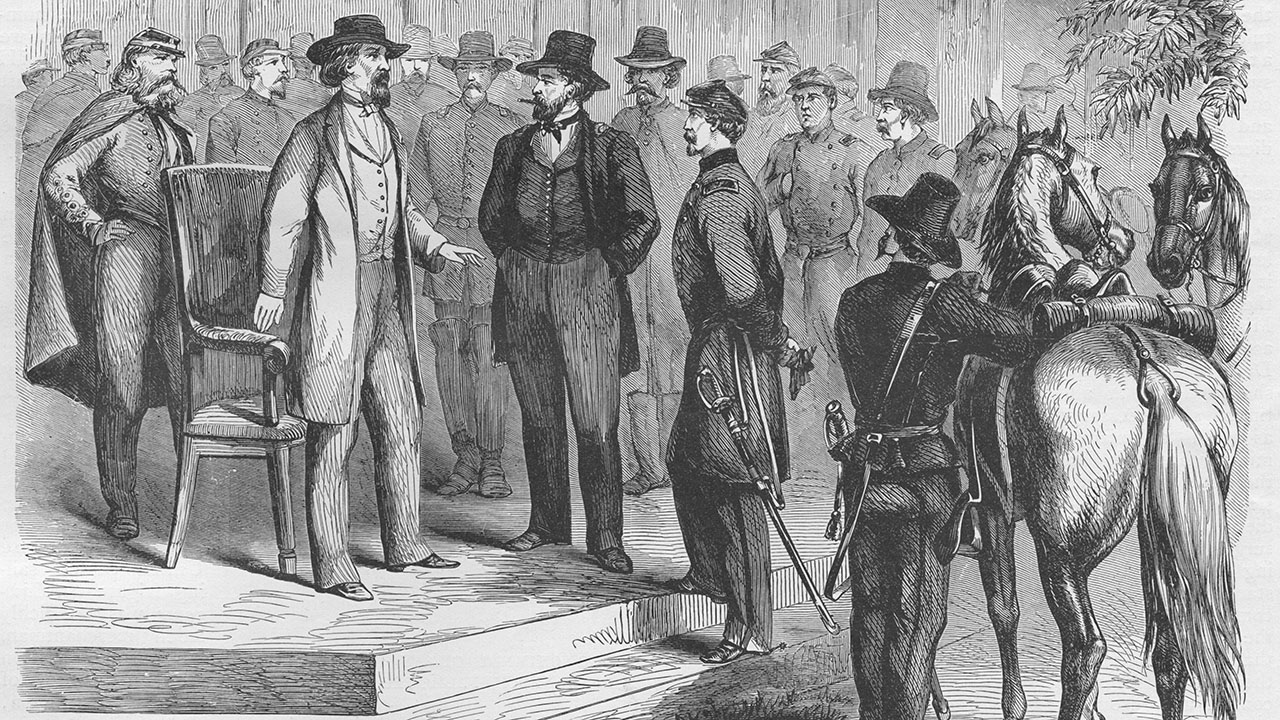
For 47 days, Grant’s army surrounded the city and pounded away at the fortifications. The Fourth of July loomed large, and weary Confederates expected the Union to launch an all-out assault on the holiday. Fearing a humiliating rout on Independence Day, the commander of the city’s defense, John C. Pemberton, met with Grant to discuss a surrender. On July Fourth, the Confederates surrendered, and the last remaining rebel fortress on the Mississippi River fell.
Grant’s terms—and his army—were magnanimous. “Our soldiers were no sooner inside the lines than the two armies began to fraternize,” he wrote later in his memoirs. “The enemy had been suffering, particularly towards the last. I myself saw our men taking bread from their haversacks and giving it to the enemy they had so recently been engaged in starving out.”
Lincoln, when informed of the news of Vicksburg’s fall, said, “The Father of Waters again goes unvexed to the sea.” The conquest split the Confederacy in half, completed a suffocating U.S. naval blockade, and removed an entire Confederate army from the field.
The victory was not just one of arms. The quality of the Union generals and officers, so wanting at the beginning of the war, was fast rising.
“A military education was acquired which no other school could have given,” Grant wrote in his memoirs of the campaign’s effect on his army.
Grant’s own military stature was now undeniable, as well. He had gained the enduring admiration of Lincoln and, by the spring of 1864, was placed in charge of all Union forces, setting the stage for his postbellum ascent to the presidency.
He knew well the full significance of that July Fourth, later writing, “The fate of the Confederacy was sealed when Vicksburg fell. Much hard fighting was to be done afterwards and many precious lives were to be sacrificed; but the MORALE was with the supporters of the Union ever after.”








 New Posts (Home)
 ChatBox
 Popular Posts
  Game Zone
 Top PodCasts