www.newsbusters.org
NY Times Issues 5,000-Word Hit Piece on Death-Dealing Florida Gov. Ron DeSantis
Sometimes the New York Times takes a respite from its non-stop vituperation of President Trump to indulge in a side-quest of leftist hostility against another successful Republican, Florida Gov. Ron DeSantis.
The New York Times Magazine issued a 5,000-word-plus collaboration with the left-wing non-profit news site ProPublica, “Capital Punishment Is on the Decline. Except in Ron DeSantis’s Florida.”
It’s written by Pamela Colloff, who “has been covering the death penalty for more than 25 years.” The online edition headline deck: “Why Is Florida Executing So Many Prisoners? – In most of the country, executions are a thing of the past. But one state has been carrying them out at a record pace.”
The opening lines observed strange new respect for religion, of the anti-death penalty variety.
This spring, Father Dustin Feddon began waking up in the middle of the night. Heart racing, he would stand at the bathroom sink in the dark, splashing cold water on his face until the feeling passed.
For about a dozen years, Father Dustin had visited prisoners on Florida’s death row as their appeals wound their way through the courts. Some had waited for decades, but the priest learned, more or less, how to accompany people through years of confinement and isolation without losing himself in their desolation. Then in January 2025, Gov. Ron DeSantis began signing death warrants at an accelerated rate. What followed was the busiest period of executions in more than eight decades in a state that has long been a stronghold of capital punishment.
Colloff noted grimly that “the Sunshine State accounted for 40 percent of all executions in the United States in 2025,” though the actual figures are modest:
Florida has executed nine men this year, more than all other states combined. The pace has transformed death watch, which had typically been empty or held one man at a time. Now all three cells are often occupied, with the next man scheduled to die housed closest to the chamber….
She noted that President Trump “has long been one of the death penalty’s most outspoken champions, making it a cornerstone of his law-and-order agenda….having “resumed federal executions in 2020, ending a 17-year hiatus.”
Nowhere has the president’s vision been pursued more relentlessly than in Florida, thanks to an unusual concentration of power in the governor’s office
….
….When I asked his office for comment, the head of communications, Alex Lanfranconi, sent a short response: “My advice to those who are seeking to avoid the death penalty in Florida would be to not murder people.”
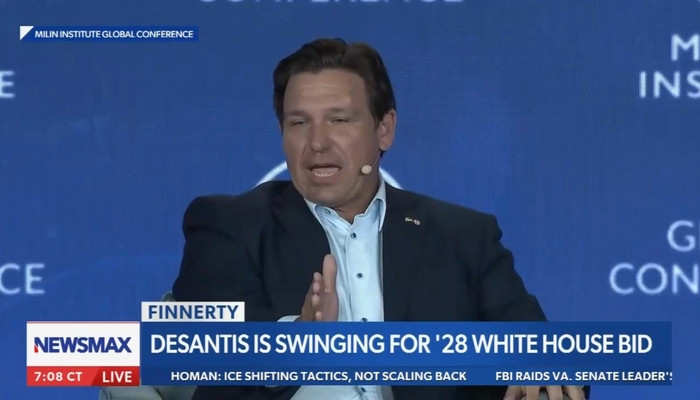
Some observers see a different calculus. DeSantis is term-limited and will leave office in January, but his political future remains an open question. Since ending his campaign for the White House in 2024, he has worked to repair his relationship with Trump; in April, Axios reported that he was lobbying for a position in the administration, with an eye toward attorney general.
Few who follow Florida politics believe he has abandoned his presidential ambitions. The sheer number of death warrants, wrote the editorial boards of The Orlando Sentinel and The South Florida Sun Sentinel last summer, “gives rise to wonder: Why the sudden rush? Is it another sign that he’s planning another run for president in 2028? Would he campaign as the governor who tried to empty his state’s death row?”
The local Orlando Sentinel paper mentioned above has been sometimes offensively biased in its DeSantis-related death penalty coverage.
The relative invisibility of executions — the sense that they take place with little public awareness — was what prompted Melanie Verdecia, a Jacksonville attorney, to start writing a newsletter on Substack, “Tracking Florida’s Death Penalty”….
Invisibility? Supposed death row doubts make the front page of the Orlando Sentinel on a regular basis. Colloff laid on the bathos with a bare mention of the victims of the men on death row.
That day, Hanna was drafting a news release, as her team did every execution day, to be sent out after Willacy was put to death. It began by acknowledging the victim at the center of the case, Marlys Sather, who was 56 when she returned to her home in Palm Bay during her lunch break one day in 1990, interrupting a burglary. Court records show that Willacy beat her, bound her and set her on fire before fleeing.
These news releases try to hold two realities at once: the suffering caused by the crime and the complicated path that led there….








 New Posts (Home)
 ChatBox
 Popular Posts
  Game Zone
 Top PodCasts