www.dailywire.com
Can The Earthquake Help Venezuela Shake The Dictatorship?
The earthquakes in Venezuela were a natural disaster, but corruption is the fault line that turned them into a man-made catastrophe. With thousands dead and tens of thousands missing, it is now tragically clear that Delcy Rodriguez is not the answer for a still failing Venezuela. If Venezuela is to be rebuilt — physically, economically, and politically — it must be as a democracy.
As decades of bribes and kickbacks filled the pockets of Hugo Chavez, Nicolás Maduro, and their cronies, corruption was simultaneously being built into the substandard buildings these earthquakes destroyed. Construction contracts went to whoever paid the largest bribe, not to whoever would build to code. Shoddy materials were used in housing developments built on unstable ground in known high-risk areas. When the earthquake hit on June 24, many of the 58,000 destroyed buildings were already hollowed out by decades of graft.
That corruption did not end with the Trump administration’s arrest of Maduro. Delcy Rodriguez, Maduro’s former vice president, has kept most of the corrupt officials from the Maduro era in place. Many of these holdovers have known ties to cartels and terror groups that are making billions of dollars from human trafficking, illegal gold mining, and drugs. Instead of developing government capacity over the last six months, officials filled their offshore bank accounts.
The earthquake made the failures of the Rodriguez administration painfully clear, with the government largely absent, ineffective, standing idly by, or actively interfering with relief efforts. Six of the senior officials leading the earthquake response are currently sanctioned for corruption, money laundering, drug trafficking, and repression.
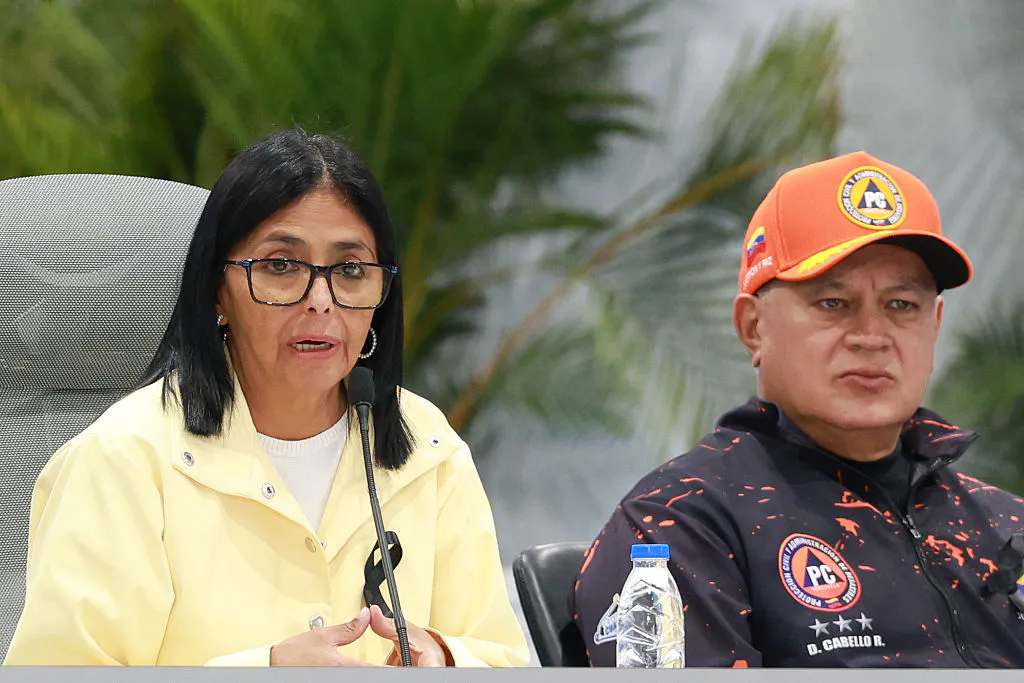
Diosdado Cabello — Minister of Interior, Justice and Peace and the target of a $25 million U.S. bounty for cocaine trafficking and selling rocket launchers to a U.S.-designated terrorist organization — stood next to the Venezuelan president as she addressed the nation about the earthquake response plan. Rodriguez encouraged Cabello to continue “working and inspecting” incoming humanitarian supplies. The next day, Cabello was caught on video blocking the truck of American rescue workers and interfering with their delivery of aid.
Rodriguez appointed Governor Rafael Lacava to her reconstruction commission, despite U.S. sanctions against him for “blocking the delivery of critical humanitarian aid” at the same time he funneled corrupt proceeds to secret accounts in Switzerland and Andorra.
Rodriguez’s brother, National Assembly President Jorge Rodriguez, will be leading a commission to build camps and housing for the displaced, despite U.S. sanctions for helping Maduro “solidify his hold on the military and the government while the Venezuelan people suffer.”
Even the runways meant to deliver relief suffered from both the earthquake and corruption. U.S. military personnel needed to repair damaged runways at Caracas’ main airport before relief flights could land, while between 2006 and 2015, Brazilian construction giant Odebrecht paid $98 million in bribes to Venezuelan officials to, among other things, overhaul the airport and its runways — a project that was never completed.
This is not a government capable of rebuilding Venezuela, and the people know it. When Rodriguez visited a neighborhood at the center of the disaster, the residents chanted, “Get out! Get out!” Trump’s popularity in the country is plummeting as well, with 90% of Venezuelans disapproving of his support for the current government.
The United States still has major interests in the country, first and foremost, the interest in helping people suffering from a traumatic event. The U.S. has pledged $300 million in disaster relief, but without major changes and strong oversight, those funds will inevitably be stolen by corrupt officials as displaced Venezuelans are left out in the cold.
Such corruption risks fueling a renewed migration crisis. And surging migration will, in turn, benefit human trafficking cartels, like Tren de Aragua, the U.S.-designated terrorist organization that formed a core rationale for overthrowing Maduro.
Cartels and terror groups given protection by corrupt officials in Venezuela could bleed over borders, undermining critical political transformations that are taking place in Colombia and Peru, or impact substantial U.S. investments in neighboring Guyana.
Even cold calculations of profit must recognize the wasted private sector opportunities if this government remains in power. This is not a country that is currently capable of attracting significant U.S. investment or acting as a regional ally.
America’s leverage to force a change of government, however, is limited. In the wake of major operations in Venezuela and Iran and with midterm elections looming, a return of substantial military pressure is unlikely. Fortunately, corruption itself provides another pathway.
As corrupt Venezuelan officials demand bribes from visiting U.S. investors, businesses, or government counterparts, they bring themselves under the criminal jurisdiction of U.S. courts. The Foreign Extortion Prevention Act, enacted in 2024, provides for sentences of up to 15 years for bribery demands of U.S. persons by foreign officials. Using the gavel instead of the gunship, the Trump administration might have the legal ammunition to incentivize the regime to establish a short timetable for a fair and free election.
It is time for the U.S. to listen to the chants of the people and deliver what this moment demands: democracy, freedom, and a path for Venezuelans to determine their own future.
***
Josh Birenbaum is deputy director of the Center on Economic and Financial Power at the Foundation for Defense of Democracies. Carrie Filipetti is the Executive Director of the Vandenberg Coalition and the former Deputy Special Representative for Venezuela at the U.S. Department of State.








 New Posts (Home)
 ChatBox
 Popular Posts
  Game Zone
 Top PodCasts