www.upworthy.com
Yes, cats do treat men and women differently. Researchers say it’s all in the meows.
If you think your cat might be a little sexist, there’s now some scientific proof to back it up.
Modern research has continued to reveal that a cat’s meow is a very nuanced system of communication used solely for the humans in their lives.
A recent study led by a team from Ankara University in Turkey had 31 cat owners wear chest cameras to see how their felines greeted them as they returned home.
Cats know exactly who they’re talking to
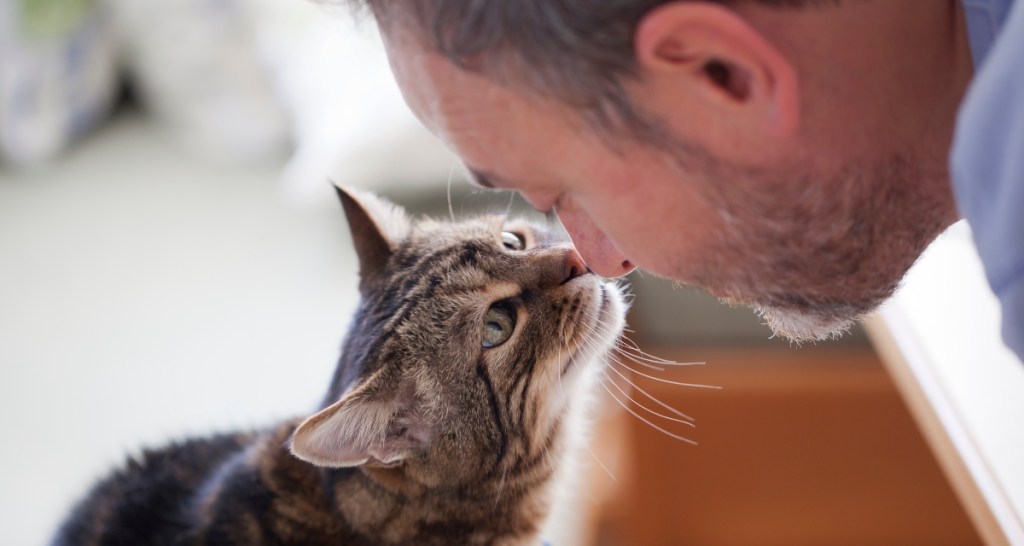
One thing quickly became clear: Cats were much more vocal when the person coming home was male.
Man and cat Canva
According to the study, male cat owners produced an average of 4.3 vocalizations (meows, purrs, or chirps) during the first 100 seconds of entering the room, compared to an average of 1.8 for female owners.
However, before you assume that this is because cats are closer to their males humors. The researchers have a different theory: men require more direct communication.
Previous studies have confirmed that women tend to give their cats more attention, pick up subtle, non-verbal signs of their cats’ emotions, and are more likely to speak in a register that feels both safe and familiar to their feline, all leading to a more “intense relationship.”
Woman with cat. Canva
Men, on the other paw, are far less inclined to give baby talk or take a hint.
And thus, cats seemingly have adapted to give their male caregivers more “explicit vocalizations,” as the researchers put it, to grab their attention.
The study also found that a tail up and rubbing up against a leg (also known as allorubbing) when greeting their owner indicated a positive relationship, whereas yawning, shaking, scratching, or licking could be a coping mechanism for stress or frustration.
More than meowing for their supper
British shorthari enjoying lobster Canva
As for whether or not cats only interact with their humans for food—not only has that stereotype been debunked previously; this study tracked “food-related behaviors” (like running to the food bowl or eating) alongside the social greetings. The findings clearly showed that greetings were in no way a method to gain food. They were purely for social recognition.
In other words: cats are not as aloof or food-driven as we have been made to believe. The excited welcome many owners receive at the door is exactly what it appears to be: a social interaction between companions, rather than a calculated attempt to fill an empty food bowl.
Every cat has its own language
While this study is admittedly small, and therefore can’t definitively argue that cats treat all men differently than all women, what it does say is that cats have a remarkable way of customizing their communication in the best possible way for their pet parent to hear them.
As scientists continue learning more about feline behavior, one thing is becoming increasingly clear: our cats are paying much closer attention to us than we may have realized.
The post Yes, cats do treat men and women differently. Researchers say it’s all in the meows. appeared first on Upworthy.








 New Posts (Home)
 ChatBox
 Popular Posts
  Game Zone
 Top PodCasts