reactormag.com
Voracious Urchins, Angry Orcas, and Tuna Conspiracies: Helen Scales’ What the Wild Sea Can Be
Books
Seeds of Story
Voracious Urchins, Angry Orcas, and Tuna Conspiracies: Helen Scales’ What the Wild Sea Can Be
Exploring the history of the ocean, the critical environmental threats if faces, and strategies and solutions for its future
By Ruthanna Emrys
|
Published on July 14, 2026
Comment
0
Share New
Share
Welcome to Seeds of Story, where I explore the non-fiction that inspires—or should inspire—speculative fiction. Every couple weeks, we’ll dive into a book, article, or other source of ideas that are sparking current stories, or that have untapped potential to do so. Each article will include an overview of the source(s), a review of its readability and plausibility, and highlights of the best two or three “seeds” found there.
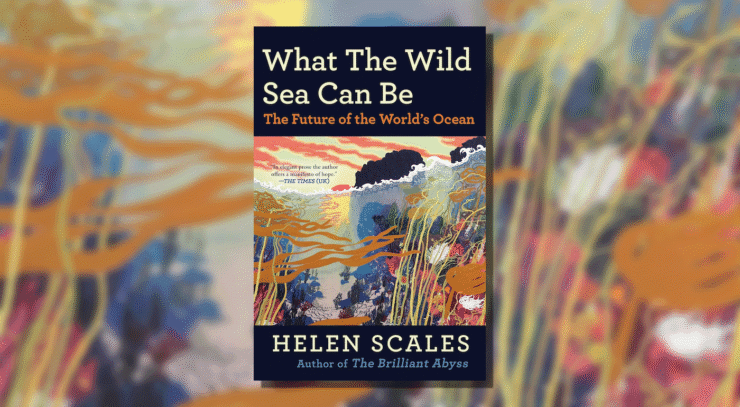
This week, I cover Helen Scales’ What the Wild Sea Can Be: The Future of the World’s Oceans. It’s a little bit census of climate impacts, a little bit exploration of cool ecosystems, and a lot of speculation about what might change in the ocean—for better and worse—in the coming decades.
What It’s About
There are many benefits to being a marine biologist. For Dr. Helen Scales, one of those benefits is a career in nature writing, with books on topics ranging from seahorses to seashells to deep sea life. What the Wild Sea Can Be goes beyond any single genus or ecosystem, with each chapter diving (sorry not sorry) into a specific human impact on the ocean. For each, we get a sense of the system in question, why it’s both cool and important, why it’s in danger, and what’s being done to save it.
As foundation, Scales kicks off with the ocean’s deep time history. Earth’s waters have changed dramatically over the aeons. Twenty-five-thousand species of trilobites flourished in the Cambrian and Ordovician, taking advantage of the initial wash of eroding minerals from the land to build exoskeletons and crystalline eyes. Though they were finally knocked out by the end-Permian extinction, ice age cooling and the loss of shallow inland seas made them vulnerable long before. Then the first fish came along and found them tasty. The point is twofold: oceanic change has a long history, and we shouldn’t underestimate how dramatically once-robust ecosystems can collapse.
The ocean faces threats from a range of anthropocene activities. Climate change warms and acidifies water, pushing species into new habitats. This isn’t, unfortunately, a matter of whole ecosystems moving en mass—there’s no guarantee that a species will move alongside its food sources, or alongside shelter and protection from predators. At the same time, microplastics and other pollution interfere with growth, health, and fertility. Orcas, for example, have massive reproductive challenges due to the combination of being top predators (accumulating pollution from their prey) and their massive blankets of warming fat (which hoard those chemicals along with everything fat is supposed to store).
Then there’s overfishing. Humans stress oceanic ecosystems not merely due to the amount of fish we eat, but via technological hunting methods that increase the speed and quantity of the catch alongside increasing bycatch of non-target fauna (e.g., longlines full of baited hooks that extend for miles) and collateral damage (e.g., bottom trawlers that cut swaths along the seafloor). Many of these methods also contribute to microplastic pollution. Despite what you hear from people complaining about straw bans, however, 80% of ocean plastics come from land-based sources—though not, to be fair, from straws in particular.
Some solutions, like banning single-use plastics, or replacing fossil-fuel-based plastics with bio-plastics, require broad-strokes change. Others are more focused. Coastal kelp forests benefit dramatically from rewilding sea otters, whose populations collapsed from over-hunting in the 20th century. Sea otters eat urchins, which if not controlled will gobble young kelp before they can grow to shelter sea dragons, giant cuttlefish, sea hares, and wobbegong sharks. The kelp in turn protects the otters from sharks that are expanding territories in warming seas, and which keep the otters from migrating naturally. Kelp also draws down 18 megatons of CO2 annually, and absorbs nutrient runoff that otherwise leads to algal blooms and mass die-offs.
Scales also talks about fishery reserves—and the importance of actual enforcement. There are a lot of ostensible oases where “illegal” fishing is at higher levels than in unregulated waters. The International Convention for the Conservation of Atlantic Tunas is sometimes called “the International Conspiracy to Catch All Tunas.” On the other hand, many fisheries—including now, finally, the bluefin tuna fishery—do recover with sufficiently strong controls. And in a few locations, no-take marine reserves allow populations to recover and thrive, often with results spilling into areas where fishing is allowed.
Scales closes out with emerging controversies, proposals, and areas of wild speculation. Companies invest in mining polymetallic nodules for the growing battery market; people push back on the massive ecosystem disruption; other companies develop saline-based batteries that don’t require the metals in the first place. Activists attempt to sweep up the Great Pacific Garbage Patch, only to discover that they risk the same sort of bycatch as fishing technologies. People become less dependent on open-fished food and more on aquaculture, but krill get over-harvested to feed farmed fish. And so on. There are last-ditch compromises, such as keeping a library of coral in a climate-controlled repository until seas cool again. There are dubious possibilities that would be great if they panned out—blockchain-based tracking of seafood sustainability, for example, and AI-based tailored reef restoration, and lab-grown fish meat (currently running about $20,000 a pound and an eye-watering energy budget). There are also some obvious wins, like rebuilding and managing coastal wetlands.
As long as we’re talking about the problems and taking them seriously, rather than trying to ignore them as we did for so long, we have many options for what the sea’s future might look like. If we follow those possibilities, it might become very wild indeed.
Buy the Book
What the Wild Sea Can Be: The Future of the World’s Ocean
Helen Scales
Buy Book
What the Wild Sea Can Be: The Future of the World’s Ocean
Helen Scales
Buy this book from:
AmazonBarnes and NobleiBooksIndieBoundTarget
This is a book I read due to immediate need, rather than as general contribution to my creative compost—homework for a high-seas adventure set in a highly-geoengineered future. I was looking for a mix of hopeful developments, distressing ones, and dramatic tradeoffs. I was also trying to figure out what role uplifted octopodes might play in minimizing the harm of a polymetallic nodule mine, which probably won’t even come up in that chapter. So, y’know, the usual woes of writing research. What the Wild Sea Can Be is a great source for this type of thing, full of crunchy conflicts and cool breakthroughs and the sort of high-risk high-tech ideas that appeal to a certain sort of funder.
For a book that has “wild” in the title, I did sometimes feel that it wasn’t wild enough. Scales calls for fishing treaties that value species for their own sake, yet doesn’t bring up the Rights of Nature movement—which creates frameworks for treaties to take non-human perspectives seriously. Macfarlane’s Is a River Alive? tries hard to step outside the view of humans-versus-nature; this feels like it ultimately keeps humans separate. This limitation is especially clear when Scales talks about no-take reserves. There’s no suggestion that humans might have a long-term natural role in these ecosystems, alongside Anthropocene innovations like rewilding. There’s a sense that we can work to mitigate our harm, but that it would’ve been better if we were never involved at all.
Extending this problem, Scales is respectful of Indigenous relationships with the ocean… in a way that almost totally ignores the role that Indigenous knowledge might play in preserving it. She’s careful to call places by their Indigenous names, and quotes Indigenous activists around the borders of international treaties. She mentions that the Siuslaw in Oregon feel kinship with otters. But beyond an Aotearoan no-take zone that inspired one in Scotland, there’s no mention of traditional fishing techniques, no Robin Wall Kimmerer-style research on how those techniques affect ecosystem health, no suggestion that excluding people from their ancestral ocean-tending grounds might be a problem. I know not every research field can have its own best-selling integrator of traditional wisdom and cutting-edge science, but basic examples aren’t hard to come by.
There is also, somehow, no mention of Elinor Ostrom, who researched effective fishery management, and won a Nobel Prize for disproving the claim that the commons are inevitably tragic.
So: frustrating, but also informative and engaging. I learned how warming oceans led tiger and great white sharks to Cape Cod, where I grew up on beaches free of both sharks and seals. I learned about the invasive lionfish that I’ve seen on menus (always somehow sold out, alas, despite their numbers). I learned about breeding coral polyps, and their photosynthetic symbionts, for heat tolerance. There’s a terrific discussion of the problems facing orcas, and the recent cetacean fad for ramming yachts. I learned about mass radiations (the opposite of mass extinctions!), and horrifying urchin mouths with mobile teeth (“Aristotle’s lanterns”!), and Elvis worms (they sparkle!). And there’s a real understanding of the degree to which change requires all sorts of community members and ecosystem participants—that you have to work with fishers and divers and scientists, that you need to take everyone’s needs into account to get agreements that last.
The Best Seeds for Speculative Stories
Beyond Cat Aliens. If you’re looking for weird models for non-humanoid aliens, the ocean might get you further than common household domesticates. No shade on people who’re into cat-girls, but consider a sand tiger shark-girl, and her fraught relationship with her twin, and the attendant ghosts of all their siblings who they cannibalized before their birth. Or a species based around the equivalent of deep-sea vents, with life focused around rare hubs and hazardous anywhere in between? (Oh wait, that’s stars, isn’t it? Have a metaphor.)
We already have space whales. We need space octopodes and space otters and space coral.
Beyond Pirates. One problem with marine reserves is that the ocean isn’t great with boundaries. Species move, habitats change, and you can’t just outline a park and leave it alone. Says Scales: “The way reserves are set up will have to become a lot more responsive, with plans and regulations that can change and adapt as the environment changes.” This opens up a lot of fascinating future jobs in tracking those changes, in trying to predict “not only where species exist now but where they will likely move to,” and in redirecting threats in real time. Some of this might involve telling ships to slow down near whales (as already happens in a few places), but it might also require more direct—and dramatic—confrontations.
Another source of jobs, and stories, is reef restoration, which Scales suggests needs “a techno-centric transformation on par with the industrialization of agriculture.” I’m not convinced that near-term robotics are up to the precision required to successfully replant polyps without breaking older coral, but it’s worth speculating what it would look like—and maybe prodding some research. (Alternatively, consider: uplifted octopuses.)
New Growth: What Else to Read
There’s an overwhelming cornucopia of oceanic non-fiction out there. At the human surface, Elliot Rappaport’s Reading the Glass: A Captain’s View of Weather, Water, and Life on Ships is a great, McFarlane-ish mix of shipboard adventure and explanation of how we predict the weather that makes shipboard life adventurous. Sy Montgomery’s The Soul of an Octopus is the seed for my uplifted octopodes. (Apologies to my wife for not using the Greek pluralization every time. Apologies to everyone else for using it most of the time.) Elizabeth Kolbert’s Under a White Sky: The Nature of the Future is next on my list for brainstorming geoengineering tradeoffs. Warren Belasco’s Meals to Come: A History of the Future of Food is on my list for what seafood we’ll be eating, and how we’ll get it from water to table.
The cornucopia of oceanic fiction is not lesser. James Cambias’ A Darkling Sea has a great alien seafloor vent ecosystem, even if it doesn’t have many women of any species. You can find sapient octopuses in Shelby Van Pelt’s Remarkably Bright Creatures and Ray Nayler’s The Mountain in the Sea. There’s a really excellent shark in Diane Duane’s Deep Wizardry. Nnedi Okorafor’s Lagoon begins with a prologue from the point of view of a swordfish and gets weirder and more awesome from there. Mira Grant’s Rolling in the Deep and Into the Drowning Deep really appreciate marine biology, and the value of studying something that’s trying to eat you. I will stop there, dammit.
Share your own aquatic story recommendations in the comments![end-mark]
The post Voracious Urchins, Angry Orcas, and Tuna Conspiracies: Helen Scales’ <i>What the Wild Sea Can Be</i> appeared first on Reactor.








 New Posts (Home)
 ChatBox
 Popular Posts
  Game Zone
 Top PodCasts