www.optimistdaily.com
How Paris uses the Seine to cool thousands of buildings without AC
BY THE OPTIMIST DAILY EDITORIAL TEAM
Every air conditioner does the same thing: pull heat from inside a building and dump it outside. On a hot day, millions of units doing that together push street temperatures up, which makes the next hot day worse. “Everything that requires energy releases heat, and that heat has to go somewhere,” said Sophie Parison, a researcher in Paris focused on urban heat and cooling. Paris has been building a different model for thirty years and is now planning to triple it.
How the Seine becomes a cooling utility
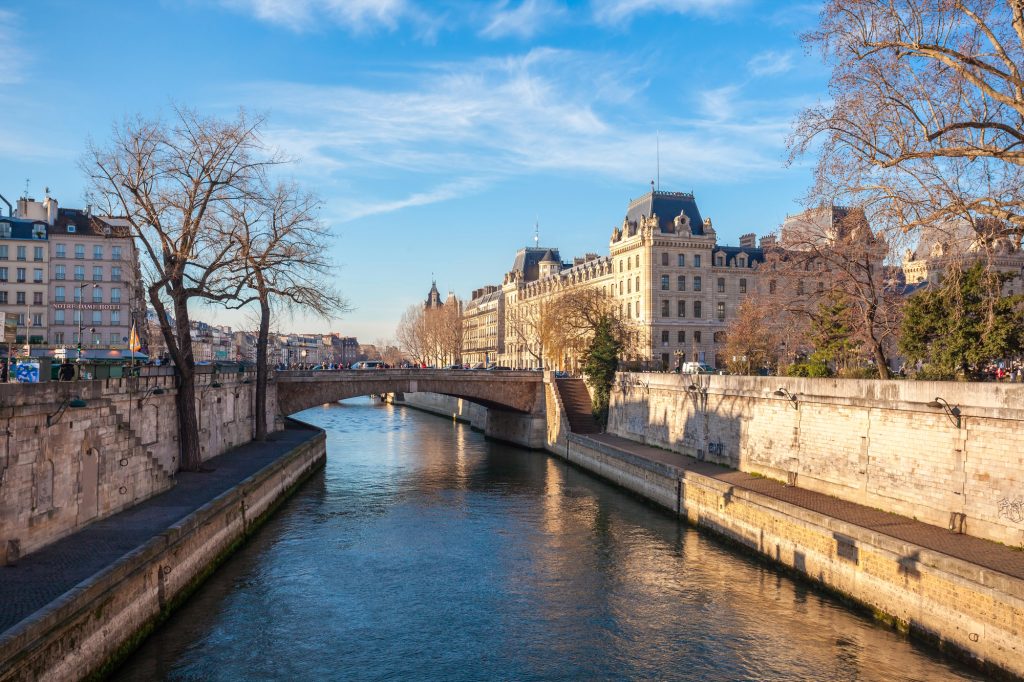
Fraîcheur de Paris, which translates roughly as “the freshness of Paris,” operates 120 kilometers (75 miles) of underground pipes beneath the city. Cold water drawn from the Seine runs through one pipe parallel to a second pipe carrying warm return water from connected buildings. A heat exchanger moves warmth across a thin metal wall between them, the two fluids never touching. The cooled water circulates back into the buildings; the Seine water goes back to the river, slightly warmer than it left.
Monitoring has so far shown that those temperature changes stay within environmental limits with no measurable harm to the river’s ecology. The Louvre, the Grand Palais, hospitals, schools, and major office districts are already on the network. Cooling is produced at a central point and piped out like electricity or water.
The expansion
Paris plans to triple the network’s size by 2042, reaching more than 3,000 buildings across all of the city’s arrondissements. Hospitals, schools, day-care centers, and retirement homes are the top priorities.
“The ambition is to move from a historic network focused on large tertiary buildings to a city-wide infrastructure,” said Tim Guigon, a spokesperson for Fraîcheur de Paris.
The 20-year contract, renewed in 2022 and valued at €2.4 billion (roughly $2.6 billion), is held jointly by transportation company RATP and Engie. The city of Paris owns the network outright.
The energy case
Individual AC units are energy-hungry, and because they push heat outside, millions of them running in parallel collectively raise the temperatures they are there to lower. District cooling cuts into that loop. “The energy consumption should be much less than if the same cooling were provided by modular systems,” said Charles Simpson, a senior researcher in climate change at University College London.
Pauline Lavaud, the city’s director of climate transition, said the network “offers much higher energy and environmental performance than individual cooling systems.” Whether Paris residents buy fewer window units as the network grows is a real test of that claim. The 2.1 million people living in Paris aren’t all eligible for connection, but every reduction in individual unit adoption takes some load off the grid and keeps waste heat off the streets.
What makes it work, and where it won’t
Stockholm uses Baltic Sea water for the same purpose. Toronto draws from Lake Ontario. Neither city copied Paris’s system; both adapted the underlying logic to fit what they had.
That’s the whole point. A district cooling network only works where the conditions line up: dense enough demand to justify the infrastructure, and water nearby with the right temperature and flow. The Thames doesn’t qualify. London’s underground is also already packed with utility lines and Tube tunnels, which makes even the geometry difficult.
Cities in the global south face a harder version of the same problem. Building one of these systems costs a lot upfront, and high interest rates make the financing punishing. The one exception might be cities without much buried underground already, where you’re not navigating around existing infrastructure and the math can look different.
“Actions must always be adapted to the type of city and local issues,” said Emmanuel Gendreau, an ecologist and environmentalist at the Sorbonne. “It is crucial not to simply apply adaptations that have already worked in one city directly to another.”
Did this solution stand out? Share it with a friend or support our mission by becoming an Emissary.The post How Paris uses the Seine to cool thousands of buildings without AC first appeared on The Optimist Daily: Making Solutions the News.








 New Posts (Home)
 ChatBox
 Popular Posts
  Game Zone
 Top PodCasts