reactormag.com
Westworld: It’s All Fun and Games Until the Robots Start Shooting
Column
Science Fiction Film Club
Westworld: It’s All Fun and Games Until the Robots Start Shooting
Saddle up for a deep dive into the making of an iconic sci fi Western and its intriguing cinematic legacy…
By Kali Wallace
|
Published on July 15, 2026
Credit: MGM Studios
Comment
0
Share New
Share
Credit: MGM Studios
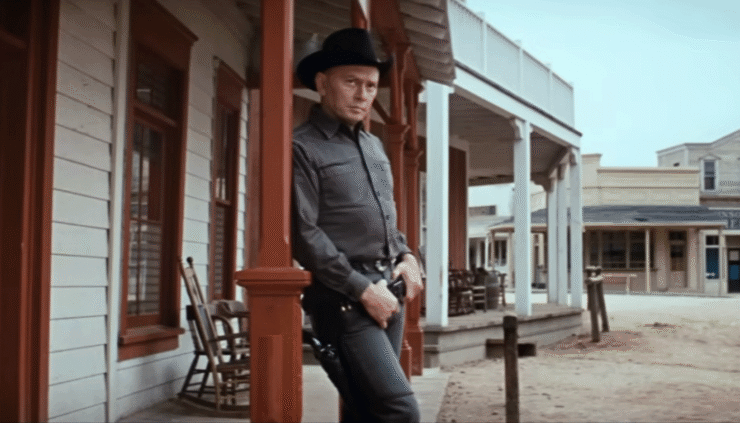
Westworld (1973) Written and directed by Michael Crichton. Starring Yul Brynner, Richard Benjamin, and James Brolin.
In March of 1974, about nine months after Westworld premiered in theaters, Bantam Books published a paperback of the film’s screenplay. The book opened with a forward by Saul David, former story editor at Metro-Goldwyn-Mayer, and an account of the film’s production by director and screenwriter Michael Crichton. None of this was unusual, but it is notable for just how frank David and Crichton were in their introductions to the book.
Normally when I research a film, I have to read through later interviews, cast and crew retrospectives, and critical reassessments to learn all the dirt about the production. It doesn’t usually come from the director himself not even a year after the movie came out.
The Bantam version of the Westworld screenplay isn’t terribly hard to find online, and Crichton’s introduction is well worth reading. He’s unapologetically straightforward in his report about how the movie was made and all the problems along the way. For example: “The first problem, to be blunt, was the studio. From the outset, the executives in the Thalberg building were divided on the project: some championed it, others loathed it. The result was something like civil war, and no more pleasant than it sounds. There were arguments every few hours; I threatened to quit every three or four days, after episodes of massive depression.” And that was just during pre-production.
This wasn’t a case of a film’s crew trying to shift blame or salvage their reputations. Westworld was both a critical and a commercial success; it made back twice its entire budget in the first week and received generally favorable reviews from critics. It ended up being MGM’s most successful movie of 1973, so the studio certainly wasn’t unhappy with it.
(Completely unrelated to Westworld but an interesting note in film history: That linked Variety edition reporting the 25 highest-grossing films of 1973 discusses a couple of entries that might seem curious to modern box office watchers. The Devil in Miss Jones at #6 and Deep Throat [1972] at #11, both directed by Gerard Damiano, are two wildly successful pornographic films sitting right there on the list alongside more typical theater fare. Variety attributes the success to a “porno rampage”—a term which should itself be a porn film title—in which watching porn in theaters became briefly chic among a larger-than-usual audience. Use this to impress friends with random movie trivia: Deep Throat beat Jesus Christ Superstar at the box office.)
Back to Westworld.
Crichton was not a completely new director at the time, but he wasn’t terribly experienced either. He was, then and now, primarily known as an author. He had written his first novel, the thriller Odds On, while he was attending Harvard Medical School. He published the book in 1966 under the pseudonym John Lange; at that time, he still assumed he would become a doctor in the future and didn’t want to worry about his writing impacting his professional reputation. He wrote several more crime novels over the next few years, as well as a medical thriller under the name Jeffrey Hudson.
Then, in 1969, the same year he graduated from medical school, he published a science fiction novel under his own name. The Andromeda Strain was an instant, runaway success, the kind of success that most authors can only dream about. In 1971 it was made into a film directed by Robert Wise, the director behind The Day the Earth Stood Still (1951). (Don’t worry, The Andromeda Strain is on my to-watch list.) The book’s success meant Crichton didn’t have to worry about being a doctor—something he had already decided he didn’t want to do—and could instead focus entirely on writing. He also got into directing; he directed the made-for-television film Pursuit (1972), which is based on one of his Lange thrillers.
Because he apparently never stopped working for even a single second, 1972 was also when Crichton wrote the screenplay for Westworld.
The story is well known and fairly simple, so I’ll just summarize it briefly: We follow two men, Peter and John (played by Richard Benjamin and James Brolin), who visit a high-tech adult theme park where life-like robots allow guests to experience versions of the American Old West, the courtly Middle Ages, or debauched ancient Rome. The experiences costs them $1000 per day, which is roughly equivalent to $7500 per day in today’s money, which puts it on par with chartering a medium-sized fancy yacht in the Mediterranean or going on a private luxury safari in the Okavango Delta. (I had to research to find those comparisons. I promise I do not know how much those things cost off the top of my head.) We don’t see much of the Roman park in the film but everything we learn about it makes it sound like a big ol’ orgy. The Delos Corporation designers did not consult Mary Beard during development.
The two men spend their time in the Old West, having gunfights and trysts with (robotic) sex workers. The madam of the brothel should look familiar to you: She’s played by Majel Barrett of Star Trek fame. (I already checked and there is no Westworld/Star Trek crossover on AO3 featuring Lwaxana Troi masquerading among androids, so feel free to write it yourselves.)
While the men are having a grand bachelor weekend, the robots begin to malfunction and disregard programming that prevents them from harming guests. Despite warnings from the robot’s head supervisor (played by Alan Oppenheimer) that the malfunction seems to be spreading, the park operators don’t want the bad press and loss of revenue that will come from shutting the park down to address the problem. So they let it play out, and by the time the Gunslinger robot (Yul Brynner) kills John, it’s too late. The robots go on a rampage, killing all of the guests except Peter. This includes a long, tense, and really quite fantastic sequence of the Gunslinger hunting Peter through all the parks and into the facility’s operations tunnels.
In the end, Peter is the only survivor, although the movie ends before we find out if he actually escapes the park.
Crichton began shopping his screenplay around to studios. As he wrote in the Bantam introduction, “Every one turned it down, except for Metro-Goldwyn-Mayer. That immediately presented a problem…. Nobody who had a choice made a picture at Metro, but then we didn’t have a choice.”
Crichton does go on to say that MGM head of production Dan Melnick did everything he could to minimize the meddling in Westworld, but it was still a project fraught with problems from the start. The studio gave the film an initial budget of $1 million, then grudgingly increased it by $250,000, but that was still a very thin margin for a major studio sci fi film, especially one starring a few well-known actors.
In a 2014 interview, producer Paul Lazarus talked a bit about the casting. I’ve seen some articles assume that the film sought out Yul Brynner as the Gunslinger because of his fame from The Magnificent Seven (1960), John Sturges’ Old West remake of Akira Kurosawa’s Seven Samurai (1954). But it sounds like it actually happened the other way around: Brynner’s agent called up Lazarus and said Brynner very much needed money, so he wanted to be in the movie. Lazarus was surprised; he clarified with the agent that the Gunslinger role had almost no dialogue and was therefore a strange role for a major star to want. The agent insisted: his actor needed the money. Brynner’s payment would be $75,000. In spite of that bit of serendipity, neither the cast nor the script were settled until one or two days before filming began.
Crichton also mentions art director Herman Blumenthal in his production account; he states that Blumenthal, who had previously worked on Joseph L. Mankiewicz’s outrageously expensive Cleopatra (1963), was able to work wonders within a very restrictive budget, mostly by reusing rooms, hallways, and staircases multiple times, and filming one location (the hovercraft interior) twice and flipping the film to create a mirrored perspective and make the room seem twice as large.
They also used real rattlesnakes (with their venom milked out) for the scene where Brolin’s character is bitten. And Brolin was actually bitten during one take. That’s not important to the discussion of this movie. I just wanted to share it because filmmaking in the ’70s was wild and actors just got bitten by real rattlesnakes on set sometimes.
But none of that is what the Westworld production is known for, right? The production is famous in film history for being the first movie in the world to use digital special effects.
When he wrote the screenplay, Crichton included some scenes to be shown from the Gunslinger’s point of view. He wanted the Gunslinger’s vision to show “a bizarre, computerized image of the world” but wasn’t quite sure how to go about achieving it. At the time, the main cinematic reference for a computer’s-eye view was HAL 9000’s wide-angle lens in 2001: A Space Odyssey (1968). That distortion works extremely well in 2001, but it wasn’t technological enough for what Crichton wanted. He wrote, “We reviewed standard special-effects techniques and rejected them all; they were too familiar, and shared a ‘filmic’ quality—no matter how strange, they still looked like photographic images. I didn’t want that.”
Crichton knew that computers could generate images, so he first approached the folks at the Jet Propulsion Laboratory to see what they could do. They replied that the two minutes of footage he wanted would take nine months and cost $200,000, so that was out of the question. He turned to experimental filmmaker John Whitney for ideas; Whitney in turn introduced Crichton to his computer-savvy son John Whitney Jr. If that name sounds familiar, it’s because we’ve seen his work before; he worked with Information International Inc. when they were doing effects work on Tron (1982) before spinning off to co-found Digital Productions and working on The Last Starfighter (1984).
Whitney Jr. is the one who came up with the pixelated version of the Gunslinger’s point of view that appears in the film. Until I read the The New Yorker article about Westworld’s digital effects, it had honestly never occurred to me to wonder where pixelated images came from. They’ve been commonplace in media for my entire life—use to obscure faces or body parts, for example—that I never thought about how somebody had to do it first. Well, that somebody was John Whitney Jr., who approached his future employer Information International Inc. to find the necessary equipment and expertise. Even then, it took months of trial and error to come up with images that looked right. It took so long that Crichton and Lazarus were screening versions of Westworld for MGM executives with missing scene placeholders right up until the finish line.
There is another notable experience from those post-production days that’s worth talking about: Crichton realized that he hated his own movie. He said, “Two weeks after shooting, I saw the assembled film for the first time. It was horrible. It was boring, contrived, self-indulgent and slack.” Editor David Bretherton told him not to lose heart. Even though they didn’t have a lot of footage—a cheap production meant they filmed as little as they could get away with—they were able to cut the film into something Crichton thought was passable.
Based on his own words in 1973, it sounds like he remained pretty ambivalent about the film even after it was released and well-received. He wrote, “Westworld was not intended to be profound. Neither was it intended to be stupid, but our clear goal was entertainment.”
I think that’s an important framework for understanding the film. It’s a film with a lot of interesting parts, but it isn’t trying to be bigger and deeper than it is. It also has some weak elements that keep it from working quite as well as it should, but I don’t think any of them are fatal flaws.
And, in my opinion, the technological stuff is not one of those weak elements. I love that we never find out what caused the malfunction, only that it spreads on its own through programming the computers wrote themselves. The park experts describe a computer virus without actually calling it a virus, because while the idea of self-replicating computer programs had been around since John von Neumann proposed it in the ’40s, the term was first used in sci fi novels around about the same time Westworld was being made. (David Gerrold’s When HARLIE Was One [1972] and John Brunner’s The Shockwave Rider [1975] are generally acknowledged as the first books to feature computer viruses, but the rigorous technical definition of “computer virus” came from the work of Fred Cohen and Len Adlemen in the ’80s.)
So it’s not the computer stuff that feels flimsy to me in Westworld. It’s a couple other things. One problem, I think, is that Westworld and the other two parks just seem so boring to visit. Some of this is a problem of portrayal: If we are to believe that the primary draws of these parks are consequence-free fighting and fucking, but the movie only shows us the fighting in any detail, and that fighting is all from the clichéd fantasies of mediocre men, the movie has to balance making those fantasies both mundane and engaging. I’m not sure it manages that, although I do think Benjamin and Brolin do a great job as ordinary men getting into the spirit of the park, right up until it turns on them.
But I also think the film could do more with its central critique of corporate profit-chasing. If you have ever gone down the grim internet rabbit hole exploring the history of amusement park deaths (it’s okay, we’ve all been there, usually at 3 a.m. and filled with regret), you know that parks, in the real world, will sometimes put up with a rather alarming number of fatalities before shutting down. I think a bit more focus on the corporate callousness would have gone a long way toward emphasizing that point.
Most people don’t get many do-overs in life, but Crichton managed to wrangle himself the best do-over of all time in this matter. He would go on to direct a few more movies, starting with Coma (1978), an adaptation of the Robin Cook novel. But his heart was always in writing novels, and in 1990 he would publish Jurassic Park, which takes the same basic premise as Westworld and fixes both of those problems in truly glorious style. What makes the park seem irresistibly appealing? Dinosaurs! What makes the corporate negligence more enraging? When the attractions eat people! (We’ll watch Jurassic Park [1993] soon, I promise.)
Crichton concludes the paperback introduction by saying, “I like to think that audiences have fun with this film. We had fun making it.” He needn’t have worried. Even though some parts of it don’t feel as strong as they could be, it is overall a fun, entertaining film.
It’s also a neat example of how a single captivating character performance can have a powerful impact on future films. Brynner’s Gunslinger was the inspiration for both Michael Meyers in John Carpenter’s Halloween (1978) and for the Terminator in James Cameron’s The Terminator (1984). Which means, by extension, that the Gunslinger is the shadow behind just about every cinematic instance of a silent, persistent, implacable, black-clad villain hunting down the protagonists. Maybe it became a cliché, but I can’t find it in myself to care, because it’s such a cool image.
What do you think of Westworld? How do you think it holds up today? How much money would you pay to visit one of those parks?
One final note: You notice that I have not said a single word about the HBO series Westworld that ran from 2016 to 2022. That’s because I haven’t seen it. At all. I’ve never seen a single minute of it. I gather that it’s about the park robots becoming sentient in some way? Please chime in below with your thoughts on how the television reboot compares!
Next week: I know absolutely nothing about John Boorman’s Zardoz except the existence of that outfit. You know the one. Oh, and there’s a computer that controls people, which is my excuse for indulging my curiosity and finally watching it. Find it online.[end-mark]
The post <i>Westworld</i>: It’s All Fun and Games Until the Robots Start Shooting appeared first on Reactor.








 New Posts (Home)
 ChatBox
 Popular Posts
  Game Zone
 Top PodCasts