reactormag.com
Artist Trevor Henderson on the Siren Head Movie, the Backrooms Phenomenon, and the Benefits of Scaring Kids
Movies & TV
Siren Head
Artist Trevor Henderson on the Siren Head Movie, the Backrooms Phenomenon, and the Benefits of Scaring Kids
“I think, for the weirdo work, it is an unprecedented time.”
By Matthew Byrd
|
Published on July 15, 2026
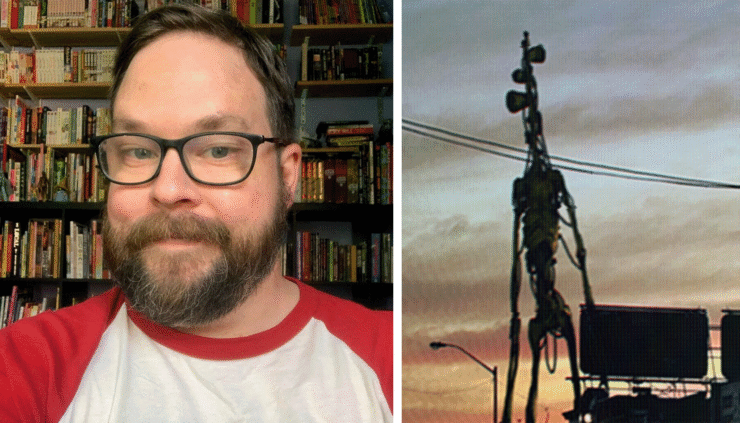
Photo and artwork courtesy of Trevor Henderson
Comment
0
Share New
Share
Photo and artwork courtesy of Trevor Henderson
The success of Backrooms understandably triggered a wave of speculation that studios and streamers everywhere were about to go on the hunt for online horror phenomena that could become the next major motion picture. Recently, Warner Bros. took a big step forward into that new era by greenlighting a feature film adaptation of the Siren Head character that will be co-written by Zach Cregger and Brian Duffield with Duffield also directing.
For some, the upcoming film will be their first exposure to the Siren Head character. But for years, this tall creature with speakers for a head that blasts ominous and seemingly nonsensical phrases has been lurking on the edges of the internet. It has been a subject of fascination and speculation among those who have spread and grown its legend through stories, images, games, and videos. Like many real-life cryptids, the creature’s story changes a bit from telling to telling and person to person. Its powers, age, height, and motivations are often subject to change. Behind all the mythos lies one of the few inarguable facts about the character: it was created by artist Trevor Henderson in 2018 when he shared the first drawing of the character through social media accompanied by this short blurb:
She was on vacation with her husband and they were scoping out graveyards on the way, as you do, when she saw it. Rising out of the old cemetery, big as an old (macabre) telephone pole. Was this some kind of bizarre art piece the authorities hadn’t gotten wise to yet? Even as she stepped out of the car, the megaphones on it’s “head” screeched to life. “NINE. EIGHTEEN. ONE. CHILD. SEVENTEEN. REMOVE. VILE.” A buzzing, doubled voice screamed random words at her. At this point, it jerked into motion, striding down the hill towards her.
The growth of Siren Head’s popularity in the eight years since the creature (perhaps appropriately) broke through the noise of the internet has been nothing short of remarkable. And yet, few have been more surprised by the creature’s rise than Henderson himself. I recently spoke with the artist about the creation of Siren Head, the upcoming adaptation, and what it means to be part of this moment when a new generation of creative voices is paving the suddenly very exciting future of horror.
Matthew Byrd: First of all, congratulations on the news of the Siren Head adaptation.
Trevor Henderson: Thank you. It’s a deeply anxious thing, but also a good anxiety, I guess. It’s really, really, really weird. It’s completely out of my wheelhouse, and it came about so fast it hit me in the face like a punch.
Matthew: How did that happen? When did you first hear there was a possibility?
Trevor: My rep is a guy named Josh Dove who has been with me since 2020 or 2019 even. So it’s been over half a decade we shopped around a pitch of the general artwork, the world, and some of the characters.
Then, when Siren Head blew up, it became more of a Siren Head-specific pitch. We had people who were interested, but when Backrooms did so well, the demand became overwhelming. Everything with the movie announcement came together in like two weeks. It was boom, boom, boom. All the way through it was like, “Okay, first this studio is interested. Now it’s a bidding war. Now Zach Cregger has a pitch and wants to be involved.” It just happened incredibly fast.
Matthew: You mentioned the Backrooms of it all. How much do you think that played into this happening when and how it did?
Trevor: I think it’s hard to overstate how intrinsic Backrooms doing so well, and it being such a singular vision from a young, independent creative person, was to the wave we’re just sitting at the start of right now. I think we’re going to see a lot of films made from online horror and specifically younger people’s online creative products.
Matthew: Why do you think that is happening now? I mean, you can look at Obsession, Backrooms, Iron Lung and say, “Well, these movies are very good.” But why now, in terms of people gravitating toward all this?
Trevor: I think people respond well to a competent, singular, specific vision.
Kane Parsons is the figurehead of that Backrooms thing, which started out as an online horror image with some text. Through his short films, he really chiseled that down into something very, very specific. Having that come to theaters through A24 and maintain that vision… I think there’s a version of the Backrooms film that could have happened, and I almost expected to happen, which was much more conventional in tone and what it was trying to accomplish.
I feel like the weird, interesting, flawed, but ambitious, strange, confident version of that movie is what people are responding to. I think that goes a long way toward getting people excited and getting people into the theater.
Matthew: Siren Head’s legacy is tied so much into its ambiguity. It’s still early days, but what are your expectations and hopes in terms of expanding on that idea through a movie without compromising the ambiguity of the character?
Trevor: I hope that a lot of that is retained.
I think a lot of the stuff people enjoy about Siren Head are things like how it can blend into the background and be this large imposing figure that is also somehow very stealthy and strange. The fact that it has no clear origin… that it’s something that shouldn’t exist and the incongruous nature of that, and that it spouts nonsense words and strange signals. At least for me, that’s a lot of the appeal of the character.
I really hope that mystique is maintained while telling an engaging and interesting story around that. I would certainly hope there’s no, “Here is the origin of the character, here’s where…” because that’s completely not the point and it won’t do anything to help. But I am confident that will be maintained. I don’t think they’re going to do that.
With the Backrooms film, they don’t say, “Here’s where the Backrooms came from,” and audiences were completely fine with that. As long as that mystique is maintained, I’m feeling very confident about the direction and very excited about it.
Matthew: It’s funny because I’ve seen people say, “Siren Head is a character that scares me intrinsically in some way, but I can’t explain why.” Some say it’s the size, some say it’s the lack of eyes, or even the lack of a backstory. What do you think it is about the character that people respond to?
Trevor: I think that for me, so many elements of it just do not make sense, and that is really scary.
It looks like a rotten human being, sort of. It has these rusted metal elements that are fused with it, but not in a way that would make any logical sense. Then there’s the fact that it’s spewing pure surreal, abstract nonsense and tornado sirens.
It has no eyes, which is always really scary for me. That’s carried over from Giger’s design for the Xenomorph, where he insisted on it not having any eyes because you lack that connection. Any time something has eyes, you can read intent. You have this level of understanding. You remove the eyes from anything, and it becomes completely ambiguous in terms of its intentions or goals. That goes a long way to make the character scary for me, and I think people respond to that.
Matthew: It’s so fascinating that, without the eyes, people have looked at this figure and read so much from it and put so much of their own stories into it.
Trevor: Yeah. When I made Siren Head, I was pumping out these photobash drawings and drawing different creatures into photos that were donated to me or that I took myself.
It was almost an art-making exercise of creature design and seeing how well I could hone the skills of blending a character into a photo through lighting, texture, and color to make it look like it was there when it was taken. I did that character, I liked the character, but then I moved on to other stuff.
Having people keep returning to it over many years and having it resonate in that way, with people telling their own stories and creating their own versions of the design and fan art and everything, there’s something there that obviously clicked with people on a deep level. I don’t know what it is specifically, but it really resonates with people, and I’m honored that something I made has endured with an audience for so long.
Matthew: One thing I’ve seen and agree with is that there’s something to the almost found-footage nature of the creation. It has this Blair Witch quality where there’s enough suspension of disbelief that it feels like this could actually be there somewhere.
Trevor: That’s a quality I try to have with every piece of art that I do with the photo-based stuff.
It’s all supposed to capture one moment from a found-footage horror movie that was never made. Kind of the one big money shot with a little bit of text underneath. On a brain level, you know it’s fake because you’re seeing impossible things. But by getting rid of a lot of the movie-making conventions, you trick your hindbrain a little bit into believing a little bit more. I try to tap that power by using photography and things like blur and different effects that make it feel like something your eye might actually see.
So I’m happy to hear you say that. That’s what I try to do all the time.
Matthew: How much of the character’s story, such as it is, existed at the time you made the drawing?
Trevor: I’ve said this before, but I’m obsessed with the idea of number stations.
I don’t know if you’re familiar, but they’re these strange, anomalous signals that actually exist on the radio waves. They’re just voices saying weird words over and over again. At the time, I was like, “What if that was coming from a thing? A creature instead of a radio station somewhere? What would that look like?” That’s where Siren Head came from.
For a long time, that was really the extent of it. But because the character was popular and people liked seeing it, I drew it more. As you draw it more, naturally this world and the idea behind the character develop more. I have some vague ideas in terms of what Siren Head is, but I never want to really say that because I don’t think it would benefit the character in any way, shape, or form.
Matthew: How much of Siren Head’s success do you attribute to people taking what you created and making it their own?
Trevor: It’s a bit of a double-edged sword because you have to make peace very quickly with the internet as a whole.
When it embraces something, there’s a degree to which it stops being yours, and you have to be okay with interpretations. In the beginning, it was a little weird because there was a lot of clickbaity YouTube stuff with the character specifically to appeal to children. It was strange to see something that I made go in that direction. But at the same time, I don’t think it would have endured the last eight years if there hadn’t been that wild fan response. Especially with kids. So it’s two things at once. It’s really weird.
The amount of times I have hopped on a Zoom call with someone and they’ve been like, “I only found out about Siren Head through my kids because my kid was on the schoolyard at his elementary school and another kid was telling an oral scary story about Siren Head…” It’s become this legitimate schoolyard boogeyman. Which is amazing. I couldn’t ask for anything else. That’s so cool that something I made up is being passed by word of mouth. That alone outweighs any possible negatives.
Matthew: I sometimes feel jealous of getting to grow up in this era of these creepypastas.
Trevor: Yeah, absolutely.
I think if I was a kid around this time, I would be over the moon for the stuff that I’m making and other people are making. I think, for the weirdo work, it is an unprecedented time.
Matthew: It is funny, though, because I do feel like there was a point when studios maybe veered away from the idea that kids do like being scared. Now as we get back to that in various ways, it does feel like that may be part of the missing piece that wasn’t there in previous years.
Trevor: Kids love monsters, and they love being scared. Especially with stuff that’s made for kids but doesn’t condescend. I think it’s so important to have kids’ horror media and gateway horror media that also has stakes and isn’t talking down to them.
When you talk down to a kid, especially with something positioning itself as “the scary stuff,” they can see through it in a second. They fully read it as bullshit and will reject it outright. When I was growing up, and I’m sure this is true for a million other weirdos now, it was the Alvin Schwartz Scary Stories to Tell in the Dark books with Stephen Gammell’s illustrations. Those three books are a dark, wonderful cloud that looms over everything I’ve done for the last twenty-five years. You can trace it all back to seeing some of those Stephen Gammell illustrations in the library and being so scared I couldn’t look at the page. I had to flip past several illustrations.
I think having something like that for each generation of kids is so important. And it has to kind of scare the shit out of them because it becomes this perfect awful gem in their memory. It will spur so much creative stuff.
Matthew: You mentioned folk monsters and folk stories. There’s a degree to which various folk monsters throughout history have represented some sort of cultural fear or anxiety. What do you think Siren Head represents to people as a folk monster?
Trevor: For me, it’s always represented a general ambiguous sense of oncoming doom. The fact that it’s an announcement siren that is traditionally associated with tornado sirens makes it feel like a walking portent. A walking portent of both decay and disaster.
It might represent different things to different people, but that’s always been my interpretation. Especially because it’s usually depicted in very rural areas in the photography. I feel like that also speaks to something.
Disaster is my answer. Ongoing doom and disaster.
Matthew: As we get into this new era of, for lack of a better phrase, this kind of internet-to-Hollywood horror pipeline, are there other creations or stories that stick out in your mind that people should take a look at?
Trevor: Off the top of my head, there’s a newer series I really love called “The Glendale Archives.”
It’s about a guy who wakes up in a world where everyone is gone. It’s just him and these really upsetting entities or monsters. So it’s him trying not to go insane by himself. But it lets the series be very human-focused and character-driven. It’s mostly him talking about his worries and anxieties. And it’s also sometimes a cooking show because he’ll just go through a recipe. It feels like such a breath of fresh air for the analog horror scene.
Matthew: Ultimately, what do you hope the relationship between the Siren Head movie and the original image, and everything that sprung online from it since then, is?
Trevor: I think it’s a really great opportunity because, purposefully, the character has stood on its own without a ton of lore or narrative surrounding it.
So I think it’s a great opportunity to build that out in a really interesting way. I don’t think it can ruin any of the art or the atmosphere or the world-building I’ve done beforehand. It can just use it as a jumping-off point. I hope a lot of that mood is preserved in the film version.
But at the same time, I’m unbelievably excited to see the take on the material that Brian Duffield and Zach Cregger have internally. I hope to find out about that soon. I think both things are going to be able to coexist. I hope they will inform and help each other.[end-mark]
The post Artist Trevor Henderson on the Siren Head Movie, the <i>Backrooms</i> Phenomenon, and the Benefits of Scaring Kids appeared first on Reactor.








 New Posts (Home)
 ChatBox
 Popular Posts
  Game Zone
 Top PodCasts