www.dailysignal.com
If the Driver Had Just Stopped the Car, the Officer Would Have Lived
A Philadelphia officer answered a gun call on June 27. The car he’d stopped shifted into reverse, plowed into two marked cruisers, and threw him onto the hood, into the windshield, and over the roof before speeding off. He survived. In Greenwood, South Carolina, an officer died in May when a driver fleeing a stop crossed the center line and hit the officer’s cruiser head-on. Neither officer pulled a trigger.
Both cases are part of the same pattern: A driver decided a stop sign, a red light, or a lawful command didn’t apply to him, and someone paid the price for that decision in blood.
I spent three years working in private security and executive protection before I ever touched a securities license, and I held a California EMT card I earned in 1993 riding in the back of ambulances. I’ve watched people make split-second calls with real consequences. Whatever else you think about a given encounter, the safest, simplest choice is also the one nobody wants to talk about: Stop when you’re told to stop.
That’s worth remembering when the vehicle in question belongs to someone an officer shot rather than someone who hit an officer. Three fatal encounters this year have dominated the news: Ren ée Good, shot by an ICE agent in Minneapolis in January; Lorenzo Salgado Araujo, shot by an ICE agent in Houston on July 7; and Johan Sebastián Durán Guerrero, shot by an ICE agent in Biddeford, Maine, on July 13.
All three are now under federal investigation, and serious questions remain open in each one, including whether the agents’ accounts match the video recordings. I’m not going to pretend those investigations are finished.
But one fact isn’t in dispute, because federal officials confirmed it themselves: None of the three was the person federal agents were actually there to arrest that day. Every one of these deaths happened during an encounter with someone who was never supposed to be the point of the operation in the first place.
If the Department of Homeland Security’s account holds up in each case—meaning the agents reasonably believed a vehicle was being used to threaten them with death or serious injury—then the deadly-force standard was met and the shootings were lawful. That’s a real “if,” and the investigations exist precisely to test it.
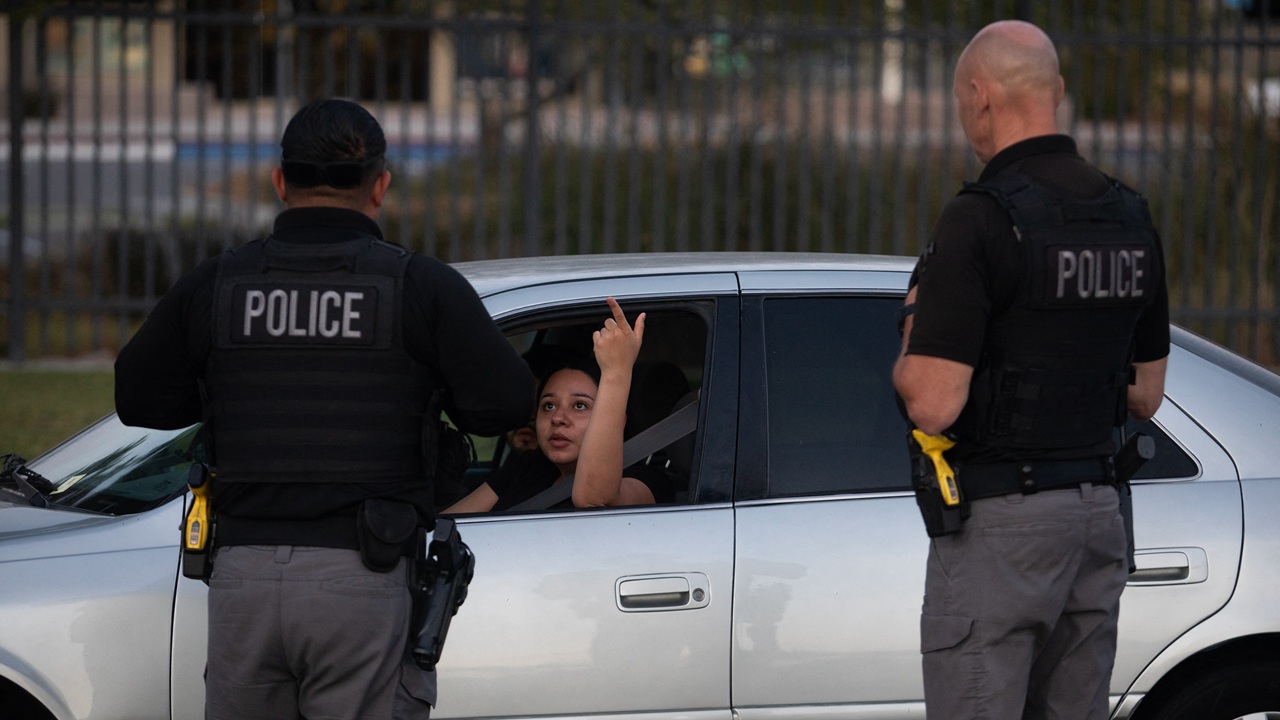
But set the legal question aside for a moment and look at the sequence of events DHS itself describes: An agent approaches a vehicle, gives a command, and the vehicle moves toward or past him instead of stopping. Whatever else remains contested, that part of the timeline is not complicated. A driver who stops the car when told to stop does not get shot for driving away from federal agents. It’s the one variable that was entirely within each driver’s control, right up until it wasn’t.
Here’s the actual rule, not the cable-news version. The Department of Justice’s use-of-force policy and decades of case law under Graham v. Connor set a narrow standard: Deadly force against a vehicle is justified only when the officer reasonably believes the car itself is being used to threaten death or serious injury, and only when there’s no safer alternative.
Officers aren’t supposed to fire at a moving vehicle just to stop an escape. There’s no special “car exception” that lets agents open up on every fleeing sedan. It’s the same objective-reasonableness test that governs every other use of force, applied to a driver who has chosen, or is accused of choosing, a weapon that happens to also be a mode of transportation.
That standard already ties officers’ hands tighter than most people think. It’s also why DHS’s move this week to pause most ICE vehicle stops following the Maine and Houston shootings made sense on its face, and why the reversal happened so fast. President Trump overturned the pause less than 24 hours after it was announced, calling traffic stops “one of ICE’s most important and effective Crime Fighting tools” and directing agents to get back to work.
Whichever way that policy fight ultimately lands—and reasonable people land on both sides of it—it doesn’t touch the point that actually matters here. Camera deployment, stop policy, training curricula—none of that changes the one thing every driver in these encounters could have controlled from the start.
The FBI’s Law Enforcement Officers Killed and Assaulted data for 2025 shows agencies reported over 90,000 officer assaults last year, a rate of 13.8 per 100 officers, the highest in a decade. Vehicles remain the leading cause of accidental line-of-duty deaths. Those numbers are so high because, in far too many cases, somebody decided the rules didn’t apply to them that day.
Legislatures write the deadly-force statutes and the use-of-force policies. Agents don’t invent the Graham v. Connor standard, and they don’t get to rewrite it on the fly during a stop. They inherit a legal framework, drilled into them at the academy, and they live or die by how precisely they apply it under conditions nobody writing the policy will ever face themselves.
If an agent’s account of a given stop turns out to be wrong, the investigation should say so, and accountability should follow. That’s what the process is for. What shouldn’t get lost in the meantime is the simplest fact common to all three cases: A driver who stops when a federal agent tells him to stop does not end up in a morgue over an operation meant for somebody else.
Compliance isn’t submission to tyranny. It’s the one move available to everybody in these encounters that reliably keeps them alive long enough for the rest of the process—courts, investigations, and lawful appeals— to work the way it’s supposed to.
We publish a variety of perspectives. Nothing written here is to be construed as representing the views of the Daily Signal.








 New Posts (Home)
 ChatBox
 Popular Posts
  Game Zone
 Top PodCasts