reactormag.com
The Sassy Horses of Disney Animation
Column
SFF Bestiary
The Sassy Horses of Disney Animation
Who needs words when you have attitude?
By Judith Tarr
|
Published on July 20, 2026
Credit: Disney
Comment
0
Share New
Share
Credit: Disney
I’m taking a sidestep this week, from animals that speak like humans to animals that say everything they need to without uttering a word. It came about after a discussion in the horsegirlsphere, with commenters voicing expert opinions about horses in Disney animated films. The tl:dr comes to: Khan awesome, Samson awesome, Maximus is a dog, dammit.
I have thoughts about this.
The animated Mulan is one of my favorite Disney films. Sleeping Beauty was a fixture of my early childhood, but I had not seen it in quite a few years. Tangled, the most recent of the lot, I saw when it first came out because everyone, and I mean everyone who knew me and my horses said, “You have to see this. Maximus is your horse.”
Disney has produced numerous talking-animal films, but it’s also racked up a substantial collection of films in which the animals communicate without using human words. They make animal noises: whinny, nicker, snort in the case of horses. The bulk of their communication is body language, expression, and above all, attitude.
Sleeping Beauty’s Samson doesn’t get a whole lot of screen time, but he makes the most of what he has. He’s Prince Philip’s mount; we first meet him riding through the forest just before the fateful encounter with the long-lost princess. Philip hears her singing away in the woods, and takes it into his head to find the singer.
Samson is not in favor. There’s a struggle, with Philip trying to haul him around and Samson resisting. Philip resorts to bribery: “An extra bucket of oats? A few carrots?”
Samson’s expressions and body language tell us (and his rider) all we need to know about his opinions. He’s not well or truly bribed, either; during the pursuit of the singer, he scrapes Philip off into a pond. That costs him the carrots, but turns out to be a stroke of fate for Philip and his One True Love.
Samson is not too far off reality in horse terms. He has a mind of his own, but he’s always there when he’s needed. His forms of resistance are familiar to many a horse kid. When he neighs, he’s sounding an alarm, which is accurate: Horses are generally silent; they don’t whinny unless they have a clear purpose, usually to express alarm, call out to absent herd members, or sing the song of the stallion to his mares.
He is a weird color. Probably a buttermilk buckskin, a sort of cream color with black and mane and tail, though he’s missing the dark points (lower legs, tips of ears). Maybe he’s supposed to be light grey and his mane hasn’t greyed out yet.
Khan in Mulan is less realistic and more fantasy-coded. He’s clearly devoted to Mulan; he’s always nearby and strongly resists being separated from her. This makes sense for a war horse, as he’s her father’s retired charger. Horses will and do bond with a single human, and war horses are both trained and naturally inclined to protect their rider.
The horsegirlsphere speculates to how old he has to be if he was trained as a war horse, then came home with his rider, and now it’s how many years later and Mulan is taking him to war again. He has to be at least in his late teens and probably older. Which is not impossible—horses often live into their thirties and stay sound well into their twenties—but it says a lot for his quality that he goes through as much as he does and makes it home in perfect condition.
He would be a very special breed of horse, the Ferghana or Horse of Heaven. They are creatures of legend, and Khan has the characteristic build and substance, as well as the longevity and stamina. His coloring is, again, on the weird side: he’s what we call true black with chrome (blaze face, white stockings), but he has human-like eyes with whites and blue pupils, and a grey belly and light grey eyebrows. Horses have some movement in the skin and muscles above the eyes, and they can have lovely eyelashes, but eyebrows they do not have.
Mostly he’s there as transport, but he has perceptible opinions. These are expressed through the eyebrows, as well as through more general body language. When Mulan dithers over how to approach the military camp, he sprawls like a human, chewing on a grass stem, and manages to look both long-suffering and bored.
One truly horselike thing he does is his reaction to the arrival of the tiny dragon Mushu. He tramples Mushu into the dirt. Horses will do exactly that with creatures to whom they take exception. Snakes, scorpions. Noisy and annoying lizardy things. If they’re not dragons and therefore both magical and immortal, they don’t survive the encounter.
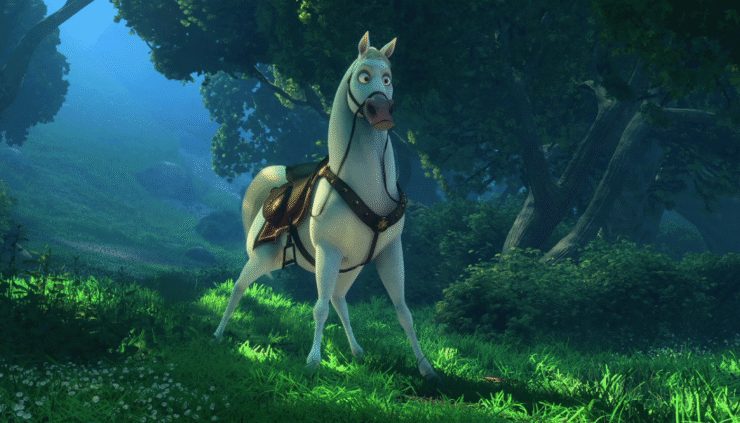
Maximus in Tangled is a different animal. Samson and Khan are important in their roles, but they are supporting cast. Maximus is a main character. When we meet him, he’s the mount of the captain of the guard, but he quickly graduates from transportation to active participant in the pursuit of the thief, Flynn Rider.
He is the most realistic as to color: your classic elite rider’s “white horse,” which usually means he’s a grey. His behavior ranges from fantastical to completely off the wall. Mostly, what he reads as is a dog, complete with tailwagging, occasional random noisemaking (whinnies and the odd nicker), and a propensity to put nose to ground and sniff his way toward his quarry.
Now here’s the thing. Horses have an extraordinary sense of smell, well up there in the dog range. They can be used in the same way as scent-tracking dogs, with the advantage that they’re that much larger and that much higher off the ground. They may put their noses down to find a scent, but they’re more likely to track it from higher up, through the air.
He does use his hooves as Khan does, to stomp his quarry, and when he uses his teeth, he’s being reasonably horselike. Horses will bite, and will grab hold of handy pieces of clothing or human anatomy. Hurts like hell, too: horses have serious bite power.
Maximus has human-level intelligence. He knows exactly what he’s doing and to whom he’s doing it. He’s devoted to his duty as a royal horse. He pursues the thief relentlessly, applies strategy and tactics to the hunt, and he never gives up.
He has an extremely expressive face and a ton of attitude. He also succumbs to the allure of the horse girl. When Rapunzel loves on him, he melts. He doesn’t exactly change sides—she is after all the lost princess—but his priorities shift. He stops being the enemy and starts being an ally.
All without saying a word. He doesn’t need to. His intentions are clear, and humans in this world are capable of understanding them. They don’t have any delusions of human superiority, either, as we discover at the end, when Maximus takes the place he’s earned in the palace hierarchy.
Yes, I had that horse. Gone now and much missed, but he was Maximus. He had a fancy registered name and a royal pedigree, and attitude for days. No, he never wagged his tail, but he could lash it like a cat, and if he loved you he’d die for you, but if he didn’t, you seriously had to watch your back. Every horse kid can tell you stories of Samsons or Khans that they’ve known. Maximus, too: even the fantastical bits.[end-mark]
The post The Sassy Horses of Disney Animation appeared first on Reactor.








 New Posts (Home)
 ChatBox
 Popular Posts
  Game Zone
 Top PodCasts