reactormag.com
You’ve Seen the Movie, Now Read the Book: Planet of the Apes by Pierre Boulle
Books
Front Lines and Frontiers
You’ve Seen the Movie, Now Read the Book: Planet of the Apes by Pierre Boulle
Thoughts on finally reading the novel that inspired a pop culture phenomenon…
By Alan Brown
|
Published on July 21, 2026
Comment
1
Share New
Share
In this bi-weekly series reviewing classic science fiction and fantasy books, Alan Brown looks at the front lines and frontiers of the field; books about soldiers and spacers, scientists and engineers, explorers and adventurers. Stories full of what Shakespeare used to refer to as “alarums and excursions”: battles, chases, clashes, and the stuff of excitement.
A few weeks ago, at my favorite used bookstore, I discovered a pile of movie tie-in books, including both novelizations and books that movies were based on. Having enjoyed reading Jurassic Park recently, long after I first saw the movie, I thought it might be fun to revisit, in book form, more stories that I’d initially experienced in a movie theater or on television. After all, there are all sorts of tales that I and many other science fiction fans have been exposed to thanks to movies while remaining unfamiliar with of the original works the movies were based on—for example, I don’t think I’ve ever read a book by H.G. Wells or Jules Verne, even though I am very familiar with the stories they told.
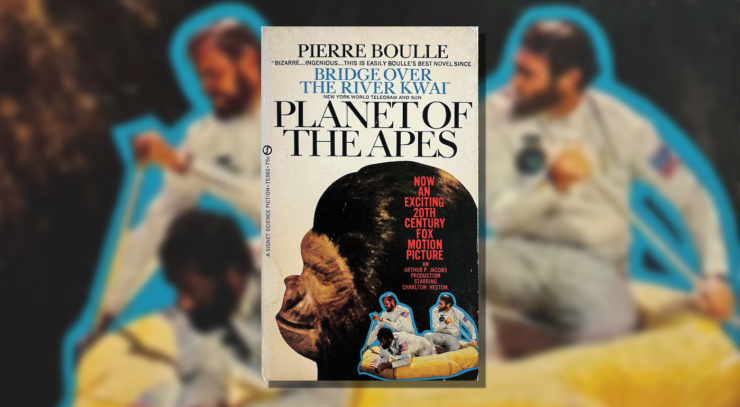
The first of the books I picked is Planet of the Apes, by Pierre Boulle, which became the classic 1968 movie that blew me away when I first watched it as a young teenager. The copy I am using for this review is a Signet paperback edition, the first of which was published in 1964, based on the hardcover edition that had been published by Vanguard Press in 1963. But this particular copy couldn’t have been part of that first edition, because the paperback cover (while it does not mention the movie in its copy) uses photos from the film as illustrations.
About the Author
Pierre Boulle (1912-1994) was a French author whose work during his long career included over twenty novels and enough short stories to fill a number of collections. His first major work was The Bridge Over the River Kwai, published in 1952, inspired by his experience as a prisoner in World War II, where he served as a secret agent for the Free French in Indochina. A 1957 movie based on the book was a major hit, winning seven Academy Awards, including Best Picture, and Best Actor for Alec Guinness. He next garnered widespread attention for his novel Planet of the Apes, a science fiction book that took its protagonists to a world where apes rule and humans are primitive, and whose social satire reminded readers of works like Jonathan Swift’s Gulliver’s Travels.
Planet of the Apes — The Movie
I can’t separate my memories of movies in the 1960s from memories of the theater where I saw most of them. I can’t remember the name, but it was the biggest theater in Rockville, Connecticut, a stately old brick building. It had velvet-cushioned seats, brass rails, a balcony, lots of gilt ornamentation, and a big maroon curtain that opened just before the films started. I liked to sit up front, in the fourth or fifth row, near the left side, so the screen loomed above me, and I felt like I was surrounded by the action. In 1968, when Planet of the Apes came out, I was thirteen, the “golden age of science fiction,” where every story hit me like it was brand-new and fresh. I remember the intensity of the opening, as the spaceship careened out of control toward a crash landing, the astronauts struggling to awaken from hibernation while reacting to the danger, inflating a raft, grabbing emergency backpacks, and barely having time to react to the fact that one of their crew is long dead. The spaceship, while futuristic, was believable because it was inspired by ships already in use by NASA in our race to the moon.
I was already showing the tendency, common to many science fiction fans, to nit-pick, as I remember wondering why, if there was a concern about perpetuating the species, the crew had three men and one woman instead of two couples, or one man and three women. And as a Boy Scout, I was singularly unimpressed by the astronauts’ impractical hard-shell backpacks, with a poor layout, and very little inside them. The next thing I noticed was the angry, even nihilistic, intensity of Charleton Heston’s portrayal of Taylor, which did not allow his crewmates, Landon and Dodge, any chance to make an impression on the viewers. The initial bleak landscape made their discovery of greenery and a pond exciting, and their eagerness to jump in entirely believable. And when their joy vanished with the loss of their clothes and gear, followed by the attack of the gorilla troops, I was as stunned and confused as they were.
The apes were utterly convincing, their believability supported by the makeup and prosthetics, their costumes, their gear and weapons, and the architecture of their village. Taylor’s jeopardy as a laboratory animal, and his growing affection for Nova kept my attention, while Kim Novak as Zira and Roddy McDowall as Cornelius were charming as a pair of chimpanzee scientists. The script was snappy, with just the right mix of jeopardy, horror, humor, and pointed social satire that felt right on point for the times. I don’t remember any moment during the movie where my attention wandered, and the archaeological expedition that led to the reveal of the true history of the planet—and that memorable twist at the end—capped the story perfectly. It is no wonder the movie was so successful, and it remains one of my favorite films of all time.
Planet of the Apes — The Book
The novel has an old-fashioned feel to it, complete with a framing story where a married couple on a private space yacht finds a message in a bottle that comprises the main narrative. That tale is written by a journalist, Ulysse Mérou, who has accompanied inventor Professor Antelle, along with assistant Arthur Levain, and a pet chimpanzee Hector, in a voyage to Betelgeuse via a spaceship of the Professor’s design (unlike the film, there is no chance this planet might turn out to be Earth itself). There is no mention of how the expedition was funded, and no reference to governments or space agencies like NASA. Because of time dilation, that trip will only take two years from the crew’s perspective, but many centuries will pass back on Earth. The crew seems surprisingly unconcerned that anyone they know will be long dead by the time they return.
When they arrive, they find a habitable planet orbiting Betelgeuse (although as it is a variable star, I wonder how long any planet that orbits it would remain habitable). They leave their ship in orbit, and land aboard a shuttlecraft (there is no crash landing in this version of the story). The planet has a remarkable (and unlikely) resemblance to Earth, with a similar atmosphere, geology, flora, and fauna. Professor Antelle is one of those all-purpose geniuses common in fiction, who you never encounter in real life, as in addition to designing their spaceship, he is also skilled in evaluating the environment they have found on this new planet, which they christen Soror. They find a beautiful swimming hole and after their long journey, cannot resist jumping in. And then they see a beautiful young woman, who they nickname Nova; she does not speak, but they attempt to communicate. The men are taken aback when she sees their pet, Hector, and immediately attacks and murders him. And then her tribe arrives, and not only destroys their clothing, but their landing craft as well.
At this point, I began to see that the plot of the movie followed the book pretty faithfully for the most part. Gorillas arrive in hunting costumes and kill or capture most of the tribe. Levain is killed, while Mérou, Professor Antelle, and Nova are captured. They are taken back and caged as experimental animals, and are studied by Doctor Zira, a chimpanzee. There are three races of apes that coexist on the planet: gorillas who are leaders and hunters, orangutans who are bureaucrats and priests, and chimpanzees, who are scientists. Unlike the movie, which showed ape society as relatively primitive due to budget constraints, in this version the apes are as advanced as Earth’s humans are in the present day. The apes are encouraging their captive humans to mate, and although Mérou has misgivings about mating with the unintelligent Nova, he eventually submits rather than see her given to another man. It takes time for him to learn their language, but Mérou eventually convinces the apes that he is intelligent, and is granted freedom to live in their society. He eventually finds Professor Antelle, who has reverted to a pre-verbal state due to the stress of his experiences, and is happily mated to another captive human.
Mérou meets Zira’s fiancé Cornelius, another scientist, who finds him fascinating, and takes him to an archaeological dig where they find a talking human doll (a scene the movie recreates faithfully). This discovery implies that an age of men preceded the age of apes, something the apes find unsettling. And it turns out that Nova is pregnant, which has caused more consternation among the apes, as they fear the emergence (or re-emergence) of intelligent humans. In a horrific chapter, Zira takes Mérou to meet a chimpanzee scientist who is doing brain surgery experiments on humans. He has found that removing different parts of their brains affects their thinking, and has used electrical stimulation to encourage some to speak (although only as mimics, not as a result of intelligent thought). One subject has developed the ability to tap into racial memories (something rather implausible to scientists of today, but an idea that often resurfaces in science fiction). From her, they hear the story of how humans gradually turned more of their responsibilities over to domesticated apes and grew less ambitious and engaged, which eventually led to a revolt where the apes pushed the humans out of their cities and homes.
Nova and Mérou’s baby is born, and proves very intelligent. Concerned that the baby is in danger from the apes, Zira and Cornelius develop a plan to replace human test subjects on an experimental space flight with Mérou, Nova, and the baby, so that spaceship can take them to Professor Antelle’s ship and allow them to escape back to Earth (I guess during the flight out, the journalist Mérou learned how to pilot the ship). They successfully make it back to Earth, and the story gives us a twist ending, followed by another twist ending as the framing story re-emerges.
The book stands as a clever morality tale, letting the readers re-evaluate elements of our own society by seeing its features in a different light. The movie is largely faithful to the story and its themes, although the film features a lot more action and conflict (which I guess should be expected from Hollywood).
Franchise of the Apes
The success of the Planet of the Apes movie led to a long-running film and media franchise. The original movie was followed by four direct sequels, Beneath the Planet of the Apes (1970), Escape from the Planet of the Apes (1971), Conquest of the Planet of the Apes (1972), and Battle for the Planet of the Apes (1973), although by the end of the series, the quality of the sequels had definitely suffered. These films were followed in the 1970s by live action and animated TV shows, and a series of comic books. There was an attempt to reboot the film series by director Tim Burton in 2001, although it was not as successful as the original movies. In 2011, a new series of four movies proved more successful, starting with Rise of the Planet of the Apes, which was set in the near future. This series continued the story of struggle between humans and apes with Dawn of the Planet of the Apes (2014), War for the Planet of the Apes (2017), and Kingdom of the Planet of the Apes (2024). There have also been additional comic books, tie-in books, video games, and toys in recent years. The Planet of the Apes story has become part of popular culture, and you would be hard-pressed today to find people who are not familiar with the tale in one of its many forms.
Final Thoughts
Planet of the Apes is, as I’ve mentioned, one of my all-time favorite movies, and it now stands as a classic, one that broke out beyond science fiction fandom to become a fixture in mainstream popular culture. The book was enjoyable in its own right—more thoughtful than the movie, and still very satisfying. And it is always interesting to see how a tale is handled in two different forms of media. In this case, each version of the telling works well, and both the book and the movie are worth seeking out.
And now I turn the floor over to you: What are your thoughts on the movie Planet of the Apes, or the novel that preceded it? And what do you think of the media franchise in all its different forms? Which versions and extensions of the story are your personal favorites?[end-mark]
The post You’ve Seen the Movie, Now Read the Book: <i>Planet of the Apes</i> by Pierre Boulle appeared first on Reactor.








 New Posts (Home)
 ChatBox
 Popular Posts
  Game Zone
 Top PodCasts