reactormag.com
The Unfailing Optimism of My Neighbor Totoro
Column
Anime Spotlight
The Unfailing Optimism of My Neighbor Totoro
In a hundred different ways, this movie teaches both children and adults how to hope.
By Leah Thomas
|
Published on July 23, 2026
Credit: Studio Ghibli
Comment
0
Share New
Share
Credit: Studio Ghibli
All too often, I look at any given scenario and assume the worst will happen. I am not alone in this sentiment, and you can attribute it to an anxiety disorder, or *gestures at everything*, or perhaps the mindset that became borderline prophetic during the pandemic: “Hope for the best, expect the worst.”
We’re six years out from 2020 but the negativity inherent to that old aphorism feels undiminished. For years we all made plans that we assumed would be cancelled, hoped for outcomes that would not happen, told ourselves that times were hard. And hell yes, they are and have been. Optimism has gone from seeming like a novelty—a trait my less medicated friends had managed to cultivate under circumstances and genetics unfamiliar to me and my ilk—to something more sinister. Optimism feels like ignorance, while cynicism is our sole tried-and-true defense against modern life’s seemingly endless onslaught of bullshit.
I am currently visiting my hometown in the American Midwest for the first time in three years, and I can’t say much is happening in this neck of the woods to push back against this sense of careworn negativity. We arrived at my nephew’s birthday party at the state park to discover that we could not see across the lake due to an eerie toxic haze. While annual smog from fires is unfortunately pretty familiar in the PNW, the yellowed air and dystopian orange sun made for unique conversation around the grills and picnic tables yesterday. “It’s the fires in Canada,” my uncle said. “Supposed to be even worse tomorrow.”
My brother and sister-in-law told us they’d debated cancelling the picnic or holding it indoors, but it seemed too late with all the coolers in tow.
We drove back to my dad’s place after the party ended, with the lackluster alien sun still trying to pierce the haze. My father lives in Midland, where Dow headquarters have long stood. We joked that, hey, at least the locals were closing their windows because of a fire rather than a chemical disaster. How novel!
Credit: Studio Ghibli
That reminds me that things have never been rosy in Michigan, and while I love visiting this place and its lakeshores and forests and chipmunks and stubborn turkeys, and have a twisted nostalgic fondness for its stupid big Chevy trucks and questionable jerky outlets, I am grateful to live elsewhere. Like so many places in America, Michigan has long been subject to the whims of the wealthy and the ravages of environmental destruction.
My brother, who is a police chief, tells me that two people have died this summer from trees falling on them, and how unusual that is. When even the trees are turning on you, optimism is a fool’s territory.
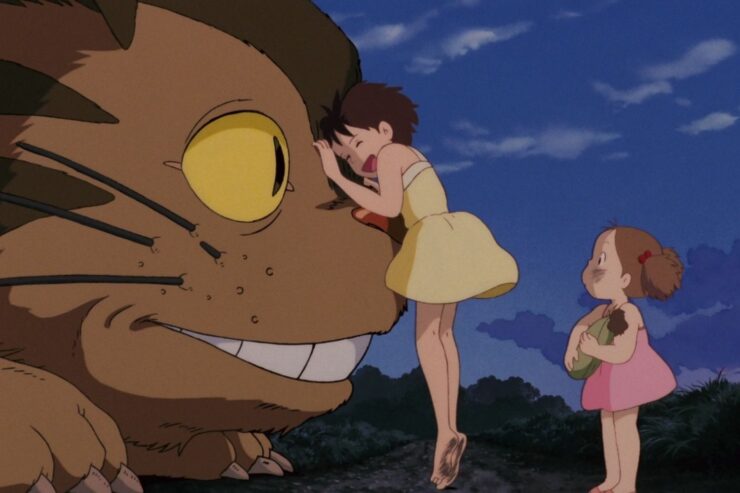
But then, in a movie the other day, I was reminded that people and trees used to be friends. I watched two little girls from the city befriend the woodland denizens and nurture the seeds of a new forest and ride a Catbus to the hospital to visit their consumptive mother, and I thought to myself, “Maybe the worst won’t always happen.”
Of course a classic ‘80s animated movie about moving to the Japanese countryside will not fix the woes of the world. And I thought I was so familiar with Ghibli films that watching one with my father during a Fathom event would be more about nostalgia than gleaning life lessons. But as is so often the case when revisiting a masterpiece, I left the theater feeling something I did not expect.
If you’re feeling overwhelmed by the woes of the world, heed a simple recommendation: rewatch My Neighbor Totoro.
Magical Mundanity
Credit: Studio Ghibli
“The umbrella is crying,” Mei says in Japanese, and for the first time I am irritated by the English translation in the subtitles: “There are holes in it.” The umbrella does have holes in it, but that is not what the little girl said. She expressed something much more childish and more beautiful and observant, lost in translation. One of the platitudes I hear weekly in Japan is “Simple is best.” But sometimes when distilling an idea to its simplest form, we lose the wonder of it. It occurs to me now that while simplicity serves us well in adulthood, imagination is essential to growing up. Maybe, then, this translation perfectly mirrors what most impressed me during this Ghibli rewatch.
My Neighbor Totoro manages to tell a convincing story from two perspectives simultaneously: it teaches not only children, but adults, to hope.
It does this for children directly, by telling a magical little story. Two sisters, Satsuki and Mei, relocated with their father from Tokyo to the true countryside of Saitama in the 1950s in order to be nearer to their ailing mother, who is staying in a rural hospital with perpetually open windows. Far from bemoaning the move, the city girls are enamored by the delights of the collapsing akiya, with its decaying pillars and dust-filled rooms and overgrown grass. This house is definitely (hopefully!) haunted, and there are critters in its crevices. The girls tell their father that they’ve glimpsed scuttling black creatures in the cobwebbed rooms, and he does not say, “You’re lying.” Instead, he suggests that perhaps they’ve seen a yokai, or Japanese spirit.
“No, nothing so scary as that,” the ancient housekeeper and local grandmother tells them. And it’s true—for all the monsters and spirits that populate My Neighbor Totoro, Miyazaki deliberately avoided relying on any real folklore and its connotations. The story he is telling is intended not to rehash old stories, but to suggest that there are stories we have yet to hear, embedded in the environments that adults so often forget to seek wonder in.
But his daughters are not afraid of the unknown, ancient things in the grass. They are smitten by the enormous sleeping forest god that the youngest, Mei, discovers while following spectral critters through the grass, in the very same way that they are smitten with the charms of a secret staircase or fish in the river outside. To them, every part of country life is worthy of excitement and exclamation. Whatever fears they have can be dispersed by hollering exuberantly into darkness or laughing. But their cheerful approach to big, frightening changes does not feel like foolish optimism or even naïveté. It seems more like a reminder that we should not take the world, be it mundane or magical, for granted.
In the film’s most iconic scene, Mei and Satsuki wait for their father in the sort of June downpour typical of Japan’s rainy season. He is not on the first bus, and the second bus is running late, but the girls keep waiting, observed by a single nosy toad. When Mei nods off on her feet, her big sister scoops her up onto her shoulders, balancing her umbrella so that she can loop her arms safely around Mei’s galoshes. When the looming gray not-cat-not-tanuki-not-bear that is Totoro approaches, we see only what Satsuki does from beneath the brim of that umbrella—sloth-like gray claws and thick gray fur. Forest gods, it seems, are not exempt from daily mundanities like bus stops and rain. And the palpable joy the monster feels when a little girl lends him an umbrella is comparable to the relief the girls felt earlier in the day, when the shy neighborhood boy Kanta did the same for them, or when, after Totoro departs, beaming, aboard his many-legged Catbus, their father arrives on the next bus. “We met Totoro! The girls exclaim, joyous in the rain, and their father, while bemused, never disbelieves them. The world as they see it is never dismissed or belittled. They are allowed to find beauty in situations others would find miserable. They are allowed to be children.
And so the umbrella is crying, and the big-toothed forest monster is a friend-to-be, and Dad will be on the next bus, and Mom will get well soon and come home to enjoy corn from Nanny’s garden.
Through the Eyes of an Adult
Credit: Studio Ghibli
The first time I watched this movie, I was somewhere between Mei’s and Satsuki’s ages and experienced their emotions with them. But now I am watching it at their father’s age, and the movie is no less magical. The source of the magic has shifted, however, into something more unspoken. It is the magic of addressing the worst outcome and, time and again, avoiding it. It is the magic of reeducating a cynical mind, a reminder that sometimes it is okay to embrace a daydream.
Because so often, it is easy to foresee the worst in this film. But just as Totoro is a friend, so many potentially awful scenarios in My Neighbor Totoro turn out all right. Let me count the ways…
Satsuki and Mei’s mother does not die. Yes, she is sick with what appears to be a very terrible disease of the lungs, and she has been hospitalized for so long that we can watch the calendar behind her change from June to July and August. Time and again, the girls are told or repeat the sentiment that she will be home in just a few days. Again and again, her return is delayed, or her sickness resurges. It would be so easy to believe that while the movie ends on a positive note, their mom surely dies after the credits roll. Instead, the credits show the events that occur in the months after, and we see snapshots of Mom returning home and reading to her daughters in bed and even having another baby. More fool me for assuming the worst.
On that note, Kanta’s father isn’t dead, either. When we see neighborhood boy Kanta, he is almost always wearing a sailor’s cap. While these are sometimes included as part of the school uniform, especially in the Showa era, we can’t help but notice that his rundown country home is occupied by his mother and grandmother. For the majority of the movie, not a word is spoken of his father, and context clues from an adult perspective would lead us to a suspect a loss or a tragic backstory. However, when Mei goes missing near the climax of the movie, Kanta is told to fetch his dad to help. More fool me, once again, for assuming the worst.
Credit: Studio Ghibli
Mei does not drown. Perhaps the darkest moment of the film is a harrowing scene that results from Nanny finding a small sandal floating in a rice paddy. The neighbors trawl the water with poles and fearful expressions, expecting to find a body. It is not until Satsuki confirms that the sandal is not Mei’s that the adults feel some measure of relief. Instead, Mei is shown crying by herself at the foot of a row of Jizo statues along a country road. In Japan, Jizo is the friendly deity, often mistaken for Buddha by Westerners, who keeps watch over travelers and guides the spirits of dead children into the afterlife. Jizo is a good omen, not a bad one, and Mei, while crying, is far from dead or alone.
There are endless echoes of this—potential threats cheerily defused, raised hackles immediately smoothed, worrying plot bullets dodged: the monsters are friendly, and so is the weird old lady next door. The girls love the countryside despite their city roots. When Mei shows up, crying, at Satsuki’s school, the teacher does not get angry; instead, she lets the little girl sit in on the class. Time and again, Dad is lost in his work while his girls play outside unsupervised. But nothing ill befalls them. The dust sprites in the attic flee rather than attack. The wind that barrels into the house does not bowl it over. Dad gets off the bus late but in good spirits. Mom’s cold is only a cold, and not a death knell. All these giant-toothed grinning creatures never bite.
All these unspoken concerns an adult might have when watching the story unfold do not come to pass. Instead, the best outcomes unfold again and again.
For so long, it has been entertaining for people—myself included—to speculate on urban legends about My Neighbor Totoro, including ones linking the movie to real-world tragedies. A common internet theory suggests that Totoro is a death god. Internet forums have long pushed a fridge-horror narrative that Satsuki and Mei both die halfway through the film. According to the theory, Mei does drown, and when Satsuki boards the Catbus to chase down her missing little sister, she’s actually agreeing to die. After all, the Catbus destination marker briefly flashes cemetery as an option.
All of this is wrong, but maybe it’s how we react to a movie that seems so impossibly pure. Totoro acknowledges darkness and overcomes it, again and again, and it’s such a rarity in cinema that we recoil and make up myths that make things darker. It would feel cloying or sentimental, perhaps, if the movie were not so firmly rooted in realism. These characters feel like real people in a real setting, kids growing up shielded from the elements by a mosquito net and a father’s support and the belief that mom will come home soon. The belief is that things will be alright.
And for once, they really will be.
Planting Seeds
Credit: Studio Ghibli
Now that I am visiting northern Michigan, I am looking forward to seeing some white-tailed deer. I have always loved deer, though they plagued my mother’s daylily beds for years and are a known menace on the roads. Around dusk every day around here, you have to keep your eyes peeled for the flash of stares on the roadside. In my family, only my sister and I have not hit a deer. It’s a known consequence of life in the woods.
The deer in the headlights are not stupid: the world has changed too quickly for their brains. Like them, we’re all caught in the beam of a rapidly changing world with no biological context for how to respond in time to the endless inventive disasters incoming. The forests will burn, and we will know we should take action, do something to stop it, but instead stand frozen, eating Walmart cookies and cream cake on the grass. Does that make us foolish, or is clinging to these small moments of comfort essential to surviving as a human being?
Every time something magical happens in the vicinity of Mei and Satsuki’s father, we do not know whether he’s aware of it. He smiles at his desk with the sliding door open when he hears the sound of his girls laughing outside or the ethereal flute music of forest creatures. He closes his eyes and listens, and then gets back to work. Perhaps he does not actively engage in believing in magic, but he does not discount it, either. It is enough to know that his daughters believe in it, and their belief can sustain them and him and allow him to hope for the best, too. In the countryside, things grow green and tall, and a forest may even sprout overnight, and the bus does not go to the cemetery. Instead, it takes you and your loved ones home safely.[end-mark]
The post The Unfailing Optimism of <i>My Neighbor Totoro</i> appeared first on Reactor.








 New Posts (Home)
 ChatBox
 Popular Posts
  Game Zone
 Top PodCasts