reactormag.com
Star Trek’s Christopher Pike Is a Horse Girl
Featured Essays
Star Trek
Star Trek’s Christopher Pike Is a Horse Girl
We keep equating cowboy archetypes with machismo, when the image an “equestrian” evokes these days looks far different…
By Sylas K Barrett
|
Published on July 27, 2026
Credit: Jan Thijs/Paramount+
Comment
0
Share New
Share
Credit: Jan Thijs/Paramount+
I keep seeing comments floating around the internet in which people claim that Captain Pike of Strange New Worlds is a throwback—a rugged, conservative-type cowboy of a man. And I have to say, I find the assertions baffling. Of course, there is nostalgia for the 1960s (and the genres popular during that era) built into the show, since it takes place during the years leading up to the events of the Original Series. But other than the beard and gruff attitude Pike briefly adopts while struggling with the horror of having seen his own dark future, the Enterprise’s first captain doesn’t really embody much of what we in the 21st century would call “traditional masculinity.”
I mean sure, sure, he loves horses, but it’s not really in a Wild West, all-American cowboy sort of way. It’s more in a horse girl sort of way.
Though there have been some ups and downs with the quality of the episodes and their messaging over the course of the show, Captain Pike’s character has remained consistent. He is shown to be gentle and kind, and to possess an unwavering dedication to the community-minded ideals of Starfleet. He prefers diplomacy over confrontation, and works hard to understand other beings, including those who seem strange to him. Throughout the course of the show we see him using every available avenue to find ways to use words and empathy to bridge gaps and solve disputes. We also see him resist to the last moment each time he must resort to a show of force, in direct opposition to what manosphere influencers recommend on today’s internet.
When it comes to life on the ship, Pike is a good listener, always encouraging his officers and crew to come to him when they are struggling, so that he can offer guidance and comfort. And he is even willing to talk about and share his own feelings in return—his communication issues with Captain Batel notwithstanding. Pike also loves to feed people, exploring cooking (another thing that in our society is generally considered the purview of women right up until it is a career) not as an occupation but as a hobby, using his passion to promote social connection on his ship and to make sure his people are nourished in body and in soul.
Credit: Paramount+
Christopher Pike is a caretaker, first and foremost. Of course, none of these attributes make him less of a man, but they are traits that are more often associated with femininity in our modern society, over 230 years in the past for Pike.
It is certainly true that the vibe of Star Trek have that all-American-cowboy aesthetic built into its bones, with its “final frontier,” and settlers constantly terraforming and building farming communities on distant worlds. Plus there’s the pool of actors who were working in the 1960s during the Original Series; Wild West media was quite popular, meaning a great deal of the actors on Trek were already known for western roles.
We see a lot of cowboy TV sets re-used by Star Trek throughout the course of the series, too, and the show often finds ways to do “western” episodes, even though it is set in a space-traveling future: There’s “Spectre of the Gun,” the season three episode in which Kirk, Spock, McCoy, Scotty, and Chekov end up trapped in an alien recreation of the shootout at the O.K. Corral. Or “The Paradise Syndrome,” in which an amnesiac Kirk ends up living on a planet populated by the descendants of Mohican, Navaho and Delaware tribes, whose ancestors were brought there by aliens. And the tradition of using western settings and themes continued on throughout the many following Star Trek series, right up to and including Strange New Worlds.
And then there’s the very first version of Captain Pike, played by Jeffrey Hunter in “The Cage,” the original pilot for Star Trek, as well as in “The Menagerie” which re-used portions of footage from the rejected pilot as flashbacks. In “The Cage,” psychic aliens try to manipulate Hunter’s Captain Pike into a romantic relationship with a female human they also have trapped in their menagerie. Using their mind powers, the aliens make Pike and Vina hallucinate that they are on a picnic date in Pike’s home state of California. They have ridden on horseback to their picnic spot, and Pike is wearing denim from head to toe. In this scene, we first learn that Pike loves horses and riding, and even the names of two of his horses, Mary Lou and Tango.
Credit: CBS
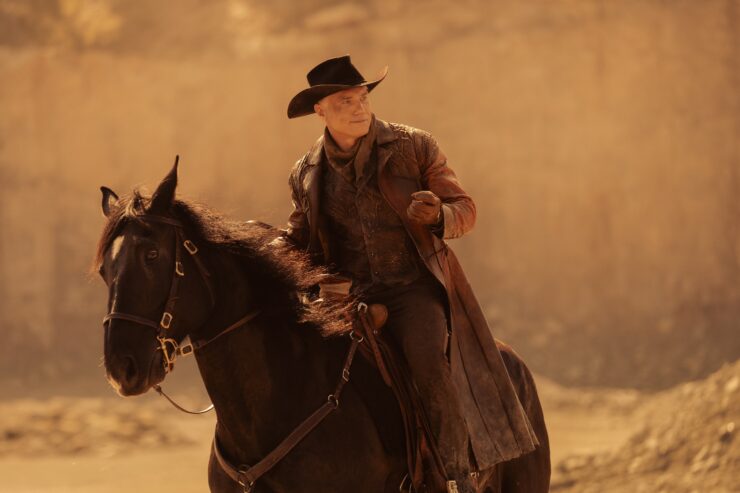
But although Pike’s history has the set-dressing of a cowboy persona, even the Hunter version isn’t particularly full of machismo—we see him struggle with indecision and identity issues, confide in others even to the point of being accused of whining, and admire the beauty of flora on an unfamiliar planet. In Strange New Worlds, Anson Mount takes Pike’s sensitivity, emotional struggles, and love of beauty, and elevates them over the course of the three seasons that he has (so far) had to explore the character. And as an avid equestrian, Mount (ironic last name there) also takes Pike’s history with horses to another level, as we get to see Pike out for a snowy winter’s gallop in the pilot episode, and then again, riding along with M’Benga and La’an, having the time of his life while undercover on some kind of Wild West planet in the opening of season four.
When it comes to humans and horses, especially in American pop culture, one of course will think of cowboys and ranchers and rodeos—of rugged working men and their trusted companions, the horses that make their livelihood possible. But in our modern world, much of the work that would have been done using or riding horses in the past is now accomplished with trucks, mechanized farming equipment, and other machines. And today, modern machismo culture revolves primarily around cars and motorcycles, much more so than horses or any other kind of animal that you’re supposed to bond with… which feels pointed, to say the least. A horse is a living being with emotions and needs of its own; a mechanized vehicle is not.
When I think about what horses mean to the culture I grew up in, I think primarily of rainbow ponies, of the princess and maidens that folklore tells us unicorns are drawn to. Of my mom, who wanted a horse so badly when she was a little girl that she promised my youngest sister she could have one when she turned 16—and even followed through with the promise ten years later. I think of all the horse girls I knew growing up, and the many, many toys they all had, both realistic and fantastically colored, and the games I played on the playground with my female friends where we imagined having stables full of beautiful horses and ran around imitating trotting and cantering.
Horses are a lot of work. They are not only expensive to feed, stable, and care for, they are also remarkably fragile creatures that can injure or sicken easily, and which need a lot of regular training and exercising. They need companionship, both from other horses and from their owners/trainers. Riding well requires building a strong bond of trust between horse and rider, and especially a good sense of each other’s bodies and movement. In our culture (speaking as a citizen of the U.S., specifically), putting this kind of effort, gentle care, and shared body awareness is more often encouraged in women than in men. What used to be framed as a purely masculine pursuit would now be perceived as feminine to many, including fans of cowboy archetypes.
That is a cultural generalization, of course. There are plenty of boys, and men, who love horses and all that comes with owning and riding them. And there are areas of U.S. life that still revolve around horses, such as rodeo riding and ranch work. The arena of professional sports riding is also still dominated by men, despite the preponderance of women on the so-called amateur end of that field.
As a generalization, however, I think the above evidence renders my point: Remember when The Two Towers came out, and everyone was talking about how the majority of the Rohirrim were not played by men? When Peter Jackson was looking for extras with excellent riding skills—particularly extras with excellent riding skills and their own horses—most of the New Zealanders he found with those qualifications were women.
Women with enough disposable income and free time to devote to a beautiful, but very expensive hobby. You know… grown up horse girls.
Credit: Paramount+
That cost isn’t a problem for Pike, of course, as he lives in a technologically advanced, post-scarcity future. Horses may still be best suited for some jobs in our current era, especially in less mechanized countries, but in Pike’s time there are robots and flying shuttles and transporters, all of which are available to everyone in the populace. And while the lives of every person on Earth are ostensibly provided for more or less equally, one can argue that being the captain of Starfleet’s flagship is about as close an equivalent to being a rich person as a world without money can offer.
So. Pike is a sensitive, kind, “wealthy” person, who lives in a beautiful home in Montana that he goes to when he’s not out among the stars. His hobbies are cooking elaborate meals and being an equestrian. We don’t actually see him interacting with horses very much, just a brief glimpse of him riding that beautiful black horse in the pilot episode (it’s Tango, by the way) and a saddle that he keeps on his starship, but we can be sure that his gentle, nurturing nature suits his equine companions just as well as it does his friends and his crew.
What I’m saying here is that Spock’s surrogate dad, Captain Christopher Pike, is basically living Tina Belcher’s dream. He may insist on one more ride on that Wild West planet in the opening of “Valles Marineris,” even though the mission is already completed, but he doesn’t love that moment because he’s a rough and tumble cowboy man.
He loves it because he is a horse girl.[end-mark]
The post <i>Star Trek</i>’s Christopher Pike Is a Horse Girl appeared first on Reactor.








 New Posts (Home)
 ChatBox
 Popular Posts
  Game Zone
 Top PodCasts