www.thegospelcoalition.org
Don’t Judge Christian Womanhood by ‘Yesteryear’
Perched on the edge of a marsh, the bookstore was tiny. Gray shingled walls chronicled years of brackish weather. It smelled of seawater and paperbacks, espresso and honeysuckle.
Like the other three bookstores we’d visited, this one had a shelf dedicated to the current bestsellers. But unlike the other three, it had several copies of the book in spot number one. Ink-blue handwriting scrawled across a neon orange sticky note affixed to the cover: “IT’S HEREEEE!!!!!!”
I didn’t buy it then, instead checking my local library for a copy. “Congratulations!” The pop-up notification told me. “Hold successfully placed. You are: 138th in line. Your estimated wait time is: nine months.”
I can’t remember the last time I heard about a book with this much hubbub. I wondered what proved so intriguing, specifically to my generation (Gen Z), that it would skyrocket to the top of the bestseller list mere weeks after its April release.
Then I met Natalie Heller Mills: “A flawless Christian woman. The manic pixie American dream girl of this nation’s deepest, darkest fantasies. The mother every woman wanted to be, and the wife every man wanted to come home to . . . perfect at being alive” (4).
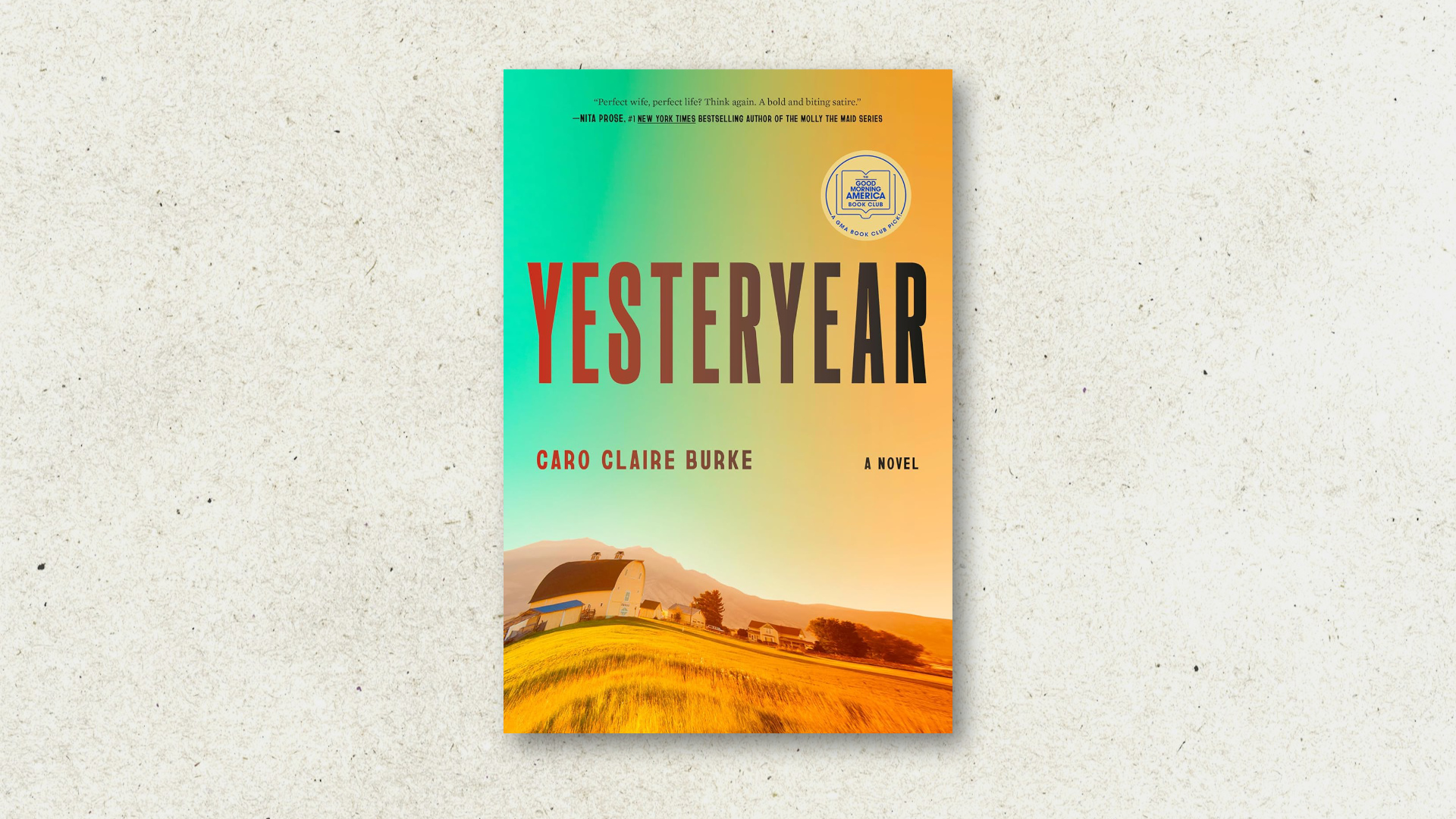
Thus spoke the protagonist of Caro Claire Burke’s debut novel, Yesteryear.
Intriguing Concept
Set in the mountains of rural Idaho, Yesteryear Ranch is home to Natalie and Caleb Mills and their gaggle of children. Natalie’s days are filled with baking sourdough bread; collecting eggs with her daughters; giggling at her husband; and posting, always posting, every little minute of it online. She wears organic cotton and walks across planks of imported Brazilian hardwood. She’s easily, always pregnant. She prays and quotes Scripture to herself.
To fund their simple lifestyle, Natalie is a stay-at-home mom. At least, that’s what her millions of Instagram followers think. She glosses over the fact that her farm began with a small loan of $5 million from her father-in-law, the spearhead of a growing political dynasty. She hides the barrels of pesticide, the hired nannies, the video producers. She passes out NDAs and avoids public interviews. In doing so, she keeps up appearances. And her followers eat it up.
Then one day, her perfect life nosedives when she wakes up in the year 1855, in the crude reality of the world she so carefully curated. She thinks at first it’s a reality TV stunt. Maybe it’s time-travel. Or maybe, she concludes, it’s a test from God.
Tale of Two Pitfalls
This book, with its f-bombs and sexually explicit scenes, isn’t worth the time it takes to turn the pages. But the truth is, women all around us are turning the pages. And their view of Christian womanhood is being shaped by the story.
The book’s premise is to take a cutting, satirical look at the “tradwife social media influencer” and her evil twin, the working woman ground to the bone at the expense of family and happiness. To get these points across, Burke gives us an unreliable, unlikable narrator, presented as a Christian wife and mother.
When crafting Natalie, Burke sought to explore the “fascinating social experiment [where] many women force and contort themselves to try to fit into a lifestyle that is fundamentally unnatural, even though it is billed as fundamentally natural.” Yesteryear isn’t the only place she dissects this “fundamentally natural” lifestyle. Whether on a late-night show or on her podcast, Diabolical Lies, she throws punch after punch at what she understands Christian marriage and womanhood to be.
At her baptism, Natalie wonders with dismay if Anyone is really out there at all, if Anyone is coming to save her. In her motherhood, she’s filled with a sense of doom. She thinks her children are evil joy-suckers and is immensely relieved when the nannies are hired and she “never has to be alone with them again” (264). When she is alone with them, she thinks her daughter is God incarnate (234). Her marriage oscillates between gender-confused and physically abusive.
But the whole book hangs on her faith. In tight italic lines, we see the inner workings of Natalie’s brain: the prayers she whispers, the Scripture she quotes. Like a mirror cracked from side to side, the whole of it seems familiar until you peer closer and find the reflection distorted, the individual pieces jagged and sharp.
What’s the Point?
Reading the book as a young Christian wife and mother is a bit like sitting in Sylvia Plath’s Bell Jar, like being stuck in the snaking, smoggy lines of La La Land traffic. Every few pages, I needed to come up for air. Natalie is some sort of ambiguously Protestant woman, or maybe Mormon (a la Ballerina Farm), or maybe Catholic, or maybe Orthodox Jew. Who knows? Not the reader, and maybe not even the author.
Nor does she understand just what she’s taking potshots at. I’m not the only one to feel this way; another reviewer describes the work as a “clever premise wearing the skin of a novel.” The attempt at satire is evident throughout Yesteryear, but good satire requires enough of a grasp to know what you’re making fun of. Burke doesn’t.
Submission. That’s part of what she’s rallying against. The patriarchy! A general sense of subservience, the understanding that the woman stays home, out of finances, out of any real contribution to her family and country, God help her. Burke’s feminism and wit tumble like a dirty little snowball, hurtling with increasing speed toward the end of the plot. Natalie’s 1855 experience? After sexually assaulting her female producer, she has a mental breakdown and retreats to the far corners of her farm, completely out of touch with reality. Natalie is eventually arrested for child abuse, and so the book concludes with a thud.
Important Critique
With a film still on the way—Amazon MGM Studios picked up the rights before the book’s release, with Anne Hathaway set to star as Natalie—Christians should be aware of what the book is communicating, especially to my generation.
We grew up in a world where our algorithms latch on to what we’re interested in and feed us that content until we’re engorged. The algorithm dangles carrots: buy this dress, adopt this 10-step routine, and you too could have the happiness this 30-second video captures. Gen Z has a nostalgia for a life we’ve never lived. There’s a generation-wide desire to do what Paul exhorts: live quietly and work with our hands (1 Thess. 4:11). We want to build analog habits and unplug our phones, unfollow the influencers—once we let them teach us how.
Credit where credit is due: Burke rightly recognizes that the tradwife social media influencer movement isn’t as transparent as it claims to be. She also rightly identifies that the alternative on the other end of the spectrum isn’t any better: give up a family to work until you die.
Missed Target
But Burke lies to us, too, and it’s brazen: Be a married Christian mother who aspires to build her home and follow the Lord, and you’re doomed to a psychotic breakdown eventually. It’s implicit in the book and explicit in her interview with NPR: “I think a little bit of what I was thinking about when I was writing the novel is almost like pushing a theory to its final conclusions. . . . Let’s carry it out all the way and see what happens when we get to the end.”
There’s a generation-wide desire to do what Paul exhorts: live quietly and work with our hands. We want to build analog habits and unplug our phones, unfollow the influencers—once we let them teach us how.
This would be an interesting premise and an even more interesting read if it had any grounding in reality. Instead, Burke’s characters are caricatures, her social commentary socially unaware. Another reviewer asserts that it’s “painfully obvious that Burke has never once meaningfully interacted with the sort of person she means to satirize.”
Burke also seems unable to decide whether women lean toward tradition because they are hypocrites or because they really believe what they say they do. At times she portrays Natalie as a charlatan whose husband dances to her tune. At other times, she portrays her as a naive true believer, and thus worthy of disdain. In any case, we’re supposed to dislike her and all she stands for.
If Burke wanted to meaningfully interact with whom she meant to satirize, all she had to do was put down her phone and go to church. That’s where real Christian wives and mothers live and love.
If Burke and Gen-Z women are hungry for a picture of a different kind of life (and, apparently, they are, with more than half a million copies of Yesteryear sold already), they’d get the truest picture every Sunday morning. Instead of pews lined with people who spend their lives curating their online ones to perfection, Burke would see sinners in need of a Savior. And in their repentance and forgiveness, she’d be pointed to him too.








 New Posts (Home)
 ChatBox
 Popular Posts
  Game Zone
 Top PodCasts