www.dailywire.com
Sinatra, ‘Swingers,’ And America’s Golden Age
“Heya pal, got a cigarette?”
Frank Sinatra was walking outside the Moulin Rouge in Los Angeles, heading west. Outside the club, the guests at the evening’s charity event had started heading out, getting some fresh, damp spring air to cure their mild drunkenness — not as drunk as Spencer Tracy or Clark Gable, but enough that a few stumbles were caught beneath the circular words, perched on the building’s broad side facing Sunset Boulevard: “Thru These Portals Pass The Most Beautiful Girls In The World,” and the rendering of a woman’s profile illuminated in neon — a relic that the club’s manager, Frank Sennes, wouldn’t dare remove, lest the cache of the club go down in the dumps with it. No, this was Hollywood and no one made a move without having some well-connected friends or a bulletproof reputation. Frank Sinatra had both.
Lighting his cigarette, Sinatra stared up at the neon goddess and kept walking. Somewhere in the night, the HOLLYWOOD sign was staring down from Mount Lee, above Beachwood Canyon, right over 6230 Sunset Boulevard. Its blinking marquee lights had been taken down years before, but its looming presence remained, overlooking its Pacific desert empire, daring young men and women to follow their ambitions. Fortunes and reputations and dreams were made and lost here — Peg Entwistle’s ghost would oversee all of it from the top of the Hollywood “H.” Sinatra, by this May 13 night in 1960, had been through it all. And now he was back on top.
To an outsider, there was no better place to be than in the Sinatra orbit. Post-WWII America was still in the midst of a national boom and tiptoeing up to a decade-long transition that would wave a wistful goodbye to one Golden Age and then oversee its burial without realizing how rich we had it.
Sinatra had taken over the original Rat Pack from his pal Humphrey Bogart, who hosted the group in a revolving-door style in the Holmby Hills home he shared with his wife Lauren Bacall. And they made a show of it in this showbiz town. David Niven, Errol Flynn, Spencer Tracy, Judy Garland, Swifty Lazar, Sinatra, Cary Grant, Clark Gable and Lana Turner. They stayed at The Garden of Allah and dined at Romanoff’s. They drank Rusty Nails and champagne and played practical jokes, had affairs, danced, romanced, gossiped, and broke up. They started rumors and ended them. And when Bogart died in 1957, a part of that world went with him.
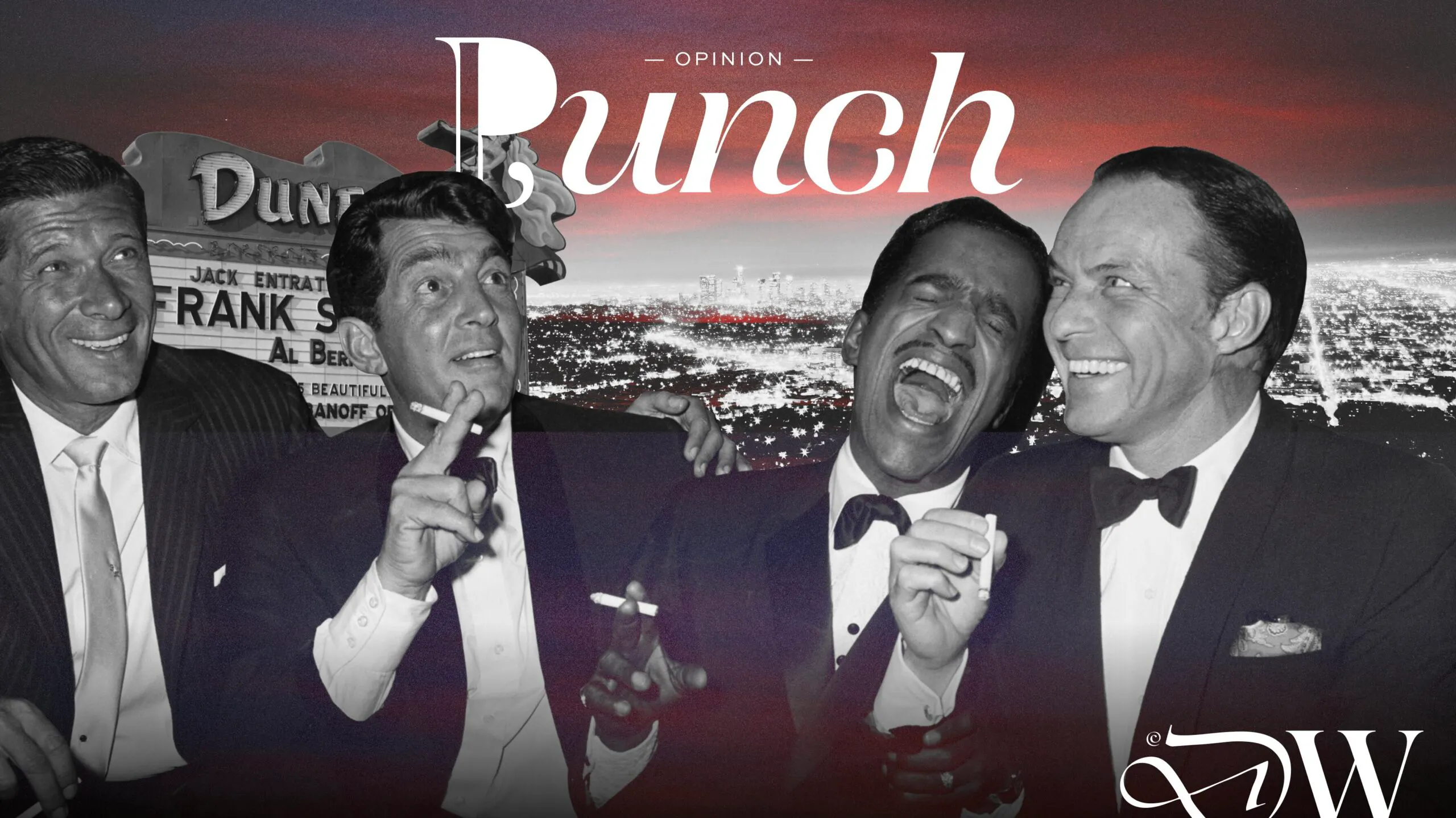
It was a new, old era. Sinatra had gathered his permanent crew, rebranded the Rat Pack in his swinging image, and set off for Las Vegas. He, Dean Martin, Sammy Davis, Jr., Joey Bishop, and Peter Lawford had a standing show at The Sands Hotel and Casino. “Ocean’s 11” was being filmed; casinos up and down the strip were headlining the stars of the day that would be buried by the counterculture of tomorrow. But the Old Guard’s code still worked. There was carousing and drinking, gambling, smoking, showgirls, money, drugs, sex, parties, and the ease of life that was confident in the present. Untouchable. It was a brotherhood of Rats but clad in black tuxedos, endearing itself to a nation at the cusp of revolution. And the genius of it all — what made it work — was the adherence to a line of respect that came down to what it meant to be a man.
By 1960, Rock and Roll had weaved its way into the mainstream. Romonoff’s skipped over Wilshire Boulevard, moving from North Rodeo Drive to South Rodeo. It preserved the original building’s mood, but the cultural shift proved too much to bear, and the restaurant closed its doors two years later. The Brown Derby on Wilshire was also shuttered, followed years later by the Brown Derby on Sunset — the one that created the Cobb salad and the sticky-sweet Shirley Temple — relics of an age that seemed like it would live forever until one day it didn’t. The culture never offers an explanation; only an autograph at the bottom of an IOU.
It was, at its core, a town of men, just like any town. And here was Sinatra, smoking a heater, a little drunk, and in a full Indian squaw outfit. The Moulin Rouge party had a Western theme, and the crooner showed up in drag with a feather-topped headdress. It was a deliberate move to tempt the entertainment gods into a fight, and that night, the god was John Wayne.
Wayne showed up as himself because he was always John Wayne, and performed his act on stage and received his applause and laughs and cheers. But not from Sinatra. The leader of the pack had beef to settle with Duke. In that town, nothing is as good as the story behind the story, and this was one for the papers. The two Big Men of the Golden Age were at odds over politics, scripts, the Blacklist, Albert Maltz, and the art of being a man — an uncompromising commitment to reputation, honor, and a Code. And so, in the small hours of a Saturday morning with half of Tinsel Town in Cowboys-and-Indians, Sinatra called out, “Hey Duke, why’d you run your mouth?” The five-foot-seven Sinatra, who registered 150 pounds soaking wet, shoved the 220-pound Wayne, a towering figure at six-foot-four even without his hat.
Wayne didn’t move; he didn’t have to. He had the advantage of size and posture and a lifetime spent being the final word in the room. Sinatra had the advantage of nerve. This was not merely a fight between two famous men. It was a collision between two competing ideas of manhood, both shaped by the old Hollywood machine but ultimately a reflection of the American Man: overcoming challenges, flaws, and sins (because… who among us?), and stepping into responsibility and danger and sacrifice for honor, reputation, the friends beside you and the family behind you.
The romance of the Rat Pack era, when stripped of the smoke, dazzling lights, crinoline-lined dresses, whitewalls, and the cultural sins of the age, rested on aspiration. A man wanted to be better than he was. He wanted to sing better, dress better, tip better, dance better, and love better. Masculinity was not victimhood. It was not a podcast grievance. It was not a rented sports car photographed at a low angle. It was movement — toward a woman, toward a friend, toward the door, toward the next town, toward the next chance to prove that style was not a costume but a discipline. And if you stepped out of the Moulin Rouge on a starry night below the Hollywood Hills with a heater and an attitude and moccasined feet right into your custom, two-toned 1958 Cadillac Eldorado Brougham and headed toward Route 91, the crystal desert air giving way to the razzle-dazzle of Sin City, a man just might find that discipline refined in ways that only shone under the electrified oasis.
That is the thing about the lure of this show town, embedded in the ethos of Las Vegas in its heyday: glamour that is too easy to misunderstand from a distance. It was not simply the tuxedos, the cigarettes, the neon, the women, the jokes, the drinks, the swagger, the snap of a cufflink, or the band hitting the downbeat while a man in a dinner jacket leaned into a microphone as if the whole country had been waiting for him to explain the meaning of cool. It was performance, but performance with obligations. You had to be funny. You had to be generous. You had to be able to take a joke, buy a round, show up for your friend, and know that the woman across the table was not an accessory to your mythology but the reason the mythology had any stakes at all. The Beautiful Babies who understood that what it meant to be a lady was just as important as what it meant to be a man.
This is why the film “Swingers,” released in 1996 and set inside the hungry, half-broke, retro-cool Los Angeles of aspiring actors and late-night bars, understood the Rat Pack better than most nostalgia ever could. Set against the backdrop of the revival-swing era, an underground, niche scene that was at its best when it was still below the surface — a spontaneous zeitgeist that originated in small, intimate venues in Southern California — was a reaction to the heavy-handed hair bands and carbon-copy grunge rockers popular at the time. The players never took themselves too seriously, and it reflected the upbeat, carefree fun of the original American Swing of the 1930s and ’40s, but with a punk/ska twist. It only became cringe when GAP mainlined it into its khaki commercial, and Super Bowl XXXIII featured one of the more commercially successful bands, Big Bad Voodoo Daddy.
Doug Liman’s film, written by Jon Favreau, was not about men who had made it. It was about men rehearsing for the possibility that they might. Mike was heartbroken, broke, embarrassed by his own need. His friend Trent was loud enough to cover the terror beneath confidence. Rob, Sue, Charles — all of them were orbiting the same dream factory Sinatra had conquered and the same city that keeps a ledger of everyone who thinks wanting something badly enough makes it inevitable.
But “Swingers” is not cruel to Mike. That is its grace. His friends tease him, push him, dress him up in their borrowed bravado, drag him to Vegas and back, and tell him he is money long before he believes it. Their friendship is noisy, immature, and occasionally ridiculous, but it is also tender. The movie knows that male friendship, at its best, is a rescue mission disguised as a bit.
And the women in “Swingers” matter precisely because they are not merely trophies in the boys’ recovery narrative. Nikki’s answering machine becomes a tribunal — a trainwreck of a scene that rivals any horror flick. Mike humiliates himself not because a woman is cruel but because he’s upended by his own panic. Lorraine (Favreau ahead of the curve, utilizing an old-fashioned name before it became trendy, again), when she arrives, is not conquered. She is met. She is another person in Los Angeles trying to begin again. The happy ending is not that Mike gets the girl as a reward for suffering. It is that he becomes capable of speaking to her without dragging the wreckage of his old life into the conversation. He becomes, in the old sense, a gentleman — not because he wins, but because he finally stops making his pain someone else’s problem.
And here’s the thing that made Swing revival the understated hero: Swing music wasn’t meant to be heard over speakers. It was meant to be live. It was meant for dancing — partner dancing. With a live swing band playing and a postage stamp dance floor, a guy who wasn’t afraid to dance had no shortage of girls to dance with. It was an immediate icebreaker. No stupid pickup lines; all you had to ask was, “May I have a dance?” Hell, maybe she’d buy you a drink if you made her look good. It was a real-life part of the L.A. scene.
Favreau frequented the Los Feliz Derby, a version of one of the original Brown Derby restaurants, located in the Los Feliz neighborhood in the greater Hollywood area of Los Angeles, abutting Hollywood and encompassing part of the Santa Monica Mountains. The Hollywood location was the haunt of Bogart and the boys, and the spirit was the same: There was no animosity between men and women; no “trad,” no longhouse. There is no patriarchy, matriarchy, manosphere, feminazis, cat ladies, or chads. There were beautiful babies and cool cats, and no one took it or themselves too seriously.
A few members of the cast of “Swingers” recalled that mood in a 2014 interview in Grantland:
Vince Vaughn: When Jon moved to L.A., I started to take him out to a lot of these swing music places. A lot of the old punk rock bands started to play swing. It was an alternative to the alternative scene — great live music, people dressing up, and the dancing was fun in a fun, intimate way. You would go and dance with a girl and hang out. It was really conversational. It was like being back in Chicago, where people would actually talk.
Glen “The Kid” Marhevka (trumpet player, Big Bad Voodoo Daddy): When we first started playing, we would show up at a club in suits and fedoras and people would just trip. They stared at us like we were aliens. But you’d go out and you’d dance. You’d dance with people. There was physical contact. It was kind of romantic. And just plain cool.
Morris: It was Hollywood personified. I mean, it was as hip as any club I have ever been into ever.
There is a line running from Sinatra’s Vegas to Favreau’s Los Feliz, from the Sands to The Derby, from the tuxedo to the bowling shirt, from “Luck Be a Lady” to “You’re so money and you don’t even know it.” It is not a straight line of virtue. It is a line of posture, music, friendship, romance, and the belief that life is worth dressing up for even when your checking account says otherwise. The swing revival of the 1990s understood that glamour was democratic if you had the nerve to enter the room. You didn’t need to own the casino. You needed a jacket, a friend, a song, and enough self-respect not to confuse rejection with oppression.
In the Golden Age of aspiration, risk, men with ambition, men in love and the beautiful babies they pursued — from the mahogany booths of The Brown Derby, the glitz and red lips of the Sands and the showgirls at the Flamingo; hard-boiled toughness of Bogart and the easy swagger of Wayne — post WWII America placed a lot of expectations on men and men were up to the challenge.
The grifter, by contrast, never risks the room. He broadcasts from a throne he built out of insecurity and charges admission to men who have not yet learned that no woman, no friend, no city, no world owes them applause, and when life breaks your heart, call your buddy. Put on the jacket. Go hear the band. Try again. “Cock your hat — angles are attitudes,” Sinatra said.
This is the inheritance worth keeping from the Rat Pack’s long shadow: not the vices, not the swagger for swagger’s sake, not the belief that masculinity is proven by intimidation, but rather the American wager that a man can lose, get dressed, meet his friends, hold onto the woman in front of him, and still walk into the night as if the band is playing his song. That’s money, baby.








 New Posts (Home)
 ChatBox
 Popular Posts
  Game Zone
 Top PodCasts