www.civilwarmonitor.com
The Course They Didn’t Advertise
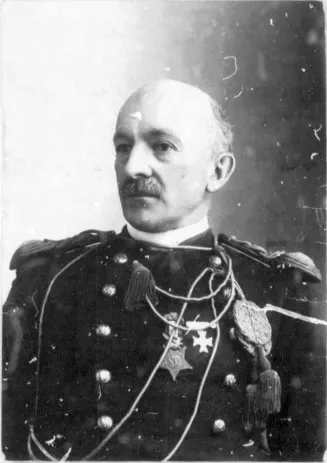
armyatwoundedknee.comCharles Varnum
In 1895, Captain Charles Varnum of the 7th United States Cavalry arrived at the University of Wyoming in Laramie to assume the position of professor of military science. Varnum, 49, son of a Civil War major and a West Point graduate, had spent the better part of three decades in the Regular Army, nearly all of it in the West. In 1876, as a young lieutenant, he served as chief of scouts under George Armstrong Custer during the Little Bighorn Campaign. He and his Crow and Arikara scouts located the enormous Lakota and Cheyenne encampment along the river; Varnum was one of three officers to survive the battle that followed. In December 1890, Varnum commanded Company B of the 7th Cavalry at the Wounded Knee Massacre. The following day, at the Drexel Mission Fight on White Clay Creek, his conduct during a difficult withdrawal earned him the Medal of Honor, which he received in September 1897.1
That Varnum ended up at the University of Wyoming is not surprising—in a historical sense. It was a consequence of the Civil War and the conflict’s remaking of the American West. Varnum was teaching military science in Laramie because of a provision embedded in the Morrill Act of 1862, legislation that had established creating the Land Grant colleges of the American West. The act also required every institution so founded to teach military tactics alongside agriculture and the mechanical arts.
The Morrill Act is remembered, rightly, as one of the most consequential pieces of legislation in the history of American education. Its sponsor, Justin Morrill of Vermont, one of the founders of the Republican Party and in the midst of his five terms in the House of Representatives, envisioned a national system of public colleges dedicated to what the act called “the liberal and practical education of the industrial classes in the several pursuits and professions in life.” Morrill was a mostly self-educated man, the son of a blacksmith, and he spoke passionately about the Americans his bill served. In an 1858 speech before Congress, he described working people who had to “snatch their education, such as it is, from the crevices between labor and sleep. They grope in twilight,” he said. “Our country depends upon them as its right arm to do the handiwork of the nation. Let us, then, furnish the means for that arm to acquire culture, skill, efficiency.” Congress passed Morrill’s original bill in 1859, but President James Buchanan vetoed it on constitutional grounds—as it complicated issues of federalism, the relationship between the federal government and the governments of the states.
Library of CongressJustin Morrill
When Morrill reintroduced his legislation on December 16, 1861, eight months into the Civil War, the bill had changed. He had added a requirement that recipient institutions include “military tactics” in their curricula. The original bill said nothing about training soldiers, sensible enough given that it had been drafted in peacetime. The amended version placed the requirement directly into the act’s central clause, specifying that the colleges’ “leading object shall be, without excluding other scientific and classical studies, and including military tactics, to teach such branches of learning as are related to agriculture and the mechanic arts.” The phrase carried the force of law. Every land grant college in the country was obligated to produce not only educated farmers and engineers but also trained soldiers.
The addition reflected both the crisis of the moment and Morrill’s own background. The Union army had entered the Civil War with roughly 1,500 trained officers and found that it needed closer to 20,000. The shortfall was filled by political appointees and civilian volunteers; men whose bravery was not in question, but whose preparation was. After the battles at Bull Run, Ball’s Bluff, and Wilson’s Creek, Congress was under considerable pressure to address the problem of U.S. officer quality. Just as in the War of 1812 and the Mexican War, the United States found that volunteers were not as capable as formally trained soldiers.
Norwich University Archives and Special CollectionsAlden Partridge
Morrill had grown up near Alden Partridge, the former West Point superintendent who had founded what became Norwich University, in Norwich, Vermont, in 1819. Partridge spent four decades arguing that military training should be woven into civilian education, producing citizen-soldiers rather than a professional officer caste separate from the republic it served. When the war came, Norwich supplied 523 officers to the Union army. Morrill’s amendment nationalized Partridge’s idea. President Abraham Lincoln signed the Morrill Act on July 2, 1862, the day after George McClellan’s Army of the Potomac completed its retreat to the James River following the Seven Days Battles.
The institutions that took up the Morrill Act’s mandate had little guidance on what military instruction was supposed to look like. The act specified “military tactics” and nothing more. There was no syllabus, no authorized provision for uniforms or equipment, and no prescribed outline of courses. But there was excitement at the idea that the United States would finally be freed from the onerous institution of West Point professionalism. As the land grant colleges got on their feet throughout the 1870s and 1880s, most hired Civil War veterans as professors of military science, often as a sideline to their full teaching loads in other subjects. The instruction consisted almost entirely of drill. When the University of Wyoming organized its first cadet battalion in 1891, the 55 students had no rifles and purchased their own uniforms at a cost of $18. Such improvisation was typical.
What matters for the history of the American West, however, is not the quality of early military instruction but the geography and timing of the land grant system’s expansion. The act allocated 17.4 million acres of federal land to fund its colleges. The federal government had acquired most of that land through what scholars have catalogued as 162 cessions backed by violence or coercion, expropriating approximately 10.7 million acres from 245 tribal nations.2 Roughly a quarter of the individual parcels had never been purchased from the tribes at all. Treaties went unratified, agreements uncompensated. The proceeds from selling these lands funded colleges primarily in the eastern and midwestern states, which had the congressional representation to claim the largest grants. Western congressmen, as historian Craig LaMay has noted, “generally disliked the bill, since of course much of the public lands to be given away and sold were theirs, the benefits to accrue to eastern states.”
Even so, the western territories were filling in, and they needed colleges of their own. The timing of their establishment tracks onto the final decades of the Indian Wars with striking precision. Kansas State opened in 1863, Colorado State in 1879, the University of Wyoming in 1886 (the year of Geronimo’s surrender), and North Dakota State and Oklahoma State both in 1890 (the year of Wounded Knee). These institutions did not arrive after the Indian Wars had concluded. They arrived while the campaigns were still underway, on land recently taken from the peoples those campaigns dispossessed, and every one of them was required by federal law to teach the tactics of dispossession to their students.
University of WyomingWorkers pause during construction of “Old Main,” the first building on the University of Wyoming campus, in 1886.
The result was a closed loop. Federal land, seized from Native nations, funded western colleges. Federal law required those colleges to produce students who were trained soldiers. Those students could be called to serve in the continued war against the peoples whose land had made the colleges possible. Varnum’s career traces the loop precisely: he fought at the Little Bighorn in 1876, at Wounded Knee in 1890, and arrived in Laramie in 1895 to train the next generation. The University of Wyoming existed because of the Morrill Act. The Morrill Act was funded by land taken from the Lakota and other nations. And the man teaching Wyoming’s students how to be soldiers was a veteran of the wars that had taken that land.
In the eastern states, the military instruction requirement was one obligation among many in a crowded landscape of higher education. Harvard, Yale, and dozens of other private colleges existed outside the land grant system entirely, with no obligation to teach anyone how to march. A student who wanted an education without the drill had options. In the West, options were far fewer. The land grant college was often the only higher education option. Wyoming had a single university (still does). If a young person west of the hundredth meridian wanted a college degree, that education came with a federal mandate to learn military tactics. The democratization of higher education in the West and its militarization were not separate developments—but the product of a Civil War Congress that saw no contradiction between the two.
And the pattern continued into the next century. As the United States contemplated intervention in a world war in 1916, the National Defense Act created the Reserve Officers’ Training Corps (ROTC). This provision gave the War Department direct oversight of military instruction at land grant colleges. The University of Wyoming was among the first seven institutions in the country to establish a ROTC unit. By then the Indian Wars were nearly a generation past (though places where the commander of the American Expeditionary Force, General John J. “Black Jack” Pershing, had cut his teeth), and the origins of the military requirement had receded from view. But the provision Morrill added in December 1861, two words tucked into a subordinate clause, had done its work. It had embedded military training in the institutional foundations of western higher education from the very beginning, in a region where those foundations and the federal government’s campaigns of Indigenous peoples’ dispossession were, for decades, the same project.
Cecily Zander is an assistant professor of history at the University of Wyoming. She is the author of The Army Under Fire: Antimilitarism in the Civil War Era (LSU Press 2024) and is writing a history of Abraham Lincoln and the American West, to be published by Liveright.
The post The Course They Didn’t Advertise appeared first on Civil War Monitor.








 New Posts (Home)
 ChatBox
 Popular Posts
  Game Zone
 Top PodCasts