www.dailywire.com
‘Lanterns’ Shows The Limits Of The Superhero Genre
HBO’s new television series “Lanterns” is revealing to a broader audience the limits of the superhero genre. The show tries to capture the spirit of the first season of “True Detective” (perfect television) while being shackled to Green Lantern’s expectations. Put those aesthetics on Batman or The Question, and it would work; slap them on a cosmic superhero whose power is fueled by imagination and a magic ring, and they begin to break under the weight of expectation.
The show is dour, but uplifted by a cast whose charisma tends to break what the script asks the viewer to believe and think. Kyle Chandler is obviously magnetic and shakes off any negative connotations some writers wanted to saddle the character with (old, racist, privileged, etc.; roll the clip). John Stewart is played well by Aaron Pierre and is given the reverse problem from Chandler: we are told he’s going to be great at the job, but his actions tend to say otherwise. It’s an odd framing for a story ostensibly about a superhero who comes with lots of baggage and expectations. Nathan Fillion’s Guy Gardner at least feels like he’s playing in the same sandbox his source material requires.
This problem of missing expectations and weighing down heroes with such bleak, morally dubious problems and decisions is something of a hallmark of Tom King. Since his rise to prominence in the comics scene, he has been handed the reins to many a superhero property. King is a good writer; his stories are generally well received (except, of course, from his extremely vocal critics who think he single-handedly waged the war in Iraq); it’s just that his stories tend to be ill-suited to the expectations of the superhero genre.
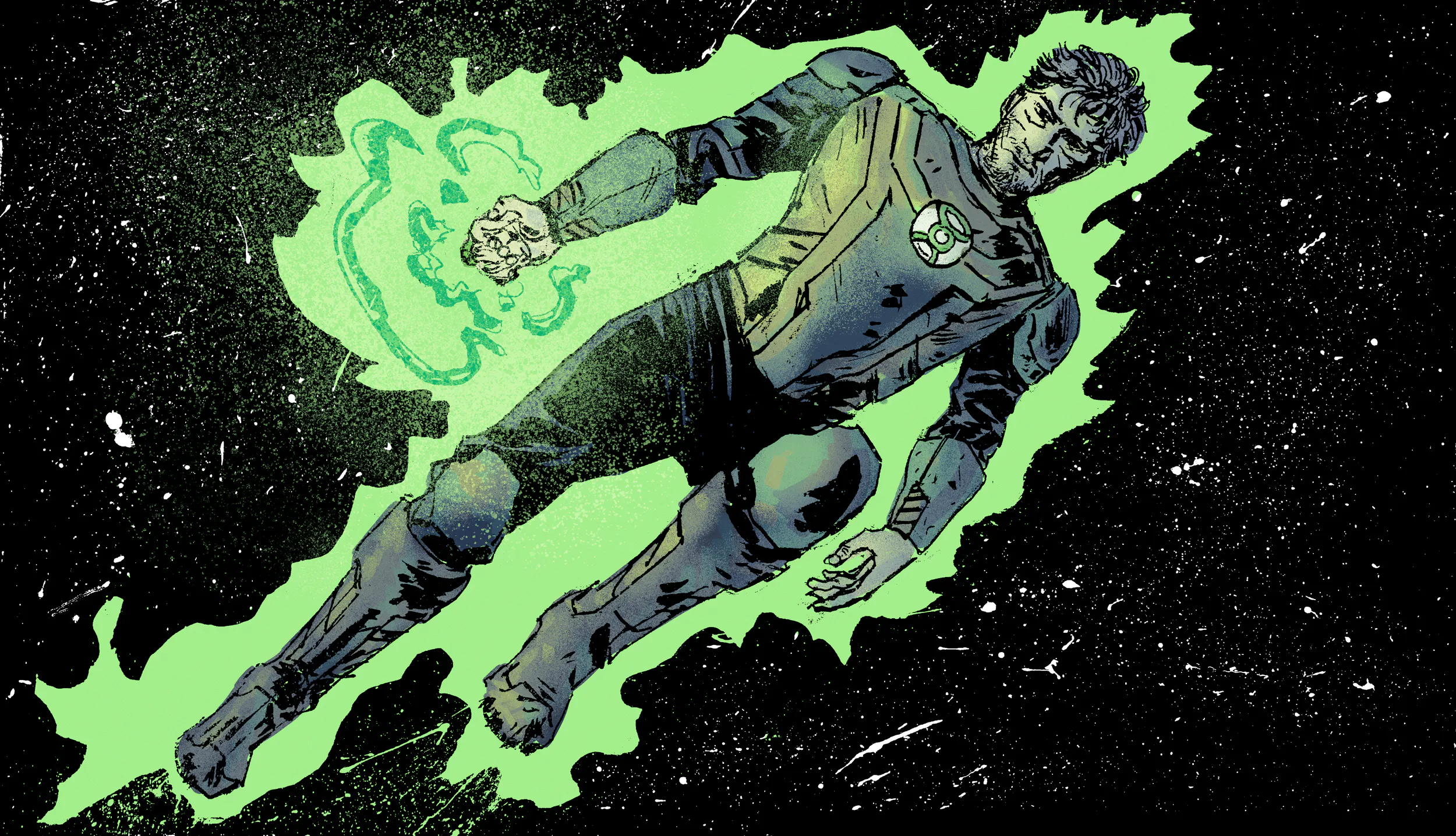
In this interview, King namechecks his, and the writers’ room’s, desire to fit in the film noir aesthetic, removed from the old Hollywood code where ill deeds must go punished. However, film noir and Green Lantern are clearly poor bedmates. Gabriel Hardman’s “Green Lantern: Earth One” was cited as a reference for the show – and while aesthetically the book is darker and grimmer, it still primarily happens in outer space, the fantastical exists, and ultimately Hal Jordan and the Lanterns prove they can do heroic stuff. The rings are used (though admittedly with less of the imaginative constructs and more “energy blast” stuff), and while they’re suffering from low power, they still work.
The issue with King’s writing and themes in the TV world is that his styling is finally running up against budget limitations. When paired with artists like Greg Smallwood on “Human Target,” Doc Shaner and Mitch Gerards on “Strange Adventures,” and Mitch Gerards again on “Mister Miracle” (these three being the closest analog tonally to “Lanterns”), the dour writing is buoyed by colorful, exciting visuals, even when the staging can become mundane (see the relatively low dynamics in “Mister Miracle” compared to the Jack Kirby high dynamism source material). Those visuals are entirely absent from “Lanterns”, the suits are drab, the power use is limited, this isn’t the big space opera stuff that is expected from the character.
King tends to mine the hero for guilt and regret, rather than heroics. His take on Adam Strange is a compromised man who ended up in over his head, making sacrifices that he couldn’t handle; His Mister Miracle is suffering from crippling depression and anxiety; Christopher Chance in “Human Target” is dealing with a terminal poisoning and trying to solve his own pending murder (spoilers: his murderer shares a good deal with Hal Jordan’s in “Lanterns”). His DC series “Heroes in Crisis” places all of the superheroes in therapy, and one of them is unable to handle all the pain that they are holding onto, thus creating a murder mystery.
He also leans on female leads who dominate their male counterparts. Mister Miracle and Big Barda at least veer into showing a supportive marriage, whereas Adam Strange’s marriage with Alanna is fraught with lies, similar to Chance’s relationship with Ice, which plays on the classic femme fatale trope.
None of these decisions are bad in and of themselves, and they’re all well done for the choices being made; they just tend to undermine the superhero genre to the point of crumbling. He dealt with many of these themes in his breakout book “Sheriff of Babylon,” which, I think, is a fantastic read dealing with the Iraq War. All the themes King keeps mining in superhero properties were present there, and they fit well. It’s a powerful book that remains relevant. The key difference is that “Sheriff of Babylon” deals with regular people; his other work deals with superhumans and the decision to reduce them to normal, flawed people, pushed to the breaking point and morally compromised to the point where they are indistinguishable from evil. Which may very well be his point – and it’s a point that Alan Moore makes in “Watchmen.” However, with “Watchmen,” Moore is using analogs of other heroes, while King is using the actual characters themselves and all their accumulated baggage. His stories would play so much better unchained from these legacy characters and all their weight.
I’m not a full-blown Ditko disciple; however, I can’t help but put him in opposition to King’s work – especially since King used and killed a Ditko allusion in his Rorschach series (albeit a bizarro Ditko world where he was an acolyte of Hannah Arendt instead of Ayn Rand). King has fully dismantled and subverted everything Ditko believed a hero to stand for. Ditko believed superheroes should inspire us to be good and moral and upstanding; King asks us to believe that superheroes are flawed and broken, victims of the violence they engage in, and incapable of being moral arbiters of anything. In a world where we are surrounded by a society that is breaking and fracturing, it is a shame our myths and heroes continue to be turned into a mirror rather than an inspiration.
***
Matt Battaglia is a comic artist and video producer. He is the author of “House on Fire,” and Executive Producer at Free the People. Follow him on Substack, X, and Instagram.








 New Posts (Home)
 ChatBox
 Popular Posts
  Game Zone
 Top PodCasts