reactormag.com
Five SFF Stories About Underground Resistance Movements
Books
Five Books
Five SFF Stories About Underground Resistance Movements
Taking a stand, while facing overwhelming odds.
By James Davis Nicoll
|
Published on March 24, 2025
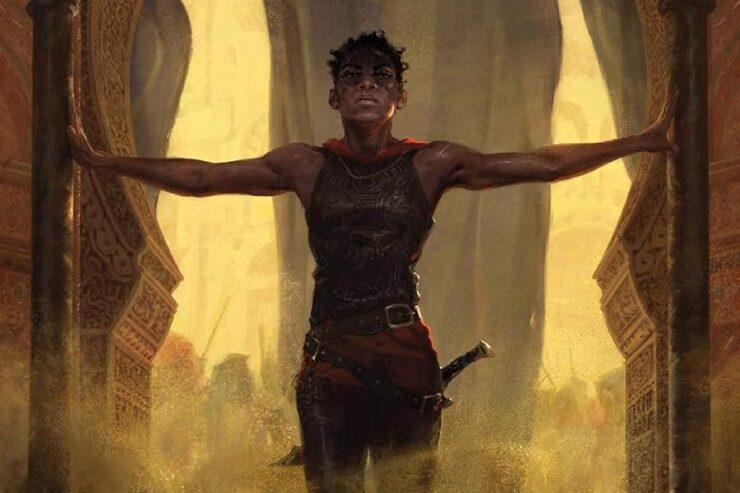
The Unbroken cover art by Tommy Arnold
Comment
0
Share New
Share
The Unbroken cover art by Tommy Arnold
Everyone likes to cheer for the underdog, particularly in military conflicts. This presents a challenge for speculative fiction authors. On the one hand, writing about the little guy somehow overcoming tremendous odds is a crowd-pleaser. On the other hand, the underdog is an underdog for a reason. If overwhelming military force worked so well in places like Vietnam, Somalia, and Iraq, how could it fail in the author’s fictional universe?
Here are five answers to that question.
Sinister Barrier by Eric Frank Russell (1939)
Americans in the unimaginably futuristic year of 2015 are doing a dismal job of resisting their overlords. This isn’t due to some inherent flaw in the American character. Rather, it’s because Americans in particular and humanity in general have no idea that they have overlords.
Liaison officer Bill Graham is convinced that the recent wave of deaths amongst America’s top geniuses is being orchestrated by some unknown agency. Graham is astounded1 to discover that the culprit is no internal enemy nor foreign foe. The immaterial, invisible Vitons have long controlled humanity, the better to feed off humans. The scientists knew too much and had to die. Now Graham too must die, along with everyone with whom he has shared the secret of the Vitons. Which, thanks to mass media, is a lot of people.
Sinister Barrier is an example of Fortean fiction, a subgenre that seems to have fallen out of favor. In particular, it’s an exploration of the proposition that humans are property, which seems like the sort of central concept that might find ready audiences these days. Be aware, however, that the novel is also an example of how badly certain elements of olden time SF can age.
Spoiler: the resistance wins, but I’m not going to tell you how.
The Word for World is Forest by Ursula Le Guin (1972)
For overcrowded, resource-depleted Earth, New Tahiti is a godsend, a perfect world for Terran colonists like Captain Davidson to exploit. New Tahiti is an untouched paradise. Its forests cry out for clear-cutting. True, the natives aren’t good for much, not even slavery, but no doubt some Final Solution will present itself.
From the Athshean perspective, matters are considerably grimmer. Aliens have invaded Athshe, renamed it New Tahiti, displaced and enslaved the Athsheans, and are seemingly intent on obliterating the forests. Diminutive, lacking the Terrans’ sophisticated mechanical arts, the Athsheans seem doomed. In fact, salvation is within the Athshean grasp… if they are willing to pay the price.
The Athsheans have an asset they are poorly situated to fully appreciate. Athshe is twenty-seven light-years from Earth in a universe where crewed starflight is sublight. The vast, powerful military-industrial complex on which the thoroughly reprehensible Davidson depends is at the other end of a very long logistical chain.
Red Dawn (1984), dir. by John Milius, written by Milius and Kevin Reynolds
World War Three having developed not necessarily to the United States’ advantage2, Calumet, Colorado finds itself swarmed by Red Communists backed and armed by Soviet Russia. The heavily-armed invaders massacre anyone foolish enough to resist. Calumet is occupied territory.
In the chaos of the invasion, a small group of high school students managed to elude the invaders. Poorly armed compared to the occupying army, the students lack suitable expertise to carry out a guerilla war. Nevertheless, the Wolverines are determined to make the invaders regret targeting Calumet.
To be honest, the Wolverines don’t make a strong case that an assortment of poorly-armed American high school students would be an effective guerilla force. “WOLVERINES FUCK YEAH” loses to “reality ensues”3. But sometimes, winning isn’t the point.
American Empire: The Victorious Opposition by Harry Turtledove (2003)
Although the US lost the states comprising the Confederate States of America, the republic did manage to conquer Canada. Quebec was then spun off into its own republic, theoretically independent from but dependent on the US. The rest of Canada was occupied.
Enter heroic Mary Pomeroy, whose family lost two members thanks to the US invasion. In general, the US has done a spectacularly awful job4 of integrating Anglo Canada into the US. In the case of Mary, nothing the US can do will ever compensate her for her loss. Thus, Mary’s mail-bomb campaign.
Canadian national mythology has at its core thrilling tales of how we fended off previous US invasions, burned the White House5, and how the Geneva Convention was inspired in part by a desire to get Canadians to moderate their enthusiasm for war crimes6. Campaigns like Mary’s would seem to be an inevitable reaction to a US invasion and occupation in some quarters. Imagine the Iraq resistance, as conducted by people who can travel freely through the US while passing as Americans.
The Unbroken by C.L. Clark (2021)
Balladair has a simple formula for success: crush weaker nations, occupy them, and send those children who might otherwise form a resistance off to be indoctrinated as loyal (and very expendable) soldiers in service of Balladair. It is in all respects an infallible plan, except for the part where it does not work.
Touraine and her fellow conscripts are dispatched to Touraine’s birth country Qazāl. Their mission? To suppress a rebellion. The actual outcome? To drive home to Touraine how little Balladair values the lives of Touraine and her fellow conscripts and how useful Touraine’s skills could be in the hands of Qazāl’s freedom fighters.
Readers might wonder if it’s a bad idea to kidnap someone, provide them with military training, and then send them back to the very nation from which they were kidnapped. It is. It’s a tribute to Balladair’s self-confidence that its rulers think this little plan is going to work out the way they expect.
Science fiction and fantasy love plucky resistance stories—the above are only a few of the many examples I could have selected. No doubt I missed some favorites. Feel free to remind us of them in comments below.[end-mark]
But only because Sinister Barrier was published in 1939. Had it been published after October 1960, Graham would have been analoged. ︎More alarmingly from my perspective, British Columbia was also occupied (see the map reflecting the events of the movie), thus imperiling the national Nanaimo bar supply. ︎At least the Wolverines do better than the German teen soldiers in 1959’s Die Brücke, whose misguided efforts to needlessly defend a strategically unimportant bridge from well-equipped, skilled American soldiers goes extremely badly. On the plus side, the kids were Nazis (or at least fighting for the Nazis). ︎Even more astonishing, the US occupation of Utah is somehow even more ineptly managed than the occupation of Canada, with some Mormons turning to suicide bombing. Given that the US historically rebounded from their less-than-entirely successful Utah War to successfully integrate Utah into the US, this version of the US seems to have lost crucial administrative skills. ︎Which Canadians didn’t. That was the British. We did blow up our own fortifications to confound the Yanks. As the schoolyard joke goes, “What was the last thing that went through Zebulon Pike’s mind?” “The York armory.” ︎Many Canadians really do believe the Geneva Convention thing. I know this because three different Canadians have mentioned it to me since January 20th in positively gleeful tones. However, Canadian national mythology is not all self-aggrandizement and reveling in violence. Our mythology enshrines the idea that the return on investment of privateer-based American gold acquisition was grossly overstated, leaving investors wishing they were in Sherbrooke now. (I understand and accept that many American readers won’t get the reference or understand why a number of Canadians are conditioned to respond to it with a four-word vulgarity and I am OK with that.) ︎The post Five SFF Stories About Underground Resistance Movements appeared first on Reactor.








 New Posts (Home)
 ChatBox
 Popular Posts
  Game Zone
 Top PodCasts