New Posts (Home)
 ChatBox
 Popular Posts
  Game Zone
 Top PodCasts


Order Jamie Glazov’s new book, ‘United in Hate: The Left’s Romance with Tyranny, Terror, and Hamas’: HERE.
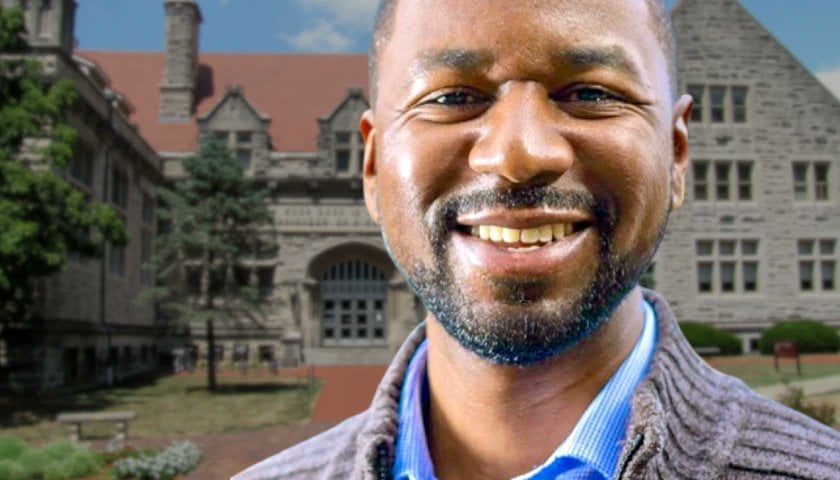
When a black professor at a mainstream university is sanctioned for discrimination against his white students, you know that his conduct had to be egregious. The case of Indiana University Professor Marcus Croom presents exactly that scenario.
Marcus Croom is a self-described “race critical researcher” and an Assistant Professor at the School of Education at Indiana University-Bloomington. In the far-left ecosystem of the modern university, schools of education—responsible for training America’s future teachers—are known for being particularly radical in their outlook, and IU-Bloomington is no exception. But even in that rarefied woke environment, Professor Croom took his anti-white agenda too far.
In the summer of 2024, IU-Bloomington student Michael Claycamp filed a formal complaint with the university’s Office of Civil Rights Compliance charging that Professor Croom exhibited unambiguous racial discrimination in conducting his class, creating a hostile environment for Caucasian students.
According to Claycamp, Croom made near-constant statements denigrating Caucasians in class, including comments that “white teachers are white supremacists” (a particularly pointed statement given that the students he was instructing were training to be future teachers) and that he would “rather not associate with white people over the course of the class.”
Croom’s racism was so egregious that the investigative committee was forced to recognize its severity.
“Many of the witnesses stated [Croom] tried to make them feel bad about being White and additionally made assumptions about them as White students which were often times not true,” states the investigative committee’s report, which added that Croom “continually defined” students “in terms of their race” including using such terms as “nice White women,” “privileged White girls,” and “White saviors.”
Apparently subscribing to the “White Fragility” theory of racism, Croom told white students in his class that they were all “intrinsically” and “indirectly” racist since “nice White women can be racist.”
The investigative report notes the “consistency” of witness statements corroborating these comments, concluding that “it is more than likely” Croom made “these or similar statements” to white students in his class and that “a preponderance of the evidence” suggests that he “placed the students’ race as central to their participation and evaluation in the course.”
Consider for a moment what would happen if a white professor—or a professor of any race—treated black students in this manner. If he made disparaging comments about “privileged black girls” or insulted black teachers as a group? If he declared he would “rather not associate with black people over the course of the class”? Does any sane person believe that he would be permitted to spend even five more minutes in that classroom? That he would not have been summarily fired and permanently blacklisted in academia?
Well, that’s not what happened to Professor Croom. Even after substantiating the professor’s egregious racism and discriminatory conduct in the classroom, IU-Bloomington’s Office of Civil Rights Compliance enacted only a “level one” sanction against the professor. According to the Tennessee Star this means that “Croom’s job or salary will not be affected by the punishment, but he will be required to attend trainings on ‘inclusive teaching practices’ and ‘respectful engagement with students of all backgrounds.’” Surely a few training sessions are all that is needed to cure this professor of his Caucasian Derangement Syndrome.
One also must question why Indiana University did not see this scandal coming. Croom was hardly secretive about his anti-white proclivities. His own university bio is rife with red flags and DEI-inspired verbiage. “Typically, I generate knowledge through case study and qualitative methods using post-White vindicationist philosophy, practice of race theory (PRT), and race critical practice analysis,” he explains.
Croom’s book, Real Talk: How to Discuss Race, Racism, and Politics in 21st Century American Schools, is dedicated to “Racial literacies and post-White futures for us all.” The university at best overlooked—and at worst endorsed—Croom’s racist tendencies.
Unsatisfied with the extremely mild sanctions given for the professor’s overt racism, Claycamp, the student who filed the initial complaint, appealed the decision to request great disciplinary sanctions, but Provost Rahul Shrivastav refused to reconsider the punishment.
“In supporting this decision, I trust these measures will provide adequate motivation and oversight for Professor Croom in addressing the issues that emerged in this case,” Shrivastav wrote in a letter denying the appeal.
The rest of us must be forgiven if we are not so optimistic.