New Posts (Home)
 ChatBox
 Popular Posts
  Game Zone
 Top PodCasts


‘There has been zero soul searching and zero rethinking,’ one MIT source said
Some Massachusetts Institute of Technology departments use so-called broader impact statements in the hiring process in the wake of a nearly two-year-old decision to ban mandatory diversity, equity and inclusion statements.
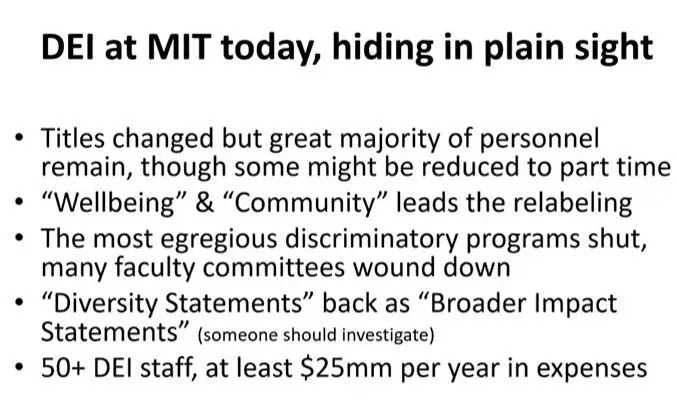
It’s one example of how the ideology remains part of the ecosystem at MIT, with an estimated expenditure of $25 million annually on about 50 part and full-time employees working on DEI, according to an alumnus watchdog in a presentation Tuesday.
William Frezza, founder of the MIT Free Speech Alliance, made the comments at a webinar hosted by the center-right National Association of Scholars called “DEI Reform at the Universities.”
The event was, in part, a follow up to a research report NAS published last fall that detailed DEI’s deep incursion at the venerable institution.
“We’re looking for some trustee to stand up and say, ‘Hey, maybe we should do an audit’ … looking at all the centers, and all the departments, and figure out what are we spending on DEI,” Frezza said.
One big concern is that campus leaders have found a way to continue to assure ideological conformity among faculty.
“Diversity statements are back,” Frezza said. “They’re called broader impact statements, and they’re being used as a screen to hire faculty. Someone needs to investigate this.”
Frezza spoke on behalf of himself and not the alliance at the webinar.
In May 2024, MIT pledged to ban DEI statements in hiring. But an MIT source told The College Fix via email Wednesday that, in fact, some departments do use the broader impact statements in the same sort of way DEI statements were used, corroborating Frezza’s webinar comments.
He said they “changed last year from Diversity to Broader Impact Statements after President [Sally] Kornbluth announced that MIT would no longer have diversity statements for faculty hire.”
Asked how they are the same as DEI statements, he said: “Because faculty candidates are not stupid.”
He said the DEI aspects in the broader impact statements have been subdued over the last year, and that in conversations, campus leaders insist they are not diversity statements.
Yet candidates “read ‘diversity’ in the job announcement and know that universities like MIT support DEI, i.e., the evaluators of their applications, and that they are just waiting for Trump to leave, so they can go about as they did before,” he said. “There has been zero soul searching and zero rethinking.”
Frezza, in his comments at Tuesday’s webinar, presented other concerns as well.
Using data MIT reported to the federal government’s Integrated Postsecondary Education Data System, Frezza said twice as many males apply to MIT than females, but the admit rate for men is about half the admit rate for women.
He also said research conducted for him by two researchers, a retired lawyer and a retired securities analyst, looked at faculty bios, titles, organization charts, statements of work, “anything that could be culled publicly” from the private university’s online footprint, to estimate an annual DEI expenditure of $25 million on about 50 part and full-time employees.
“To the best of our ability, we have determined that the great majority of the personnel that were part of the DEI leviathan before the wind-down are still there,” Frezza said Tuesday. “They have different titles. Well-being is very popular. Community is very popular. Engagement is very popular. It’s hard to tell. … But they’re the same people.”
“And if you believe that personnel is policy, then you know that the problem has not been solved.”
Asked about the claims, data, and staff and dollars figures made during the webinar, campus spokesperson Kimberly Allen told The College Fix that “MIT’s culture is built on merit, problem-solving, and real-world results.”
“MIT was the first to reinstate the SAT as a requirement for undergraduate applications and eliminated DEI statements in faculty hiring — steps that other universities have emulated. We took these steps while remaining steadfast in the belief that our strength as an institution stems from openness to people from all backgrounds,” Allen said via email.
“As President Kornbluth says, ‘MIT is in the talent business. Our success depends on attracting exceptionally talented people of every background, from across the country and around the world, and making sure everyone at MIT feels welcome and supported, so they can do their best work and thrive.'”
Allen added that “MIT is grateful for each of the nearly 145,000 living alumni in our community. We respect that there are a range of views across that group on any number of topics, and as a general practice our office does not comment to the media about the individually held and freely expressed views of any particular alumnus or alumna.”
Allen did not respond to a follow-up question from The Fix specifically asking about the broader impact statements.