New Posts (Home)
 ChatBox
 Popular Posts
  Game Zone
 Top PodCasts


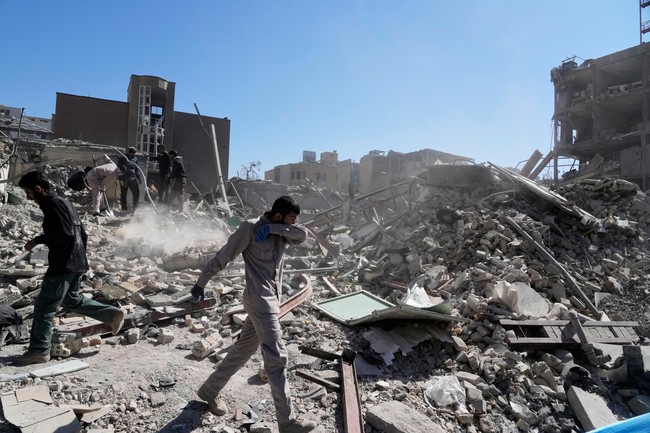
Iran's president to his Gulf neighbors: Oops, that was a mistake. Forgive us for bombing your airports and hotels.
No, seriously. He's going with that. Read Ed's analysis of the strategic situation here.
Advertisement
BREAKING:
The President of the Islamic regime in Iran Masoud Pezeshkian has released a message in which he says there won’t be any more Iranian attacks on neighbouring states unless there are attacks on Iran from those states:
“Yesterday, the Temporary Leadership Council… pic.twitter.com/cjwuAbyXIw
— Visegrád 24 (@visegrad24) March 7, 2026
The President of the Islamic regime in Iran Masoud Pezeshkian has released a message in which he says there won’t be any more Iranian attacks on neighbouring states unless there are attacks on Iran from those states:
“Yesterday, the Temporary Leadership Council approved that there won’t be any more attacks on neighboring countries and no missile launches, unless an attack against Iran originates from those countries”
It will be very interesting to see whether this turns out to be true. Tehran could be worried that additional attacks will risk counterstrikes from those countries, many of which have very large air forces.
However, it could also be a lie meant to minimize reputational damage.
It makes sense; if the Gulf states that Iranian missiles and drones were aimed at decided to start striking Iran with their own aircraft—and if they coordinated with Israel and the United States, they could do so with relative impunity now that there are clear safe corridors in Iranian airspace—the number of aircraft striking Iran could increase by a third.
Iran suddenly says they're "halting attacks on neighboring countries" right when they're ballistic missile fire was on track to reach the single digits anyway. day 1 they fired 500 missiles, by day 5 they fired 45 by tomorrow they were on track to fire 5. pic.twitter.com/LqTYGvLfds
— Chris Cappy (@Cappyarmy) March 7, 2026
Advertisement
It also makes sense because Iran is rapidly running out of missiles and launchers, and its capacity to launch drones is significantly degraded. Hitting hotels and airports in semi-neutral countries (Qatar and Oman!) is not exactly a high priority.
Iran Apologizes to Neighbors, But Vows Strikes on U.S. Bases
Tehran’s president expresses regret for regional attacks, yet the IRGC clarifies that U.S., and Israeli installations remain targets an apology paired with an unmistakable threat underscores Iran’s dual messaging… pic.twitter.com/pnd5lMIMl8
— Washington Eye (@washington_EY) March 7, 2026
So Iranian President Masoud Pezeshkian decides to bow to the inevitable, and as one-third of the temporary leadership council, he nominally has the juice to make it stick.
? JUST IN: The IDF has dropped 230 BOMBS overnight on Iranian military targets with 80+ jets
PRESIDENT TRUMP: "Iran, which is being beat to HELL, has apologized and surrendered to its Middle East neighbors, and promised that it will not shoot at them anymore."
"Today Iran will… pic.twitter.com/l3paWwVNGR
— Eric Daugherty (@EricLDaugh) March 7, 2026
The problem, of course, is that command and control is so degraded that it's unclear that orders from Tehran will make it to isolated IRGC troops who actually do the launching. Some missiles kept flying to Gulf states despite the apology and the promise not to attack neighboring states.
Everyone is counting Iran’s missiles. They are counting the wrong thing.
The number that determines the outcome of this war is not 2,000 or 2,500 or 3,000. Those are pre-war missile inventory estimates and they are now largely irrelevant. The number that determines the outcome… https://t.co/cgJ7yHJLwf pic.twitter.com/45jw3JbTsc
— Shanaka Anslem Perera ⚡ (@shanaka86) March 6, 2026
Advertisement
On Day 1 of Operation Epic Fury, Iran fired 504 ballistic missiles and drones across the Gulf theater. On Day 5, the number was 29. That is a 94 percent collapse in daily launch volume in less than a week. Not because Iran ran out of missiles. Because Iran ran out of the thing that launches them.
Launchers.
The ballistic missile is a precision munition that requires a precision launch platform. Iran entered this war with approximately 200 operational launchers, rebuilt from the roughly 100 serviceable platforms that survived the June 2025 Israel-Iran war. JINSA assessed that 75 percent of those launchers have been destroyed through March 5. The B-2 strike on the underground Damavand missile base east of Tehran, which CENTCOM confirmed today, targets the category of facility designed to protect launchers from exactly this kind of attrition. Damavand is not a missile warehouse. It is a launch infrastructure complex, the place where the hardware that puts missiles in the air is hardened and sheltered below ground.
The GBU-57 Massive Ordnance Penetrator does not care about the rock above Damavand. That is what it was designed to not care about.
Iran’s missile doctrine was built on volume and simultaneity. The mass salvo, hundreds of missiles launched in coordinated waves from dispersed platforms designed to overwhelm Iron Dome and US Patriot batteries by saturating their intercept capacity, is the only mechanism by which Iran’s missile force constitutes a genuine strategic threat to Israel. A degraded launcher pool that can produce 29 fires per day is not a mass salvo capability. It is a harassment capability. The two are not the same threat in any meaningful military sense.
The Damavand strike is not simply another underground complex attacked. It is the US targeting the reconstitution node, the facility where surviving or replacement launchers would be sheltered, maintained, and redeployed. Destroying Damavand does not just eliminate what is there. It eliminates the survivability architecture that would allow the launcher fleet to recover.
Day 1: 504 fires.
Day 5: 29 fires.
The trajectory of that number is what the B-2 was sent to Damavand to continue. Every penetrator bomb that goes into that mountain is not destroying a missile. It is foreclosing the operational recovery that would allow the 29 to become 504 again.
The missiles still exist in tunnels and caches across Iran. They are increasingly becoming missiles with nowhere to go.
Advertisement
It is just as likely that the massive air campaign, which switched from just hitting launchers to the underground "cities" where the ballistic missiles are stored and made, has so degraded the ability of Iran to launch retaliatory strikes that commanders are on their own deciding to use their last remaining missiles on American and Israeli targets.
Not all of them, though. They are following orders given before the war, likely because they have been able to get none since.
? BREAKING: The Iranian regime is furious, the level of degradation is off the CHARTS and President Trump's not backing down
Iranian missile attacks down -90%
— Eric Daugherty (@EricLDaugh) March 7, 2026
Drone attacks down -83%
80% of Iran's air defense systems dstroyed
60% of ballistic missile launchers destroyed ? pic.twitter.com/xOucW2hxWz
Missile launches have declined by 90% since the beginning of the war, and drone swarms by 80%.
The U.S. and Israel say they have degraded Iran’s missile stockpiles and launchers, blunting Tehran’s ability to unleash the massive barrages that opened the war https://t.co/s2RD00yhAO
— The Wall Street Journal (@WSJ) March 6, 2026
The calculus for both Iran and its enemies is simple: Iran's ability to successfully strike a major target depends entirely on sending a high volume of missiles and drones at individual targets. Only by overwhelming air defenses can anything get through, so spraying and praying is a losing strategy.
The Iran missile chart is the most important geopolitical visual of 2026. Not because of the 350 on day one. Because of the zero on day ten pic.twitter.com/x1uN65ts6y
— Rand Group (@cryptorand) March 5, 2026
Advertisement
Iran will still send missiles by onesies and twosies, and some will still get through because that is how it is. It matters to those who are struck, but in the strategic sense, Iran's ability to project power in any meaningful way appears to be eliminated.
Next on the list: Cuba.
? JUST IN: President Trump reveals CUBA is "in its last moments of life" and Sec. Marco Rubio is going to strike a deal
Wow!
"It will have a great new life. It's in its last moments of life, the way it is."
"Our focus right now is on Iran. We'll do that, I'd say, what will… pic.twitter.com/DoIoIGDPjL
— Eric Daugherty (@EricLDaugh) March 7, 2026
JUST IN: President Trump reveals CUBA is "in its last moments of life" and Sec. Marco Rubio is going to strike a deal
Wow!
"It will have a great new life. It's in its last moments of life, the way it is."
"Our focus right now is on Iran. We'll do that, I'd say, what will you do, take 2 days off, Marco? No, he won't. He'll take 1 hour off, then finish up a deal on Cuba."
"That'll be an EASY one." ?
Editor's note: If we thought our job in pushing back against the Academia/media/Democrat censorship complex was over with the election, think again. This is going to be a long fight. If you want to join the conversation in the comments -- and support independent platforms -- why not join our VIP Membership program? Choose VIP to support Hot Air and access our premium content, VIP Gold to extend your access to all Townhall Media platforms and participate in this show, or VIP Platinum to get access to even more content and discounts on merchandise. Use the promo code FIGHT to join or to upgrade your existing membership level today, and get 60% off!