New Posts (Home)
 ChatBox
 Popular Posts
  Game Zone
 Top PodCasts


In what timeline are we living?
Earlier today, I wrote about how we are in living in a world where everything has become its opposite in the media, and this is just one more example:
Advertisement
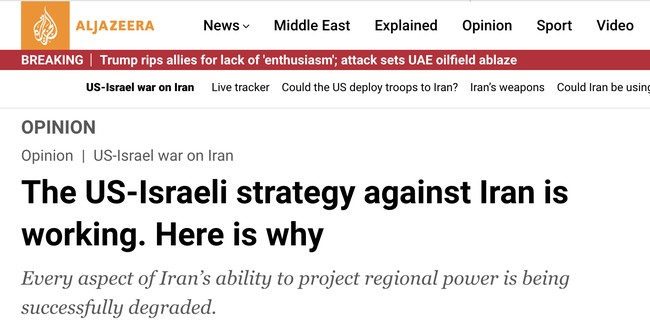 As American and Western media are desperate to convince people that America is getting its butts kicked by the Iranians before Trump and Netanyahu can win the war, Al Jazeera has published an article from an Arab Security Studies expert from the Doha Institute for Graduate Studies that presents a radically different, and from what I can tell, far more accurate account of how the war is going.
Once again, I will insist that until the war is over and the dust settles, we won't know if the strategic goals of the war will be met successfully, but all the evidence suggests that we are meeting or exceeding our tactical goals, and the strategy as planned from the outset of the war is on track to likely success. But, as always, the enemy gets a vote.
Two weeks into Operation Epic Fury, the dominant narrative has settled into a comfortable groove: The United States and Israel stumbled into a war without a plan. Iran is retaliating across the region. Oil prices are surging, and the world is facing another Middle Eastern quagmire. US senators have called it a blunder. Cable news has tallied the crises. Commentators have warned of a long war.
The chorus is loud and, in some respects, understandable. War is ugly, and this one has imposed real costs on millions of people across the Middle East, including the city I live in.
But this narrative is wrong. Not because the costs are imaginary, but because the critics are measuring the wrong things. They are cataloguing the price of the campaign while ignoring the strategic ledger.
When you look at what has actually happened to Iran’s principal instruments of power – its ballistic missile arsenal, its nuclear infrastructure, its air defences, its navy and its proxy command architecture – the picture is not one of US failure. It is one of systematic, phased degradation of a threat that previous administrations allowed to grow for four decades.
Advertisement
As I have argued many times in my pieces, this is a multi-phased campaign, not a one-and-done bombing campaign that was supposed to displace the Iranian regime in one decapitation strike. So far, our bombing campaign has been just more than 1/3rd as long as the bombing prior to the first Gulf War invasion, so demanding that the results by day 16 or 17 be total victory is beyond absurd.
And nobody making the claims that this is a fiasco is doing so seriously; they are trying to erode political support for the war before Trump can execute the strategy, because they want it to fail. This is also why the Democrats are continuing to defund the Department of Homeland Security—they are anticipating and hoping for a successful terrorist attack as they keep the path open for terrorists.
You are an idiot if you believe otherwise. Who, in their right mind, would defund the TSA in the middle of a war if they cared about security?
The campaign has moved through two distinct phases. The first suppressed Iran’s air defences, decapitated its command and control, and degraded its missile and drone launch infrastructure. By March 2, US Central Command announced local air superiority over western Iran and Tehran, achieved without the confirmed loss of a single American or Israeli combat aircraft.
The second phase, now under way, targets Iran’s defence industrial base: missile production facilities, dual-use research centres and the underground complexes where remaining stockpiles are stored. This is not aimless bombing. It is a methodical campaign to ensure that what has been destroyed cannot be rebuilt.
Iran now faces a strategic dilemma that tightens every day. If it fires its remaining missiles, it exposes launchers that are promptly destroyed. If it conserves them, it forfeits the ability to impose costs of the war. Missile and drone launch data suggest Iran is rationing its remaining capacity for politically timed salvoes rather than sustaining operational tempo.
This is a force managing decline, not projecting strength.
Advertisement
Well, yeah. Obviously.
Neither the United States or Israel wants to do what either Bush did in Iraq—a large-scale invasion of the enemy—so they are pursuing a different strategy. First, the systematic dismantling of Iran's ability to project power; second, the systematic dismantling of Iran's ability to rebuild its power-projection capability; and third, the destruction of the cohesion of its internal security forces.
You can't do all these things simultaneously. Our military power is mighty, but not magic. Of course, it will take weeks to accomplish these goals, and it has to be done in phases to minimize damage to other countries in the Gulf.
The closure of the Strait of Hormuz is dominating the critical commentary. US Senator Chris Murphy has called it evidence that President Donald Trump misjudged Iran’s capacity to retaliate. CNN has described it as proof that the administration has lost control of the war’s escalation.
The economic pain is real: Oil prices have surged, a record 400 million barrels of oil will be released from global reserves, and Gulf states are facing drone and missile strikes on their energy infrastructure.
But this framing inverts the strategic logic. Closing the strait was always Iran’s most visible retaliatory card, and always a wasting asset. About 90 percent of Iran’s own oil exports pass through Kharg Island and then the strait.
China, Tehran’s largest remaining economic partner, cannot receive Iranian crude while the strait is shut. Every day the blockade continues, Iran severs its own economic lifeline and alienates the one major power that has consistently shielded it at the United Nations. The closure does not just hurt the global economy; it accelerates Iran’s isolation.
Meanwhile, the naval assets Iran needs to sustain the blockade – fast-attack boats, drones, mines, shore-based antiship missiles – are being degraded daily. Its naval bases at Bandar Abbas and Chahbahar have been severely damaged.
The question is not whether the strait reopens but when and whether Iran retains any naval capacity to contest it. Critics compare the challenge of escorting a hundred tankers daily to an impossible logistical burden. But you do not need to escort tankers through a strait if the adversary no longer has the means to threaten them. That is the operational trajectory.
Advertisement
It's amazing that all the discussion is about the US running out of weapons and the economic pain being imposed on us, but there is an assumption that Iran's magazines are endless and its inability to pay its security forces is irrelevant. And comparisons to England in the Blitz are inapt; Churchill had the support of the English; Iran's regime is deeply unpopular, and people are just waiting to take it down.
And the strain on Iran's security forces is taking a toll:
The body lies mutilated in the street. The wounds are savage but calculated. This is more than sadism. It is a message.
At first glance, it’s just one more Iranian who has lost their life amid the state’s promiscuous violence. A tragedy – as death always is – but in the Islamic Republic, sadly a part of daily life.
But this is different: it’s not an Iranian protester lying in the dirt for all to see but an officer of the regime’s first and last line of defence: the Islamic Revolutionary Guard Corps (IRGC).
Since the US-Israeli strikes on Iran began on February 28 I have been in contact with a source who is across western intelligence inside the country.
And what they have revealed to me is something extraordinary: that amid the chaos and fury of the war in Iran, the state’s most brutal security forces are not only penetrated by enemy services and in disarray – they are turning on each other. ‘Over the past four days, reports have painted a picture of an Iranian security apparatus under severe and accelerating internal strain,’ says my source.
‘More than 60 incidents have been documented across virtually every branch of the regime’s military and security apparatus, spanning multiple regions simultaneously.
Advertisement
Again, the fact that we are winning the war tactically and that our strategy is proceeding as planned hardly guarantees success. But assertions that this is a fiasco are absurd.
It tells you something that Al Jazeera, a news outlet famously hostile to the United States, is publishing articles that are more favorable to the US and Israel than the American media.
And that something is simple: the US media is, indeed, the enemy of the people.
Editor's note: If we thought our job in pushing back against the Academia/media/Democrat censorship complex was over with the election, think again. This is going to be a long fight. If you want to join the conversation in the comments -- and support independent platforms -- why not join our VIP Membership program? Choose VIP to support Hot Air and access our premium content, VIP Gold to extend your access to all Townhall Media platforms and participate in this show, or VIP Platinum to get access to even more content and discounts on merchandise. Use the promo code FIGHT to join or to upgrade your existing membership level today, and get 60% off!